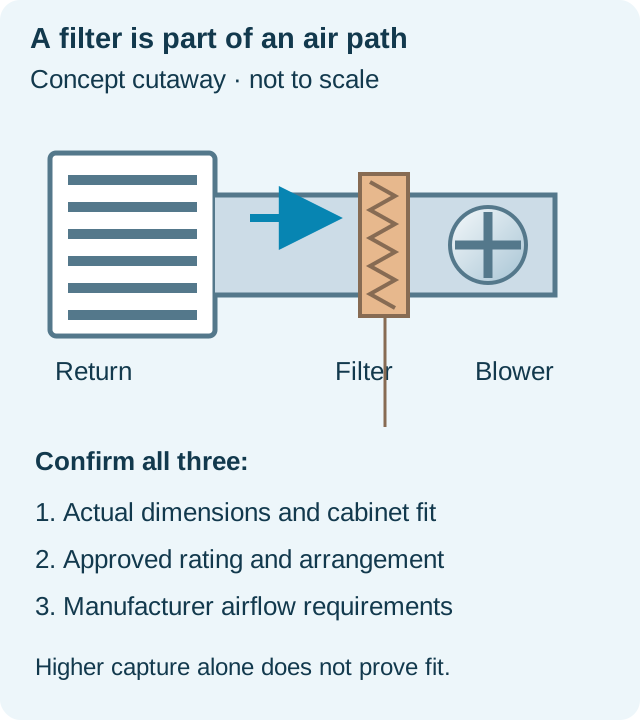
A higher MERV rating can improve the capture of certain particle sizes, but you still need a filter your HVAC system can accommodate. Start with your equipment instructions, the filter's actual dimensions, and a clear idea of the indoor-air problem you want to address.
You do not have to buy the strongest-looking filter on the shelf to make a sensible choice. A filter that fits correctly and works within your system's airflow requirements gives you a more useful starting point than a rating considered by itself.
Decide what you want the filter to do
Think about the reason you are shopping before comparing packages. Are you replacing a dirty filter, responding to seasonal particle concerns, or trying to fix a damp room that smells musty?
Those are different problems, and a central filter cannot solve all of them. EPA treats filtration as a supplement to controlling pollution sources and providing appropriate ventilation, rather than a replacement for either approach.
If you have a roof leak, visible moisture, or an ongoing indoor source of smoke, make a plan for that source. Changing the filter may be part of your response, but it does not remove the underlying cause.
Write your goal in a sentence you can check later. “Replace the correctly sized filter on time” is a manageable task, while “make every room healthy” asks one component to deliver a result you cannot verify from its label.
Understand what the rating actually describes
MERV stands for Minimum Efficiency Reporting Value, and the rating describes particle-capture performance under a standardized test. EPA explains that it relates to particles between 0.3 and 10 microns, with higher ratings providing better capture for specified particle sizes.
That makes the number useful for comparing filtration performance. It does not tell you whether a particular filter fits your return grille or how your blower will perform after you install it.
You may also see other rating systems or prominent marketing phrases on retail packages. Ask for the stated MERV rating when you want to compare filters on that common scale, and avoid treating unrelated numbers as directly interchangeable.
A HEPA filter belongs to a different performance classification, and it is not automatically a suitable replacement for a central-system filter. Do not force a filter into a cabinet simply because you recognize the label from a portable air cleaner.
Check the cabinet before changing the specification
Locate the actual filter position using your manual or an installer-confirmed system record. You might have a filter at a return grille, at the air handler, or in a dedicated media cabinet.
Take a photograph of the existing filter label and record the dimensions before removing anything. A nominal size printed on a package may differ from the actual measured size, so compare the manufacturer's exact dimensions when ordering a replacement.
Do not assume that a deeper filter will fit because the length and width match. The cabinet must support the intended depth and arrangement without crushing the frame, leaving a bypass gap, or preventing the cover from closing normally.
If you discover filters in more than one location, confirm whether that arrangement is intentional. Adding another filter to a system is not a substitute for checking how the complete setup was designed.
Keep airflow in the conversation
Your blower has to move air through the filter and the rest of the duct system. A change that affects resistance can affect that operating arrangement, which is why a filter upgrade needs more context than a shopping comparison.
EPA recommends MERV 13 or the highest rating that your system fan and filter slot can accommodate when you upgrade efficiency. If that limit is unclear, ask an HVAC professional to determine what works for your installation.
Give the contractor the filter's brand, model, dimensions, and current rating. Ask whether the proposed replacement meets the equipment's airflow requirements, rather than asking whether MERV 13 is always good or always bad.
A useful answer should relate to your system and, where appropriate, actual measurements. Neither an online rule of thumb nor the fact that the blower sounds normal can establish that every operating condition is acceptable.
Make the filter fit the room-level plan
The room below shows ordinary furnishings, textiles, and surfaces where dust can collect. It is a context photograph, not a picture of a tested filtration installation or evidence that this room has a particular air-quality problem.

Use that room-level view to decide what you can control alongside filtration. You can look for identifiable pollution sources, keep surfaces clean using appropriate methods, and avoid blocking the supply and return paths your system needs.
Do not expect a new filter to eliminate every visible speck of dust or every odor. Particle capture and gas removal are different tasks, and a product claim about one does not automatically establish performance for the other.
If you are considering a portable air cleaner for a particular room, evaluate it separately from the central filter. EPA notes that central filters and portable cleaners serve different spatial roles, so compare the device with the room and the pollutant you actually care about.
Replace it based on instructions and observation
Follow the equipment and filter manufacturer's maintenance guidance, then inspect conditions often enough to notice when the filter becomes heavily soiled. Household conditions and runtime can change how quickly that happens.
Avoid treating an advertising promise about service life as a guarantee for your home. A calendar reminder helps you remember to check, but the reminder cannot inspect the filter for you.
Keep the replacement package or photograph its details when you find a suitable product. That makes the next order easier and reduces the temptation to choose an almost-matching size during a rushed shopping trip.
Before changing a filter, follow the equipment's instructions for shutting down operation and accessing the compartment. Do not reach into unfamiliar equipment, disturb wiring, or remove panels that the user manual does not identify as a homeowner maintenance point.
Watch for changes without diagnosing from them
After a replacement, pay attention to comfort and obvious changes in operation. If you notice new noise, weak airflow, or another concerning symptom, record what changed and contact the appropriate service professional.
Keep the old and new filter specifications together so you can describe the change accurately. Saying “I switched from this model to that model yesterday” is more useful than saying only that the new filter is better.
Do not deliberately run the system without a filter as an experiment, or bypass a safety control to see what happens. The goal is to choose a supported maintenance item, not to troubleshoot the blower through trial and error.
If a contractor recommends a different cabinet or filter arrangement, ask what problem the change addresses. Get the recommended replacement specification in writing so future maintenance follows the same plan.
Compare the whole purchase
Once compatibility is confirmed, compare the actual filter model, quantity in the pack, replacement availability, and recurring cost. A low price can be misleading if you accidentally compare one filter with a multipack.
Do the arithmetic with your own inspection and replacement pattern, rather than inventing a yearly schedule to make one product look cheaper. Keep the calculation separate from any claim about energy savings or health outcomes.
For a simple purchase example, imagine two correctly approved filters with different pack sizes. Divide each total by its filter count first, then consider storage space and whether you can reliably buy the same specification again.
That example is a shopping method, not a performance ranking. You still need the manufacturer's fit information and a system-specific compatibility answer before price becomes the deciding factor.
Keep a short filter record
Save the location, actual dimensions, approved specification, last inspection date, and the next check reminder in one note. Add a clear photograph showing the airflow arrow in the orientation confirmed for your installation.
If you cannot confidently identify airflow direction or the correct filter position, ask before installing the replacement. A few minutes spent confirming the arrangement can prevent repeated purchases based on the same uncertain assumption.
Your best filter choice is the one that balances supported particle capture with proper fit, appropriate airflow, and maintenance you can sustain. Make those decisions together and the number on the box becomes a useful piece of information instead of the entire buying strategy.
Sources & how to use this guide
Sources checked October 15, 2026. Factual references inform this research guide; the examples and planning steps are original editorial suggestions.
- EPA: What Is a MERV Rating?
MERV meaning, particle size range, upgrade compatibility, HEPA distinction - EPA: Guide to Air Cleaners in the Home
Filter fit, maintenance, source control and filtration limits - EPA: Air Cleaners and Air Filters in the Home
Central and room filtration roles; filtration does not remove all pollutants
This article does not claim hands-on product testing, professional inspection of your home, or measured outcomes.