For basic checks on ordinary matte indoor surfaces, the Klein Tools IR1 is the straightforward option; choose the IR5 if visualizing the measuring area and comparing readings matter more, or the Fluke 62 MAX if you value its documented protective features. None turns a cold patch into a confirmed diagnosis of an air leak.
An infrared thermometer can help you compare a wall, window frame, or floor surface without touching it. Buy one for a clear observation task, rather than expecting a pocket tool to replace an energy assessment or an HVAC service visit.
Decide what you are trying to measure
These instruments measure surface temperature rather than the temperature of the air in front of them. Fluke also explains that reflective materials, intervening glass, and the size of the measuring spot can affect a result.
That distinction changes the shopping question: a gun-shaped thermometer aimed at a supply grille does not give you a dependable reading of the moving air. If your question is about air temperature, choose an instrument and method intended for that measurement.
Best for simple surface comparisons: Klein Tools IR1

Klein specifies a 10:1 distance-to-spot ratio, fixed emissivity of 0.95, a targeting laser, backlit display, and automatic hold for the IR1. The stated measuring range is −4°F to 752°F, with a pouch and one 9V battery included.
Choose it if your task is an occasional comparison of similar painted surfaces in one room and you want fewer settings to manage. Write down the exact spots you intend to revisit so you can compare the same patch instead of sweeping around until you find an interesting number.
Fixed emissivity removes a setting to adjust, but it does not make every material equivalent. Skip this model if your buying plan depends on changing emissivity for different surface types, and do not treat its wide temperature range as permission to approach dangerous equipment.
Best for seeing the approximate measuring area: Klein Tools IR5

The IR5 uses a 12:1 distance-to-spot ratio, adjustable emissivity, dual targeting lasers, and minimum, maximum, average, and difference modes. Klein explains that the separation of the two laser dots approximately represents the diameter of the circular measuring area.
That visual cue is useful if you worry about accidentally including surrounding wall in a reading of a narrow target. It gives you a practical reason to choose the IR5, although you still need to read the manual and keep the whole measuring area on the intended surface.
The extra modes make sense when you have a specific comparison to record, not just because more buttons look professional. Decide in advance whether you will use a minimum, maximum, or difference value, and save enough context to explain the number later.
Adjustable emissivity also means another setting that you must understand and record. If you would rather compare a few similar surfaces with a simpler tool, the IR1 may fit your routine better than an instrument you find confusing to set up.
Best for documented protective features: Fluke 62 MAX

Fluke specifies a 10:1 distance-to-spot ratio, single-laser targeting, an IP54 dust-and-moisture rating, and a three-meter drop rating for the 62 MAX. It uses one AA battery; this selection is the 62 MAX, not the different 62 MAX+.
This is worth considering if you want those documented protective features as part of a tool you will carry between locations. They do not prove a more accurate reading in every home, and they do not remove the need to keep the instrument within its operating instructions.
Do not pay for ruggedness simply because you are anxious about choosing the wrong tool. If you will only compare a few indoor wall surfaces and then store the thermometer safely in a drawer, consider whether the simpler selection already answers your question.
Understand the spot before you trust the number
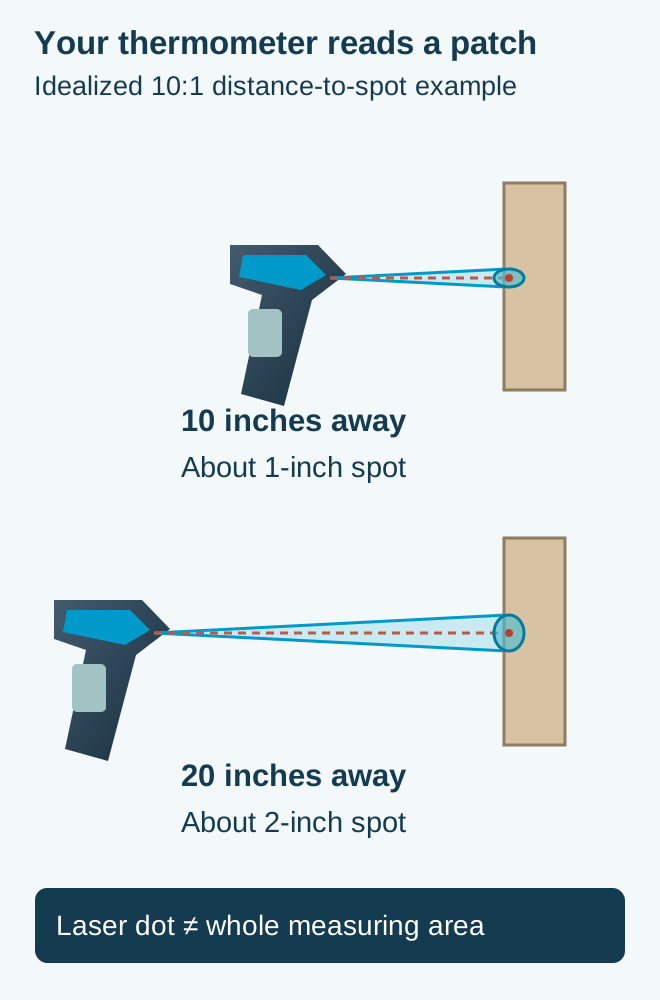
For a nominal 10:1 ratio, a distance of 10 inches corresponds to an approximately one-inch measuring diameter; at 20 inches, it is approximately two inches. This arithmetic illustrates the ratio, but your actual instrument’s manual controls the usable measuring distance and target size.
A narrow strip of trim can therefore be a poor target from across the room. Move only as close as you can safely and comfortably stand, and choose a larger comparable surface if you cannot keep the measuring area inside the feature you want to check.
Fluke advises using the laser as an aiming guide, accounting for reflective surfaces, and allowing an instrument to adjust after a significant change of environment. An obstruction between the lens and the target can interfere with the measurement.
Choose a few repeatable locations and photograph where each one is, without putting yourself on an unstable chair or ladder. Record the date, the room, the target material, and whether sunlight was reaching that spot when you checked it.
Make a useful comparison, then stop
Make a short observation sheet with room names you will recognize later, such as “office, wall beside left window.” Leave space for the target material and the circumstances, because a temperature without a location is difficult to use once you have put the instrument away.
Avoid comparing a sunlit patch in the afternoon with a shaded patch first thing in the morning and calling that a before-and-after repair check. If you cannot repeat the circumstances, describe the observations separately and explain the difference when you ask for advice.
Check the buttons and display before buying if you have specific accessibility needs. A feature you cannot read or operate comfortably will not become useful simply because it appears in the specifications, and a more complicated model is not automatically the easier one to use.
Keep the model instructions with the tool and note any settings you changed during a session. If another person picks it up next month, they should not have to guess whether the display is in Fahrenheit or Celsius or why you selected a particular mode.
If you want to compare repair proposals, ask the contractor what measurements would actually help them. You may find that a photograph, a description of when the room feels uncomfortable, and your existing service records matter more than another device purchased before the problem has been discussed.
Start with the ordinary wall beside the feature, then compare the feature itself using a similar angle and distance where practical. A tidy set of notes about two locations is easier to explain to a professional than dozens of unexplained readings scattered around your phone.
If a frame reads differently from a wall, describe exactly that observation instead of naming a fault. Different materials and surface conditions can complicate interpretation, so let the record lead to a question rather than turning it into proof that insulation or sealing has failed.
Return to the same locations when the conditions are meaningfully different, and label the difference in your notes. Do not keep rescanning until you collect a number that seems dramatic enough to justify a repair you already wanted.
Klein warns that these thermometers are not intended for people or animals and that the laser must not be directed into eyes. Keep the instrument out of children’s reach and follow the laser instructions before measuring any surface.
Leave electrical panels closed, keep away from hot or moving equipment, and do not use a temperature gun to decide whether something is electrically safe to touch. The job here is observing accessible household surfaces, with a qualified professional handling equipment diagnosis.
None of these is the right purchase when you need a thermal image, a certified energy assessment, a medical thermometer, or a dependable measurement of moving air. Once you have a small, repeatable record, use it to explain the comfort problem and choose the next step with better information.
Sources and selection notes
- Fluke: What is an IR thermometer? · Exact model or guidance checked October 16, 2026.
- Klein Tools IR1 · Exact model or guidance checked October 16, 2026.
- Klein Tools IR5 · Exact model or guidance checked October 16, 2026.
- Fluke 62 MAX · Exact model or guidance checked October 16, 2026.
- Klein Tools IR1 instruction manual · Exact model or guidance checked October 16, 2026.
- Fluke: How to Get Great Results with an Infrared Thermometer · Exact model or guidance checked October 16, 2026.
- Amazon listing: Klein Tools IR1 · Exact model or guidance checked October 16, 2026.
- Amazon listing: Klein Tools IR5 · Exact model or guidance checked October 16, 2026.
- Amazon listing: Fluke 62 MAX · Exact model or guidance checked October 16, 2026.
Recommendations reflect documented features and conditional fit, not hands-on tests. Retailer offers and selected variants can change; no fixed prices, ratings or stock guarantees are quoted.