Best Wireless Pipe Temperature Sensor for Accurate Home and Business Monitoring
Answering the need for real-time pipe temperature visibility, this guide highlights top wireless options. Each pick is suited for different environments—from residential basements to commercial HVAC runs. The best choice depends on where you monitor, battery life, and whether you prioritize WiFi or a mesh/long-range network.
The following table summarizes five strong options chosen for reliability, practical features, and relevance to “wireless pipe temperature sensor.”
| Product | |||
|---|---|---|---|
| SafeSense TempTouch | WiFi | Remote monitoring of pipes in winter-prone spaces | Batteries may require replacement after long use |
| SENCKIT Freezer Thermometer | WiFi | Refrigerator/freezer and storage areas | Requires constant power for best uptime |
| YoLink Weatherproof Sensor | LoRa, hub-based | Long-range, distant or hard-to-reach locations | Hub-dependent for full functionality |
| SONOFF SNZB-02LD | Zigbee | Wet environments with a Zigbee hub | Range depends on Zigbee network layout |
| VANLISON Clamp On | Wireless (clamp-on) | Easy clamp-on use for pipes in HVAC/refrigeration | Display readability may vary with ambient light |
SafeSense TempTouch WiFi Clamp Temperature Sensor

Best for: Homeowners and property managers who want continuous, app-based monitoring of pipe temperatures in basements, crawl spaces, or winter-prone locations. This device provides 24/7 WiFi monitoring and instant alerts to prevent frozen or burst pipes.
Why selected: It emphasizes real-time data, alerts via text, email, and app, plus long battery life with three AA lithium batteries designed for sub-zero environments. The combination supports remote management without frequent battery changes.
Caution: Battery life can vary with network activity and temperature; plan for periodic checks on battery status to avoid gaps in monitoring.
SENCKIT WiFi Temperature Sensor Freezer Thermometer
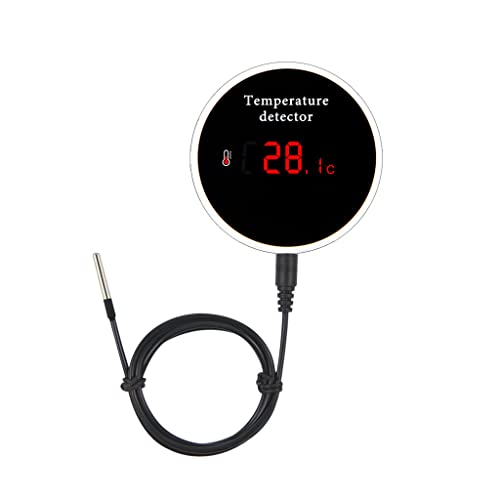
Best for: Kitchenettes, garages, and food storage rooms where remote monitoring of refrigerators and freezers is essential. The external waterproof probe supports monitoring across various containers and spaces.
Why selected: It offers remote monitoring without a hub, with alerts via the Tuya/Smart Life app and a buzzer for immediate notice. The temperature range covers extreme cold, making it versatile for food safety and cold storage.
Caution: Requires constant power for steady uptime; battery-powered options are not integrated, so plan for a reliable power source in the application area.
YoLink Weatherproof Fluid Temperature Sensor

Best for: Long-range monitoring in outdoor or remote pipe installations where a hub-based LoRa network can reach distant devices. Ideal for large properties or seasonal installations.
Why selected: The YoLink system emphasizes a long-range, low-power approach with convenient app-based alerts and multiple notification methods, including SMS on occasion. It supports flexible placement via a back-mounted magnet and simple mounting options.
Caution: Requires a YoLink hub for full operation; efficiency depends on hub placement and network setup to ensure uninterrupted monitoring.
SONOFF SNZB-02LD Zigbee Waterproof Sensor

Best for: Environments where a Zigbee hub is already in use, such as a smart home setup, and where moisture resistance is important for kitchen, bathroom, or pool area monitoring.
Why selected: The IP65-rated main unit provides basic waterproofing, and the 1.5M stainless steel probe expands temperature measurement coverage. The LCD display makes quick checks feasible without a smartphone.
Caution: Performance depends on Zigbee network strength and hub proximity; plan for adequate mesh coverage in larger spaces.
VANLISON Clamp On Wireless Temperature Probe

Best for: HVAC and refrigeration technicians or DIYers who want a clamp-on solution that avoids cutting into pipes. Useful for quick, non-invasive monitoring across many pipe runs.
Why selected: The clamp-on design simplifies installation, and the reported accuracy around ±0.3°C provides dependable readings. The wide range supports both low-temperature cooling lines and higher-temperature discharge pipes.
Caution: Readability can be influenced by lighting and viewing angle; ensure the display orientation matches the installation scenario.
Buying Guide
Key considerations when choosing a wireless pipe temperature sensor include network type, range, power source, and ease of installation. Below are practical questions and answers to help compare options.
- What network type best fits my property? To cover a single home or apartment, WiFi-based sensors (SafeSense or SENCKIT) offer straightforward setup. For large properties, LoRa-based YoLink or Zigbee options (SONOFF) can reduce WiFi congestion and improve reliability with proper hubs.
- Do I need a battery-powered sensor? Battery-powered devices are ideal for hard-to-reach pipes or places without easy power access. Battery life varies by device and network activity; some models use long-life lithium batteries while others rely on continuous power.
- Is a hub required? LoRa and Zigbee options typically require a hub to coordinate data and alerts. If you already own a hub system, these can be cost-effective and scalable. WiFi sensors generally do not require additional hubs beyond the router and app.
- What temperature range do I need? Consider the environment: cold basements, outdoor pipes, and freezers demand sensors rated well below freezing. Ensure the device’s temperature range covers your expected extremes.
- Should I prioritize alert types? Look for dual alerts (push notification plus email or SMS) for critical conditions. Some sensors offer loud alarms in addition to app notifications, which can be helpful in remote locations.
- What installation method suits my pipes? Clamp-on sensors are easiest to install without interrupting flow, while sensors with external probes offer flexibility for tight spaces and integration with existing monitoring dashboards.
FAQ
- What is the main advantage of a wireless pipe temperature sensor?
It provides real-time monitoring and alerts without running hardwired sensors, helping prevent pipe freezing or overheating. - Can I monitor pipe temperature from my phone?
Yes. Most listed sensors offer mobile apps for real-time data, alerts, and history logs. - Do I need a subscription for these sensors?
Many devices provide free app access with alert limits; some services may offer additional SMS or cloud features for a fee, depending on the system. - Which sensor is best for a humidity-aware environment?
The YoLink and SENCKIT options include robust environmental monitoring and alerting that can track humidity in addition to temperature. - What maintenance is required?
Battery checks (if used), ensuring hub or network connectivity, and periodic verification of sensor placement and battery status help maintain reliable monitoring. - Is clamp-on safer for pipes than inserting a probe?
Clamp-on sensors are non-invasive and quick to install, reducing risk to pipe integrity, but ensure the clamp provides solid contact for accurate readings.