Best Types of Air Conditioners for Every Space
Looking for the right air conditioner type for your space? This guide covers portable, window, windowless, and compact window units, highlighting who they’re best for and why. It helps buyers choose based on room size, lifestyle, and installation needs. Below is a quick reference table of the featured products.
| Product | Type | Best For |
|---|---|---|
| GEYUUM Portable Air Conditioner | 4-in-1 Portable | Small rooms or desks, flexible placement |
| Garvee 3-in-1 Portable Air Conditioner | 3-in-1 Portable | Medium rooms, customizable modes |
| KoolSiln 14,000 BTU Portable AC | Large-Capacity Portable | Large rooms or open spaces |
| FLOWBREEZE Windowless Portable Air Conditioner | Windowless Portable Windowless | Rooms without window access, dorms |
| Midea 5,000 BTU Window AC | Window Window-Mounted | Small rooms with existing window framing |
Note: The table highlights each unit’s primary type, ideal space, and use case to guide quick comparisons and help you select the best fit for your needs.
GEYUUM Portable Air Conditioner

4-in-1 functionality combines cooling, fan, humidifier, and a cooling mode using water or ice. It provides 120° adjustable airflow and three mist levels with a compact, child-safe design. Best for small rooms, bedrooms, or desks, especially when you need a portable solution without heavy installation. The device includes LED lighting for ambience and a sleep-friendly setup. A caution: maximum cooling depends on room size and ambient conditions; use with water or ice as directed to achieve optimal efficiency.
Garvee 3-in-1 Portable Air Conditioner

Offers cooling, dehumidification, and a fan mode in one compact unit designed for rooms up to 350 sq.ft. Features a 24-hour timer and Sleep Mode to minimize disruption. Best for mid-size living rooms or home offices where humidity and temperature control are priorities. It is relatively quiet (<50dB) for a portable unit, making it suitable for bedrooms. Caution: window kit compatibility should be checked before installation in nonstandard windows, as trimming may be required for some frames.
KoolSiln 14,000 BTU Portable AC

This high-capacity portable unit cools large spaces quickly, with a 14,000 BTU rating and 700 sq.ft. coverage. It emphasizes fast cooling and energy efficiency using eco-friendly refrigerant. It operates at a lower noise level suitable for bedrooms and offices, while its auto-evaporation feature reduces maintenance. Best for large rooms or open-plan areas. Limitation: portability can be less convenient in very tight spaces due to size and weight.
FLOWBREEZE Windowless Portable Air Conditioner
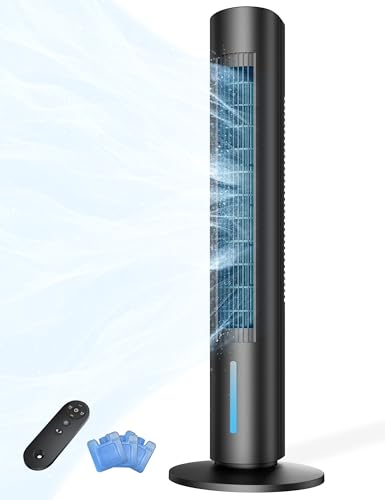
Designed for rooms without window access, this 3-in-1 unit acts as a fan, humidifier, and air cooler with a large water tank for extended use. It eliminates the need for hoses or venting, making it ideal for dorms or offices lacking window outlets. 7-hour timer and 140° oscillation provide broad coverage. Best for renters or spaces where window installation is not possible. Caution: not a traditional air conditioner; cooling relies on evaporative principles, which are less effective in very humid climates.
Midea 5,000 BTU Window AC

Compact window-mounted cooling up to 150 sq. ft., with three modes, remote control, and a reusable filter. Simple mechanical controls avoid complex tech, making it suitable for traditional window frames and users who prefer straightforward operation. Best for bedrooms or small offices. Limitation: relies on a window frame; installation is not possible without a compatible window, and installation may require basic tools.
Buying Guide: Key Purchase Considerations
What room size should guide your choice?
Smaller rooms (up to 150 sq ft) typically need 5,000 BTU or less, while medium rooms (150–350 sq ft) benefit from 8,000–12,000 BTU units. Large rooms may require 14,000 BTU or higher. Portable units are convenient for flexible spaces, while window units are often more permanent solutions with solid efficiency.
Do you need portability or a fixed install?
Portables offer easy relocation and no window mounting, but may be less energy-efficient than fixed window units. Window units generally provide consistent airflow and better efficiency for the space they fit. Windowless portable air conditioners provide cooling without venting but rely on evaporative or alternative cooling methods, which suits dry climates better.
What about energy efficiency and noise?
Look for units with eco modes, proper BTU sizing, and low dB ratings for bedrooms or study areas. Dual-motor or smart-control models can offer quieter operation and remote access for convenience. Consider if your climate demands dehumidification as well as cooling.
What installation considerations apply?
Window units require window space and secure installation. Portable units need outlets and stable placement. Windowless models require no venting but may provide less cooling power. Always verify window dimensions, exhaust requirements, and any installation accessories included.
What features improve day-to-day use?
Programmable timers, sleep modes, remote control, app connectivity, and multi-speed fans help tailor comfort. Humidification or dehumidification features can improve air quality and comfort in varying climates.
Frequently Asked Questions
- What type is best for small bedrooms? A compact 5,000 BTU window unit or a small portable unit typically provides adequate cooling with minimal space.
- Can portable units replace window units? In many cases, portable units offer adequate comfort, but fixed window units often deliver higher efficiency for the same space.
- Is windowless cooling effective? Windowless coolers work best in dry climates and provide flexible placement, but cooling power may be less than traditional air conditioners.
- Do I need professional installation? Most window and windowless units are DIY-friendly; some portable models require basic setup. Follow the manufacturer’s instructions for safety.
- How do I choose BTU for my room? Calculate square footage and multiply by a BTU factor (roughly 20 BTU per sq ft for typical rooms). Adjust for sun exposure, ceiling height, and insulation.
- What maintenance is required? Regularly clean or replace filters, clear drains or water tanks as directed, and inspect seals and hoses for wear.