Best Thermostat With Multiple Sensors for Smart Climate Control
The best thermostat with multiple sensors helps you optimize comfort and energy savings by coordinating temperature readings from several zones in your home. This guide highlights top options for different needs—from full-home systems with room sensors to portable indoor/outdoor monitors that complement your setup. Ideal buyers include: homeowners seeking precise multi-room comfort, renters needing flexible sensor placement, and tech enthusiasts wanting seamless app control and voice assistant integration. Below is a quick summary table of five tested options to consider.
| Product | Best For | Key Benefit | Sensor Style |
|---|---|---|---|
| Provirtec Smart Thermostat | Households needing centralized control | Body location-based sensing and cross-device monitoring | All-in-one thermostat with room sensor |
| U UNNI Indoor Outdoor Thermometer | Real-time environment tracking | Indoor/outdoor data with long range | Separate sensors, display & alerts |
| Honeywell Home T9 | Smart room-focused comfort | Smart Room Sensors with wide range | Room sensors + thermostat |
| ecobee Smart Thermostat Essential | Energy savings with broad compatibility | Free software upgrades and compatibility checker | Smart thermostat with essential sensors |
| ecobee Smart Thermostat Premium | High-end comfort with built-in sensing | Included SmartSensor and advanced features | Premium sensors and integrations |
Provirtec Smart Thermostat With Room Sensor

Best for: Homes needing centralized, automatic control across HVAC components. This thermostat supports 3H2C and over 95% of 24VAC systems, including central AC, heat pumps, boilers, and furnaces. The body location-based detection helps reduce energy waste and maintain comfort. It pairs with the Provirtec hygrometer for real-time, whole-home monitoring. The Three Mode Sleep/Home/Away feature saves energy by adapting to occupancy and night temperatures.
Why selected: It offers wide compatibility, a large touchscreen, and seamless app plus touch control. It is well-suited for users who want precise local control plus remote monitoring. C-wire required for full functionality.
Caution: The setup and integration rely on compatible HVAC wiring and may require professional installation for certain systems.
U UNNI Indoor Outdoor Thermometer With 4.5″ Display
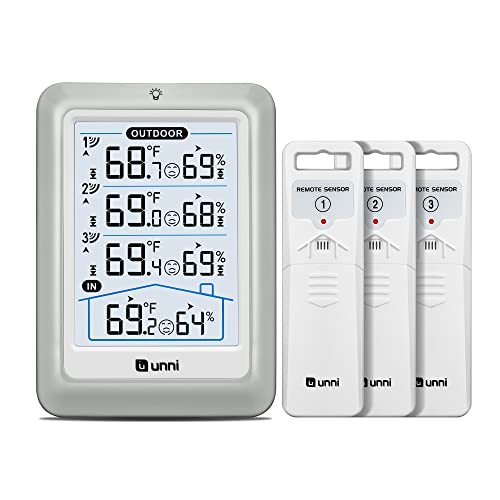
Best for: Those who want real-time indoor and outdoor environmental data displayed at a glance. This wireless system provides data from up to 330 ft and transmits every 30 seconds. It delivers three sensor readings—indoor temperature, outdoor temperature, and humidity—with a color display and backlight for quick reference.
Why selected: It’s ideal for monitoring multiple locations around a property, such as a patio or garage, and it’s good as a supplementary sensor to a smart thermostat. Caution: Data is non-integrated with HVAC controls; use as a standalone environmental monitor.
Honeywell Home T9 WiFi Smart Thermostat

Best for: Users desiring a proven smart thermostat with reliable room sensor support and broad compatibility. The included smart room sensor helps focus comfort where people are, with a signal range up to 200 ft. The Auto Home/Away feature leverages occupancy to save energy automatically.
Why selected: The T9 balances strong sensing with broad integrations and energy saving features. It is a strong mid-to-upper tier option for multi-room comfort. Caution: Sensor range can vary based on home construction; consider additional sensors if rooms are far apart.
ecobee Smart Thermostat Essential

Best for: Budget-conscious buyers seeking reliable energy savings on a wide variety of systems. It is ENERGY STAR certified and supports smartphone control with a straightforward interface. The ecobee Compatibility Checker helps ensure your system is supported.
Why selected: It provides dependable performance and software upgrades over time. It is a practical choice for new installs or upgrades when you want a solid baseline smart thermostat with sensor support.
Caution: Lower-end features compared to premium ecobee models; consider the Premium version if you want advanced sensors and richer integrations.
ecobee Smart Thermostat Premium

Best for: Homeowners seeking maximum comfort, built-in sensor power, and broad system compatibility. The Premium model includes a SmartSensor and supports advanced integrations, including connections with other ecobee devices. It is ENERGY STAR certified and aims to maximize savings with intelligent sensing.
Why selected: The included SmartSensor and richer feature set make it well-suited for multi-room control and smarter automation. Caution: It is a higher-cost option; ensure your HVAC wiring supports the setup, and verify compatibility with the ecobee support checker.
OBET Weather Station Wireless Indoor Outdoor Monitor

Best for: Users needing a three-sensor, multi-location climate view with alerts. It features a 7.68″ color LCD display and 500 ft wireless range for outdoor sensors. The system provides max/min records, trends, and barometric data to inform decisions about heating and cooling.
Why selected: It adds robust environmental monitoring that complements smart thermostats, helping you optimize HVAC usage based on precise outdoor conditions. Caution: As a standalone monitor, it won’t control HVAC directly; pair with a thermostat for automated adjustments.
Amazon Smart Thermostat

Best for: Alexa-centric homes seeking simple setup and voice-control-driven energy savings. It integrates with select Alexa devices for automatic adjustments and presence-based responses. It may offer rebates from energy providers after purchase in some regions.
Why selected: It provides easy smart-home integration with a familiar voice assistant ecosystem. Caution: It relies heavily on compatible Alexa-enabled devices and may require a C-wire for full features in some setups.
Sensi Touch 2 Smart Thermostat

Best for: Homes prioritizing privacy and energy savings with room-sensor compatibility. The Sensi system offers flexible scheduling, remote access, and usage reports designed to reduce HVAC energy use. It is ENERGY STAR certified and works with room sensors (sold separately).
Why selected: It balances privacy with practical energy management features, making it a reliable choice for users cautious about data sharing. Caution: Room sensors are optional; for multi-room optimization, ensure you add compatible sensors.
Buying Guide: Key Purchase Considerations
- System compatibility: Check how many HVAC zones your home has and whether the thermostat supports your furnace, heat pump, or boiler. Use the product’s compatibility checker when offered.
- Sensor strategy: Decide between a single all-in-one thermostat with built-in sensing versus a multi-sensor approach (separate room sensors, indoor/outdoor monitors, or smart room sensors).
- Installation needs: Confirm C-wire availability and whether professional installation is recommended for your wiring setup.
- Control and connectivity: Consider app quality, remote control features, and integrations with voice assistants (Alexa, Google Assistant, Siri).
- Energy savings emphasis: Look for ENERGY STAR certification, occupancy-based modes, and rebates or utility programs that may apply.
- Display and accessibility: Evaluate touchscreen size, readability, and whether color displays or backlighting improve usability in your living space.
- Data privacy: Review privacy options and data handling policies, especially if you prefer not to share usage data with third parties.
FAQ
- Do multiple sensors improve energy savings? Yes. Coordinated readings across zones help optimize heating and cooling for occupied rooms and can reduce wasted energy.
- Is a C-wire required for these thermostats? Many models perform best with a C-wire; some work with power-extender kits or battery power, but check the installation guide for your system.
- Can I use these with smart home assistants? Most listed options offer compatibility with major ecosystems like Alexa, Google Home, or Siri via integrations.
- Are room sensors essential? Not always. They boost comfort in large homes or multi-room layouts, but a single-zone residence may not need extra sensors beyond the main thermostat.
- What is the best option for renters? A thermostat with good mobile control and non-permanent sensor solutions is ideal, focusing on easy installation and removable components.
- Do these thermostats require professional installation? Some setups may require professional wiring, especially when a C-wire or complex HVAC configurations are involved.