Best Thermostats for Exhaust Fans to Improve Ventilation and Energy Savings
If you’re looking to automate exhaust fan ventilation, a dedicated thermostat can keep spaces like attics, greenhouses, workshops, or garages cooler and safer. This guide reviews five reliable options, highlighting who each product is best for and why you might choose it. Whether you want precise control, simple plug‑and‑play setup, or safety features like overload protection, these models help match cooling needs with energy efficiency.
| Product | Best For | Key Benefit |
|---|---|---|
| BN-LINK Digital Cooling Thermostat Controller | Attics and small cooling setups | Clear digital display with Fahrenheit/Celsius options |
| Saillong Attic Fan Thermostat Control | Greenhouses and multi-appliance control | Adjustable dial; handles up to 3 appliances |
| Makevivi Attic Fan Thermostat-Control | Easy install, high precision | ±1.8°F accuracy; socket plug design |
| Makevivi Attic Fan Thermostat-Control (Two Fans) | Two-fan setups | Two fans supported; flexible wiring options |
| iLiving iLIVING Thermospeed | Speed control and temperature pairing | Plug-and-play with speed control |
BN-LINK Digital Cooling Thermostat Controller

Best for: small attic or closet cooling projects where a straightforward, compact controller is preferred. Why: This BN-LINK unit offers a simple setup — place the probe, plug in the controller, and use the 3-button interface to set your desired temperature. The digital display supports both Fahrenheit and Celsius, which aids in precise tuning for hot climates. It’s ideal for buyers who want a rugged plug-in solution with clear status indicators.
- Rugged housing and a clear display help in low-light installations.
- Includes a 3.94 ft power cord and a 4.92 ft probe for flexible placement.
Caution: The model’s maximum load is 1000W (8.3A); avoid using it with higher‑power devices or multiple high‑draw appliances on the same outlet without verifying total draw.
Saillong Attic Fan Thermostat Control

Best for: greenhouse or attic setups seeking adjustable dial control. Why: Saillong’s thermostat uses a finger dial for temperature setting and supports up to 10 amps, with a 50°F–120°F range. It’s suitable where a simple, manual adjustment is preferred and where one thermostat can manage multiple appliances.
- Finger dial provides quick, tool-free adjustments.
- Can control up to 3 appliances within a 10A limit.
Caution: The unit’s wattage capacity (10A) may constrain high‑power installations; plan for lower‑power devices or multiple units if needed.
Makevivi Attic Fan Thermostat-Control

Best for: users seeking precision and a quick plug‑and‑play setup with overload protection. Why: This Makevivi model emphasizes precision (±1.8°F) with a modern circuit board sensor and an external socket design for fast installation. It also includes a heavy‑duty overload protector and a 1600W (120V) max load, making it suitable for larger attic fans or greenhouse exhausts.
- Precision control minimizes over- or under-ventilation.
- External socket design simplifies installation; can often be set up without rewiring.
Caution: The two‑fan capability requires careful power planning; verify load on each outlet to avoid exceeding limits per circuit.
Makevivi Attic Thermostat-Control With Socket And Wire Connector
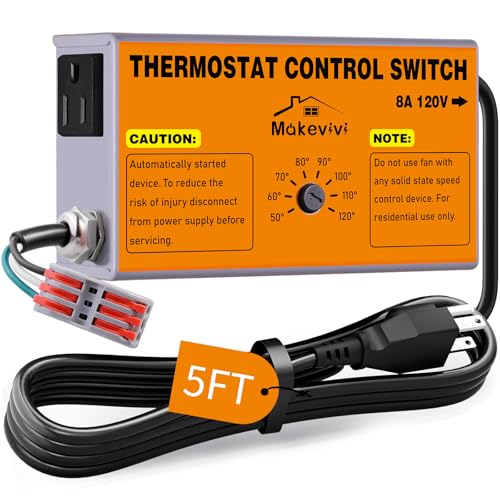
Best for: flexible installation with both socket and direct wiring options. Why: This model provides two installation paths (external socket and lever wire connectors) and supports two exhaust fans simultaneously. It combines precision control (±1.8°F) with safety features and a 1600W max load, making it versatile for various venting configurations.
- Two installation styles reduce labor when retrofitting existing systems.
- UL-listed power extension cord adds safety and reliability.
Caution: Ensure both fans and wiring are compatible with 1600W/120V and space inside the housing is adequate for dual connections.
iLiving Exhaust Fan Thermospeed Controller
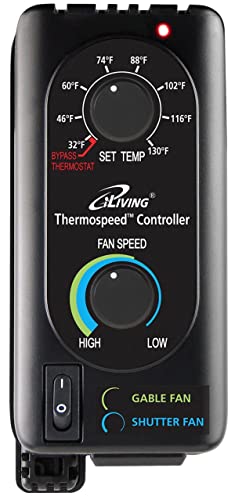
Best for: users who want both speed and temperature control in one plug‑and‑play device. Why: The Thermospeed controller supports temperature and speed control with auto cycle ON/OFF at a chosen setpoint and features an NTC sensor for precise regulation. It’s ideal when you need variable fan speed along with temperature triggers.
- Auto cycling adds energy efficiency by modulating speed with temperature.
- NTC sensor improves temperature accuracy and response time.
Caution: As a combined speed and temperature controller, it may be best for users who specifically want speed control; if you only need temperature, a simpler unit could be more cost‑effective.
Buying Guide: Key Considerations For Choosing An Exhaust Fan Thermostat
- Control precision: Look for a high-accuracy sensor (±1.8°F is common) to avoid unnecessary fan cycling.
- Load capacity: Ensure the unit supports your fan’s wattage, particularly for larger or dual‑fan setups (commonly up to 1600W or 1800W).
- Installation style: Decide between plug‑in, socket-based, or wired options. Plug‑and‑play is fastest, while socket/wire options offer more placement flexibility.
- Temperature range: Attic and greenhouse environments vary; a range like 50°F–120°F or -40°F–210°F covers most applications.
- Safety features: Overload protection and UL-listed power cords add critical safety margins for high‑draw devices.
- Number of controlled devices: If you need to run multiple fans, confirm whether the thermostat supports single or multiple loads (some models support two or three devices).
- Display and usability: A clear digital display with Fahrenheit/Celsius support helps quick adjustments in varying climates.
- Durability and environment: Look for rugged housings and weather‑resistant designs for attic or greenhouse use.
FAQ
What is the typical temperature range I should set for an attic fan?
Most thermostats used for attic fans allow 50°F to 120°F or similar settings. Choose a point that prevents heat buildup while avoiding unnecessary fan cycling.
Can I run two fans with one thermostat?
Some models support multiple loads; verify the maximum wattage and the number of controlled devices listed in the product features.
Is UL listing important for an attic thermostat?
UL listing indicates compliance with safety standards for electrical components, which is especially important in high‑heat environments.
Do I need an electrician to install these thermostats?
Plug‑and‑play models typically require no professional wiring. More advanced wired or dual‑fan installations may benefit from professional help.
Will these thermostats improve energy efficiency?
Yes. By turning fans on only when temperatures rise above the set point, they reduce unnecessary ventilation and electricity use.