Best Temperature Control Switches for Fans to Keep Cool Efficiently
Answering the common buyer question: these temperature control switches automate attic, greenhouse, and workshop fans to run only when needed. They’re best for DIYers seeking steady airflow, energy savings, and simple installation. The top picks cover residential attics, greenhouses, and small workshops, with various features like adjustable setpoints, dual-stage heating/cooling, and UL or ETL listings. Below is a concise, comparison-friendly guide to five reliable options, plus a buying guide and quick FAQ to help you decide.
| Product | Best For | Key Benefit | Limitations |
|---|---|---|---|
| BN-LINK Digital Cooling Thermostat Controller | Attic and exhaust fans | Simple setup with large display and dual-unit readout | Basic cooling-only focus |
| DEWENWILS Digital Temperature Controller | Greenhouses and incubators | High-power output and wide range (-40°F to 210°F) | Bulkier unit |
| Attic Fan Thermostat-Control (Makevivi) | DIY attic or workshop fans | Precise sensor with fast response | External socket design requires setup |
| DEWENWILS Digital Temperature Controller (Second Model) | Homebrew and greenhouse projects | Same strong performance with VA display | Repeat feature set may overlap with first model |
| LyteSolar 58033 Adjustable Thermostat Switch | Lomanco-style attic fans | Direct replacement part with adjustable range | Specific compatibility |
BN-LINK Digital Cooling Thermostat Controller

The BN-LINK thermostat is designed for attic and exhaust fans with a temperature-controlled outlet. It uses a simple three-button interface and shows readings in Fahrenheit or Celsius. Its fan probe and 3.94 ft power cord plus 4.92 ft probe support flexible placements. Best for buyers who want straightforward cooling control with a clear digital readout and easy setup. It’s suitable for attic fans and other small cooling devices in residential spaces.
Who it’s best for: homeowners seeking a reliable, plug-and-go solution for attic or exhaust fans without complex wiring. Why selected: the unit emphasizes ease of use, clear status indicators, and a rugged housing for long-term use. Caution: it relies on a single cooling function; if you need heating control, choose a dual-stage model.
DEWENWILS Digital Temperature Controller
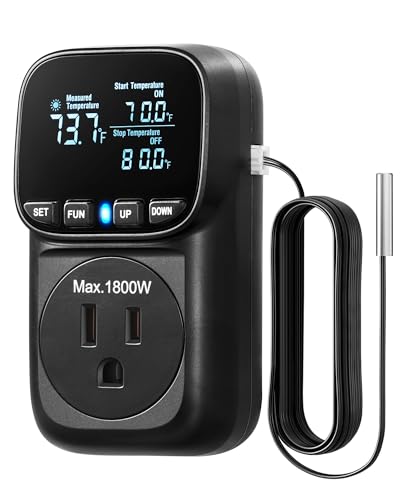
This DEWENWILS model supports up to 1800W with a 15A output, making it suitable for heating and cooling devices in larger setups like greenhouses or incubators. The VA display remains readable in dim lighting, and the control range spans -40°F to 210°F with 0.1°F precision. Best for high-power environments where clear readings and broad control are valued. Choose this if you need robust performance for substantial heating/cooling loads.
Who it’s best for: users operating high-draw heaters or coolers in greenhouses or workshops. Why selected: high power, clear display, and wide temperature range provide flexible control. Caution: larger unit footprint may require more space and proper mounting.
Attic Fan Thermostat-Control (Makevivi)

Makevivi’s thermostat offers a precise temperature control with an advanced circuit board sensor that limits errors to ±1.8°F. It features a plug-and-play external socket design for quick setup—no disassembly required. Best for DIY attic ventilation upgrades where installers want fast, accurate control without extensive wiring. A limitation is the external socket design, which may influence placement options in tight spaces.
Who it’s best for: DIYers replacing an old thermostat or installing a new external socket-controlled unit. Why selected: precision sensors and easy setup provide reliable attic ventilation. Caution: installation may be limited by socket accessibility and cord length.
LyteSolar 58033 Adjustable Thermostat Switch

The 58033 is designed as an adjustable, single-stage thermostat suitable for Lomanco attic fan motors and similar setups. It offers a 50°F–120°F range with a maximum 13A/120V capacity (up to 1200W). Best for replacement parts or direct-fit upgrades in standard attic fan installations. Choose this when you need a straightforward, compatible retrofit for older fans. Limitation: compatibility is strongest with Lomanco-like models; verify your fan’s specifications first.
Buying Guide: Key Considerations For Temperature-Controlled Fans
What should you check before buying a temperature-controlled switch for a fan?
- Power capacity: Ensure the unit can handle your fan’s wattage. Look for models rated at 1800W or higher if you plan to run heaters as well as fans.
- Temperature range and precision: Choose a range that matches your environment (e.g., -40°F to 210°F for greenhouses) and a tight precision (0.1°F–1°F) for stable conditions.
- Display and readability: A VA or LED display helps in low-light spaces like attics and basements.
- Wiring and installation: Plug-in models are easiest; external sockets save time but may require longer cables or specific outlet placements.
- Safety features: Overload protection, UL/ETL listings, and proper cords prevent electrical hazards.
- Application fit: Attic, greenhouse, and workshop fans vary in size and connectors. Check compatibility with your fan model.
Frequently Asked Questions
- What is the simplest temperature controller for an attic fan?
Plug-in models like BN-LINK are among the easiest to install, offering a plug-and-play setup with a digital display.
- Can these devices control both heating and cooling equipment?
Yes, several models, including DEWENWILS units, support both heating and cooling modes for versatile environments.
- Do these switches require professional installation?
Most plug-in units do not. External-socket designs are still straightforward but may require basic electrical safety precautions.
- What should I consider for greenhouse use?
Look for a wide temperature range and high power handling to support heaters, fans, and other equipment under varying conditions.
- Are these safety-rated?
Many listed models offer UL/ETL compliance or similar safety certifications; verify listings in product specifications.