Best RV Tankless Water Heaters for on-Demand Showers and Off-Grid Use
Answering the search for reliable, on-demand hot water in a trailer, these RV tankless water heaters provide continuous hot water without a storage tank. They’re best for campers, full-time RV residents, and weekend travelers who want steady warmth at high altitude or off-grid sites. Below are five top choices, selected for compatibility with most RVs, 12V DC power, and propane operation. A quick buyer’s table follows to help you compare key points at a glance.
| Product | BTU / GPM | Power | Best For | Notes |
|---|---|---|---|---|
| APUS RV Tankless Water Heater (Black Door) | 68,000 BTU • 3.9 GPM | Propane, 12V DC | Long showers; traveling families | High altitude option available |
| Somokg RV Tankless Water Heater | 65,000 BTU • 3.9 GPM | Propane, 12V DC | Off-grid camping; hot water on demand | Anti-freeze & altitude ready |
| Xenjum RV Tankless Water Heater | 65,000 BTU • 3.9 GPM | Propane, 12V DC | Dual outlets; exterior supply | Smart control via remote |
| APUS RV Tankless Water Heater (White Door) | 68,000 BTU • 3.9 GPM | Propane, 12V DC | Compact footprint; mountain trips | High altitude performance |
| RV Part Pro Tankless Water Heater | 60,000 BTU | Propane, 12V DC | Weekend trips; easy monitoring | Built-in fault code display |
APUS RV Tankless Water Heater With Black Door

This model delivers up to 68,000 BTU and 3.9 GPM, starting at low flow for quick hot water. It supports 12V DC power and propane, making it adaptable for both solar setups and traditional RV systems. The compact 14.96 × 14.96 × 14.18 inch footprint fits many standard compartments, and the 12.6 × 12.6 inch cutout matches common RV openings. Best for full-time travelers or large RVs where long showers are a priority.
Who it is best for: RV owners who need reliable, high-flow hot water in diverse altitudes and want a compact installation. Why selected: strong BTU rating, good for high-demand usage, and compatibility with standard fittings.
Caution: Ensure 12V DC wiring and propane supply are securely integrated; improper installation can affect performance at altitude.
Somokg RV Tankless Water Heater With 15×15 Inch Door

This unit provides 68,000 BTU and up to 3.9 GPM with a 15×15 inch door, suitable for RV compartments needing a larger access. It emphasizes quick heat (about 3 seconds to reach temp) and precise temperature control. It’s designed for use at high altitudes and in freezing conditions, featuring a robust copper heat exchanger and resilience against low gas or water pressure.
Who it is best for: Off-grid campers who prioritize quick, stable hot water and altitude capability. Why selected: strong ignition reliability at higher elevations and a durable heat exchanger.
Caution: The system relies on correct venting and gas connections; verify external exhaust clearance in tight spots.
Xenjum RV Tankless Water Heater With Dual Outlets
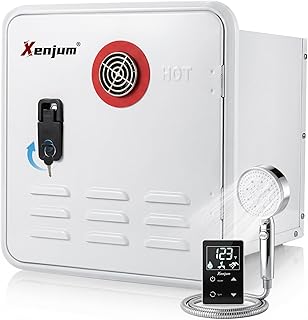
Compact efficiency with dual outlets enables hot water supply to multiple fixtures inside and outside the RV. It delivers up to 65,000 BTU and 3.9 GPM, with an intuitive remote control for temperature tuning between 95–123°F. Automatic seasonal flame adjustment helps manage energy use year-round. Ideal for larger campers and setups with multiple hot-water needs.
Who it is best for: Families or guests needing hot water in several rooms or outdoor showers. Why selected: dual outlets for broader water distribution; remote control simplifies operation.
Caution: Exterior outlet usage may require extra hose length and protective housing to prevent weather exposure.
RV Part Pro Tankless Water Heater With Black Door

This model emphasizes practical features for off-grid living, with 60,000 BTU and on-demand heating. A built-in microcomputer panel supports adjusting water temperature from 95°F to 123°F and displays fault codes, helping with troubleshooting. It’s built to operate at higher altitudes and includes a pressure-reducing valve for stable performance.
Who it is best for: RVers who want straightforward temperature control and simple fault-reading. Why selected: compact control panel and altitude-ready design.
Caution: The lower BTU rating compared with some rivals means slightly slower recovery in very cold conditions or high-demand situations; plan capacity accordingly.
Buying Guide
- What size of BTU and GPM do you need? If your RV uses multiple fixtures at once, aim for 65,000–68,000 BTU and 3.5–3.9 GPM to ensure quick hot water for showers and dishes.
- Power source: Most models run on propane with a 12V DC system. Confirm your RV’s electrical setup and propane availability before purchase.
- Altitude and cold-weather performance: Look for models with high-altitude ratings and freeze protection features for mountain or high-latitude camping.
- Installation footprint: Check the door opening size and overall dimensions to ensure compatibility with your RV compartment or cabinet.
- Outlets and distribution: If you need hot water in multiple zones, consider dual-outlet units or models with external and internal connections.
- Control and monitoring: Remote or digital control makes temperature adjustments easier on the road; note whether the unit includes a remote, thermostat, and fault indicator.
- Reliability under off-grid use: For extended trips, prioritize units with robust heat exchangers and proven ignition stability in low gas or water pressure.
FAQ
- What is a tankless water heater for an RV?
A tankless unit heats water on demand, eliminating the need for a storage tank and enabling continuous hot water as long as there is a water supply and fuel.
- Can RV tankless heaters work at high altitudes?
Yes, many models are designed to operate at elevations up to around 9,800 feet (2,987 meters) or higher with proper power and venting.
- Do these require a lot of propane?
Propane usage depends on BTU output and water flow. Higher BTU burners heat water faster, but they consume more propane when under heavy demand.
- Are dual-outlet models worth it?
Dual outlets allow distributing hot water to two zones, reducing wait times for multiple fixtures, which is useful in larger RVs.
- What maintenance is needed?
Regular inspection of connections, seals, and venting is recommended. Some units include fault-code displays to aid troubleshooting.
- Is remote temperature control necessary?
Remote control offers convenience for on-demand adjustments, especially when the heater is installed in a separate cabinet from living areas.