Best Register Booster Fans for Ceiling Vent Optimization
If you’re looking to improve ceiling vent airflow and balance year-round comfort, a register booster fan can help. These units are designed to boost air from HVAC ducts, targeted for ceiling, wall, or floor registers. This guide highlights five top options, who they’re best for, and practical buying tips. The top picks are ideal for improving cooling in small rooms, night-time quiet operation, or balancing warmth during winter. Use the quick comparison table to spot key differences at a glance.
| Product | Best For | Key Benefit | Where It Shines |
|---|---|---|---|
| VIVOHOME Reg. Booster Fan (White) | Small rooms, night use | Quiet, thermostat-controlled | Smart control, 120 CFM |
| VELLEE Quiet Register Booster Fan (White) | Energy savings | 10-speed, high efficiency | Low noise, robust cooling |
| Howeall Smart Reg Booster Fan | Whole-home control | Wi‑Fi app + dual thermostat | Smart programming |
| Orabriz 4″ x 10″ | Small rooms with aroma needs | Aroma pad slot | Remote, LCD display |
| BIOWIND 4″ or 6″ x 10″ | Quiet operation, balance | 10-speed, aluminum frame | Remote, thermostat |
Below are five cut-to-the-point product sections. Each entry presents who should buy, why the unit was selected, and a practical caveat to consider. Compare features side-by-side to determine which booster fan best fits your ceiling register application.
VIVOHOME Register Booster Fan — 4” x 10” Opening

Best for compact ceiling registers in bedrooms or offices. This unit fits standard 4×10 inch openings and supports installation on floors, walls, or ceilings. It includes a smart thermostat that turns the fan on or off automatically, helping to balance temperature while saving energy. The EC motor keeps noise low, typically under 18 dB, with airflow up to 120 CFM. A caveat: ensure vent dimensions meet the 4×10 inch opening and mounting depth before purchase.
VELLEE Quiet Register Booster Fan — 6″ x 10″

Better for larger ceiling or wall openings where higher airflow is beneficial. The VELLEE model offers 10-speed control and a high-sensitivity temperature sensor coupled with a smart chip, automatically adjusting to maintain indoor comfort. It claims up to 200 CFM with quiet operation as low as 18 dBA. Choose this if you want strong, scalable airflow without noticeable noise, but confirm your ceiling cutout matches 6×10 inch openings.
Howeall Super Quiet Register Booster Fan

Best for tech-enabled homes seeking centralized control. Howeall combines dual control options with an optional Wi‑Fi app for remote adjustments. The 2026 upgrade emphasizes intelligent programming that starts or stops the booster to align with real-time temperatures. For rooms where you want effortless adjustments, this model excels. Potential limitation: some users may prefer a simpler setup without app dependence or may want to confirm compatibility with existing smart home ecosystems.
Orabriz AC Vent Booster Fan — 4″ x 10″
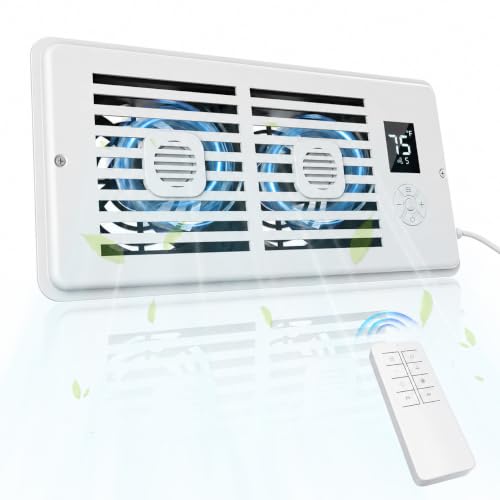
Ideal for small rooms and spaces needing improved airflow with additional aroma capability. Orabriz includes an aroma pad slot for a subtle scent and a remote plus LCD display. It suits users who want movement without heavy setup and enjoy a little flexibility in room ambiance. A caution: aroma pad use is optional and not essential to airflow performance, so rely primarily on the fan metrics for cooling efficiency.
BIOWIND Quiet Register Booster Fan — 4″ x 10″

Best for quiet operation with a focus on balanced temperatures. BIOWIND highlights a 2026 fan stability upgrade and a premium aluminum frame for a flush, modern look. It features a high-precision temperature sensor and a programmable controller to turn the fan on or off automatically. This makes it a solid choice for households prioritizing steady comfort and aesthetic integration. Limitation: verify your register opening to ensure a proper seal and fit.
BIOWIND Quiet Register Booster Fan — 6″ x 10″

Another solid option for larger ceiling openings, offering the same quiet operation and smart controls as the 4-inch variant but scaled for bigger rooms. It uses a PWM motor to maintain efficiency up to 200 CFM with low noise. Choose this if you need stronger airflow in larger spaces, but ensure your 6×10 inch register cutout is appropriate to avoid fit issues.
Buying Guide: Key Considerations For Ceiling Register Booster Fans
What size is your register opening? Most boosters labeled 4″ × 10″ or 6″ × 10″ fit standard openings, but always measure before purchasing. If in doubt, confirm the exact length and width of the vent opening and the depth needed for installation.
How much air do you need? Look for airflow ratings such as CFM and noise levels. Higher CFM helps with larger rooms or poor duct circulation. Lower dBA is preferable for bedrooms or media rooms.
What kind of control do you want? Some models feature thermostats, temperature sensors, and auto-on/off functions. Others offer Wi‑Fi app control, remote, or rely on manual switches. Consider whether you want smart home integration or a simpler, stand-alone unit.
Are there safety and installation notes to consider? Verify that the mounting surface is suitable (floor, wall, or ceiling), power availability, and cable routing for a clean appearance. Check for vibration balance and motor stability to minimize noise and wear over time.
Do you prefer extra features? Aroma pad slots, scheduling, and temperature history can add value for sleep spaces or living areas. Weigh these optional features against price and maintenance needs.
Frequently Asked Questions
- What does a register booster fan do? It increases airflow from HVAC vents, helping balance temperature and improve comfort in rooms with weak or uneven airflow.
- Can I install a booster fan on a ceiling register? Yes, many models are designed for ceiling, wall, and floor registers. Always measure the opening and follow the included installation guidance.
- Do these fans require smart devices? Some models offer Wi‑Fi control and mobile apps, while others operate with manual controls or basic thermostats.
- Will a booster fan save energy? By improving airflow and enabling more even cooling or heating, some users experience energy savings, especially when the system cycles less frequently.
- What should I consider before buying a 4″ x 10″ vs 6″ x 10″ model? Choose 4″ x 10″ for smaller rooms and limited space; 6″ x 10″ is better for larger rooms or where higher airflow is needed.
- Is aroma support important? Aroma pads are optional and primarily for comfort; they do not impact airflow performance unless you use them.