Best Refrigerant Gas Leak Detectors for Accurate, Fast Detection
Answering the question, this guide highlights top refrigerant gas leak detectors suitable for HVAC technicians, automotive workers, and DIY homeowners. These devices help identify halogenated refrigerants such as R22, R410A, R134A, and related blends. The selections emphasize reliability, ease of use, and practical sensitivity levels. Ideal buyers include HVAC pros needing handheld diagnostic tools, automotive technicians checking AC systems, and contractors seeking portable detectors for hard-to-reach areas.
Chosen products provide a balance of rechargeable power, precise sensor technology, and adjustable sensitivity. Below is a quick summary table of the five detectors selected for focused comparison.
| Product | Best For | Key Benefit | Connector |
|---|---|---|---|
| SENSYX 2-in-1 SFD201 | General HVAC & automotive | Rechargeable, high/low sensitivity | USB-C |
| Elitech ILD-100H | Compact detection, halogenates | Heated diode sensor, TFT display | Rechargeable |
| Elitech ILD-200 | All halogenated gases, robust | Infrared sensor, wide range | Rechargeable |
| Elitech CLD-100 | Professional automotive/RV use | 6s preheat, flexible probe | Battery powered |
| Aprvtio ALD-200 | 3-in-1 detection, broad refrigerants | Advanced sensor, micro leaks | Rechargeable |
SENSYX 2-in-1 Rechargeable Refrigerant & Combustible Gas Detector

The SENSYX SFD201 combines refrigerant leak detection with combustible gas sensing, offering a versatile handheld tool for mixed-use environments. Best for technicians who need a single device to cover refrigerants and combustible gases in automotive or building systems. It features a rechargeable lithium battery and a USB-C charging cable for mobility, plus a Japan-made heat dioxide sensor noted for high sensitivity. Sensitivity is adjustable between High and Low levels, enabling quick pinpointing of leaks while reducing nuisance alarms.
Best for: HVAC installers and automotive techs who value cordless operation and quick reach in tight spaces. Limitation: data on specific response times is not disclosed, so users should validate performance in their own workflow.
Elitech Freon Leak Detector Halogen Refrigerant Detector, WJL-6000S

This model detects all halogenated refrigerants, including R22, R134A, R404A, R410A, and R1234YF, making it a strong choice for shops dealing with a wide range of systems. It features seven adjustable sensitivity settings and dual indicators for audible and visual leak signals, plus battery indicators. Best for: shops needing broad compatibility with many refrigerants and simple visual/audible alerts. Caution: some users may prefer a larger display for quick field readings in bright environments.
Elitech ILD-100H Heated Diode Refrigerant Leak Detector

The ILD-100H uses a heated diode sensor for improved accuracy across halogenated refrigerants. It includes a TFT display to show sensitivity levels, leakage alerts, and battery status clearly, helping technicians monitor performance in real time. Best for: professionals who need precise readings and a clear on-device display in challenging lighting. Limitation: heated diode sensors can be more sensitive to environmental factors; ensure proper calibration in each work setting.
Elitech ILD-200 Refrigerant Leak Detector
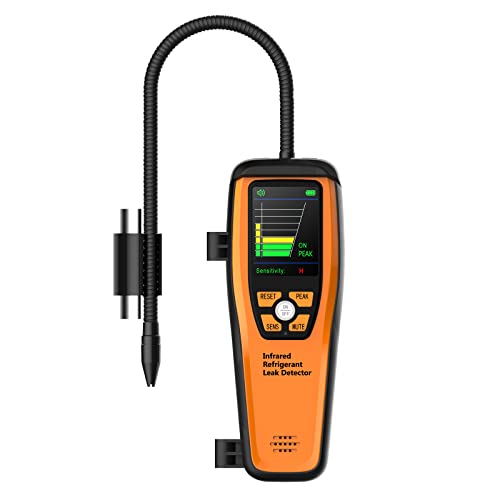
The ILD-200 uses infrared sensing for strong anti-interference, faster response, and longer life. It supplies adjustable sensitivity up to 0.14 oz/yr and detects all halogenated refrigerants, including blends. Best for: higher-volume service environments needing rapid, reliable detection across many refrigerants. Caution: infrared sensors may require careful handling to avoid misreads from intense background heat sources.
Elitech CLD-100 Freon Leak Detector

The CLD-100 is a compact detector with a traditional corona sensor and fast 6-second preheating, providing quick triggers on common refrigerants such as R11, R22, R134A, R404A, and R410A. It offers six sensitivity levels with a maximum of 0.21 oz/yr and comes with a flexible probe about 8.26 inches, enabling access to hard-to-reach areas. Best for: automotive and RV technicians needing a lightweight detector with a flexible probe. Limitation: corona sensors can be less stable in highly contaminated environments compared to heated or infrared sensors.
Aprvtio ALD-200 3-in-1 Freon Leak Detector

The Aprvtio ALD-200 offers true 3-in-1 detection with a next-generation heat diode sensor, capable of detecting A1, A2L, and A3 refrigerants, plus tracer gases. It delivers high sensitivity up to 0.14 oz/yr and provides audible alerts with a 2.8-inch TFT display, including a mute function for quiet operation. Best for: professionals who need broad refrigerant coverage, including newer blends. Caution: the device emphasizes A1–A3 coverage, so verify compatibility with any niche refrigerants used in your region.
Buying Guide
What should you look for when choosing a refrigerant leak detector?
- Sensors: Heated diode, infrared, and corona sensors each have strengths. Infrared offers strong anti-interference and longevity; heated diode provides accuracy across halogenated gases; corona sensors are fast and simple but may be less stable in highly contaminated settings.
- Sensitivity range: Look for adjustable high/low sensitivity and a maximum detection threshold that suits your typical leak sizes. Higher sensitivity helps catch micro leaks, but may trigger more false alarms if not managed properly.
- Display and alerts: A clear display (including TFT) plus audible and visual indicators aids rapid interpretation in field conditions. Some models include battery indicators and mute functions for quiet operation.
- Power and portability: Rechargeable batteries with USB-C charging are ideal for mobility and field service. A flexible probe is valuable for reaching tight or awkward spots.
- Range of refrigerants: For shops handling multiple refrigerants, a detector with broad halogenated gas coverage and support for blends is advantageous.
- Durability and uptime: Consider devices with quick warm-up times, robust housings, and proven service life to minimize downtime in busy environments.
Frequently Asked Questions
- Which refrigerant leak detector is best for automotive use?
- What sensor type should I prioritize for accuracy?
- Do detectors detect all refrigerants and blends?
- Is a rechargeable detector more cost-effective in the long run?
- How important is a display versus simple indicator lights?
- Can I use these detectors in high-temperature environments?
Answers are tailored to typical user needs. For automotive use, detectors with flexible probes and fast response times are advantageous. For general HVAC work, broad refrigerant coverage and adjustable sensitivity reduce missed leaks. Rechargeable models offer mobility for both roles, while infrared sensors tend to provide stable performance across many halogenated gases. Always refer to the manufacturer’s operating guidelines for calibration and maintenance to ensure consistent accuracy.