Best Power Vent Water Heaters Compared With Tankless Options for Your Home
Power vent water heaters and tankless systems both aim to deliver reliable hot water with efficiency, but they serve different needs. This guide helps American buyers decide which is best for their home, family size, and venting situation. The top picks below emphasize 5 tankless models that pair well with often-required venting considerations and space savings. If you’re replacing an aging tank or upgrading for on-demand hot water, these options offer a mix of outdoor, indoor, and high-flow capabilities for busy households.
| Product | ||
|---|---|---|
| Rheem RTG Series 7.0 GPM LP Tankless (Outdoor) | Outdoor Tankless | Large homes; outdoor installation |
| Rheem RTG Series 7.0 GPM NG Tankless (Indoor) | Indoor Tankless | Indoor spaces; direct vent compatible |
| Noritz NRC71DVNG Indoor Condensing | Indoor Condensing Tankless | High efficiency; compact footprint |
| MIZUDO 10.3 GPM Indoor Gas Tankless | Indoor Tankless | High flow; app control |
| VEVOR 4.3 Gal 100,000 BTU Tankless | Indoor Tankless | Budget-friendly; basic on-demand |
Rheem RTG Series 7.0 GPM LP Tankless Water Heater Outdoor

Best for households with outdoor space and no indoor venting concerns. Features include 7.0 GPM at 35°F, delivering up to 160,000 BTU/hr for 2–3 simultaneous showers. It uses non-condensing gas technology and an energy-efficient operation, with an outdoor installation that eliminates indoor venting. Choose this if you have an outdoor wall or dedicated exterior venting area and want to simplify installation. Caution: outdoor exposure requires weatherproofing and professional mounting for safe operation.
Rheem RTG Series 7.0 GPM NG Tankless Water Heater Indoor

Best for homes that want a compact, indoor option with direct-vent requirements. This model provides 7.0 GPM at 35°F and 160,000 BTU/hr, matching the outdoor unit’s capability but designed for indoor installation. It’s ideal for replacing aging tank water heaters in tight spaces and for multi-bathroom homes. Caution: requires proper indoor venting and installation by a qualified professional.
Noritz NRC71DVNG Indoor Condensing Direct Vent

Best for energy-conscious buyers who value high efficiency in a compact form. The NRC71DVNG is an indoor condensing model that delivers reliable endless hot water with very high efficiency and a smaller footprint. It’s well-suited for homes needing space savings, two to three hot-water points, and enhanced energy performance. Limitation: condensing units can be more complex to install and service.
MIZUDO Natural Gas Tankless, 10.3 GPM Indoor

Best for mid-to-large homes with higher simultaneous hot-water needs. The MIZUDO unit offers up to 10.3 GPM with 199,000 BTU input and precise temperature control, plus app control for convenience. It’s ideal for busy households that want robust performance and modern features. Caution: higher BTU input may require a stronger gas line and venting considerations for indoor installation.
VEVOR Tankless Water Heater Gas, 4.3 Gal
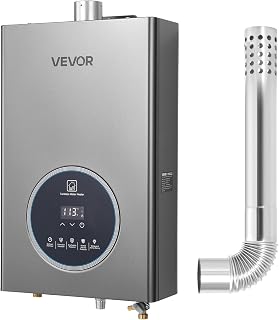
Best for budget-focused buyers or smaller homes with moderate hot-water demand. The VEVOR 4.3 Gal model provides a solid on-demand performance with 100,000 BTU/h and a straightforward control interface. It’s suitable for single or lightweight two-point setups. Limitation: lower flow capacity compared with high-end units may struggle during peak simultaneous demands.
Buying Guide — Key Considerations for Power Vent vs Tankless
- Ventilation and location: Outdoor tanks eliminate indoor venting needs but expose units to the elements. Indoor models require proper venting and space planning.
- Flow rate and temperature rise: Determine your peak simultaneous hot-water needs. Tankless units measure GPM; higher GPM supports more showers and fixtures at once.
- Energy efficiency: Condensing and high-UEF units save more energy but may have higher upfront costs and installation complexity.
- Installation complexity: Outdoor units are often easier to install but require weatherproofing. Indoor high-efficiency models may need proper venting and gas line upgrades.
- Climate considerations: In colder climates, higher GPM at lower temperature rise can be advantageous; in warmer regions, lower GPM may suffice.
- Maintenance and service: Consider local availability of technicians familiar with propane, natural gas, and condensing systems.
Frequently Asked Questions
- What is the main difference between a power vent water heater and a tankless system?
Answer: A power vent water heater uses a storage tank with a vented exhaust, while a tankless system heats water on demand without storing it. - Which system is better for a small apartment?
Answer: A compact indoor tankless unit or a small power-vented tank heater can work well, depending on water usage and space. - Do tankless heaters save more energy than traditional tanks?
Answer: Yes, especially non-condensing high-efficiency models; they heat water only when needed, reducing standby losses. - Is outdoor installation safe for tankless units?
Answer: Outdoor units are designed for exterior installation but require weatherproofing and appropriate clearances. - Will higher GPM units use more gas?
Answer: Higher GPM units can use more gas during peak demand, so ensure gas supply and line sizing meet the unit’s requirements. - Do these units require professional installation?
Answer: Yes, installation should be performed by a licensed professional to ensure venting, gas lines, and electrical connections are correct.