Best Oil Filled Baseboard Heaters for 120-Volt Homes
Finding reliable 120-volt baseboard heaters involves comparing wattage, installation type, safety features, and size. This guide highlights five top options designed for American households, focusing on standard 120V circuits and straightforward hard-wired or install-ready configurations. Each product is evaluated for performance, heat distribution, and safety, helping you choose a model that seamlessly integrates into living spaces, offices, or rooms needing steady, zone-based warmth.
| Product | Brand | Wattage / Voltage | Length | Notes |
|---|---|---|---|---|
| KING 4K1210BW K Series Baseboard Heater, 4′ / 1000W / 120V | KING | 1000W @ 120V | 4 ft | Not a plug-in model; hard-wired with full-length safety cutout |
| Cadet F Series 72 in. Electric Baseboard Heater (6F1500-1W), 120V, 1500W | Cadet | 1500W @ 120V | 72 in | Continuous heat output; designed for baseboard installation |
| King 6K1215BW 1500-Watt 120-Volt 6-Foot Baseboard Heater | KING | 1500W @ 120V | 6 ft | Hard-wired; aluminum ribbon fin element; full-length safety cutout |
| King 3K1207BW 750-Watt 120-Volt 3-Foot Baseboard Heater | KING | 750W @ 120V | 3 ft | Compact option; hard-wired with safety cutout |
| Cadet F Series 36″ Electric Baseboard Heater (3F750-1W) | Cadet | 750W @ 120V | 36 in | Requires thermostat; solid steel construction |
Note: This article focuses on 120-volt baseboard heaters suitable for standard residential wiring. All listed products are designed for permanent installation or hard-wired setups as described by manufacturers.
KING 4K1210BW K Series Baseboard Heater

The 4K1210BW model from KING delivers 1000 watts of heat across a 4-foot length, optimized for 120-volt circuits. It is designed as a hard-wired heater, not a plug-in unit, and uses an Aluminum Ribbon Fin Element for efficient heat distribution. A full-length safety cutout adds a layer of protection, making it suitable for bedrooms, living rooms, or home offices where steady warmth is needed along baseboard zones.
Cadet F Series 72 in. Electric Baseboard Heater

Cadet’s F Series 72-inch heater provides 1500 watts of continuous heat across a long baseboard profile, designed for 120-volt operation. It’s built for steady room warming and is typically installed to maintain comfortable temperatures in open living spaces. This model emphasizes reliability and long-term performance, with manufacturing details highlighting build integrity for residential settings.
King 6K1215BW 1500-Watt Baseboard Heater
The King 6K1215BW delivers 1500 watts over a six-foot length and is designed for 120-volt electrical systems. It’s a hard-wired unit with an Aluminum Ribbon Fin Element and a full-length safety cutout, offering robust baseboard heating suitable for larger rooms or spaces needing a consistent heat source along the floor line.
King 3K1207BW 750-Watt Baseboard Heater

The 3K1207BW provides a compact 750-watt option in a 3-foot length, compatible with 120-volt circuits. It uses an Aluminum Ribbon Fin Element for efficient heat transfer and includes a full-length safety cutout, delivering reliable zone heating for smaller rooms or spaces with limited wall space.
Cadet F Series 36″ Electric Baseboard Heater
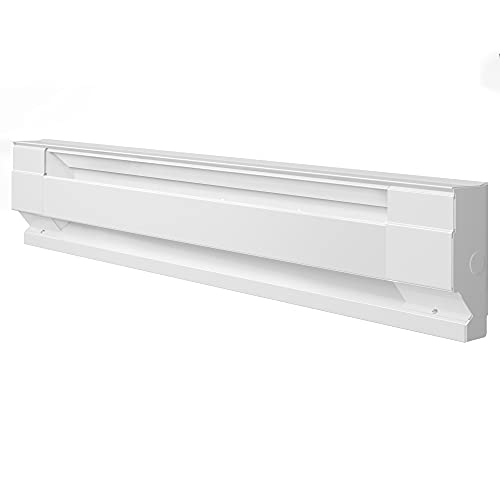
Cadet’s 36-inch baseboard option offers 750 watts of heating for 120-volt installations. It emphasizes steel construction and a protective finish with 25-gauge steel body and a grounded junction box, designed to maintain consistent warmth across smaller or medium-sized rooms while ensuring durable operation.
Buying Guide: Key Purchase Considerations And Comparisons
- Wattage and room size: Choose wattage that matches room dimensions. Larger spaces may benefit from 1500W models (6 feet or more), while smaller rooms could be adequately heated by 750W units.
- Length and placement: Baseboard heaters distribute heat along floor level. Ensure adequate clearance from furniture and walls and consider the room’s layout to maximize heat coverage.
- Hard-wired vs. plug-in: The listed products are mostly hard-wired with safety cutouts. If you prefer plug-in operation, verify compatibility with your wall outlets and consider an external thermostat for control.
- Safety features: Look for full-length safety cutouts, durable metal construction, and corrosion-resistant elements. A built-in thermostat or compatibility with an external thermostat can improve efficiency and comfort.
- Installation and compatibility: Confirm room wiring capacity and whether the baseboard heater requires a thermostat or controller. Some models may necessitate professional installation for safe operation.
- Heat distribution: Aluminum Ribbon Fin Elements improve heat transfer and distribution along the length of the heater, contributing to more uniform room warmth.
- Efficiency considerations: While all listed models provide steady heat, models with higher wattage and longer lengths suit larger areas, while compact units fit smaller spaces without excessive energy use.
- Durability and maintenance: Steel or aluminum components impact longevity. Look for protective enclosures and low-maintenance finishes to reduce wear over time.
- Noise and comfort: Baseboard heaters are typically quiet. If noise or rapid cycling concerns arise, consider models with stable thermostats and modern control features.
- Installation environment: For bathrooms or damp spaces, ensure the heater is rated for the environment and installed with appropriate clearances and protections.
These considerations help compare models for consistent comfort, safety, and long-term performance across typical American homes. When choosing, balance room size, preferred control method, and installation feasibility to select a baseboard heater that meets your heating needs without overextending energy use.