Best Inline Centrifugal Duct Fans for Quiet, High-Flow Ventilation
When choosing inline centrifugal duct fans, look for high airflow (CFM), low noise, and durable build for long-term use. This article highlights five top options that suit grow tents, greenhouses, basements, kitchens, and workshops. The best choices balance strong performance with quiet operation, and are suitable for various duct sizes and installation layouts. Below is a quick buying snapshot to help buyers compare at a glance.
| Product | Airflow (CFM) | Key Strength |
|---|---|---|
| VIVOSUN 6″ Inline Exhaust Fan | 345 | High airflow with low noise |
| VIVOSUN 4″ Inline Exhaust Fan | 130 | Compact, quiet for small spaces |
| VIVOSUN D4 4″ Inline Duct Fan | 195 | Balanced performance and noise |
| mychiii 8″ Inline Duct Fan | 720 | High static pressure, robust build |
| VEVOR Inline Duct Fan 8″ | 750 | Strong airflow with quiet operation |
VIVOSUN 6-Inch Inline Exhaust Fan Overview

The 6-inch VIVOSUN model delivers up to 345 CFM, making it suitable for larger grow tents, basements, or attics where robust ventilation is needed. Its upgraded EC motor emphasizes energy efficiency and longer service life, reducing maintenance costs. At 32 dB(A), the unit maintains a quiet profile for residential installs or noise-sensitive environments. Best for: spaces requiring strong airflow without excessive noise, such as grow tents with multiple fixtures or basements with moisture control. Caution: ensure duct length and elbows do not excessively reduce performance below 300 CFM.
VIVOSUN 4-Inch Inline Exhaust Fan Overview

This 4-inch model provides up to 130 CFM with a compact footprint, ideal for smaller grow tents, greenhouses, or workshop corners where space is limited. The upgraded EC motor supports efficient operation and a longer lifespan while maintaining a quiet operation level of 26 dB(A). Best for: tight spaces or light to moderate ventilation needs. Caution: for larger spaces or long duct runs, consider a higher-CFM option to avoid inadequate airflow.
VIVOSUN D4 4-Inch Inline Duct Fan Overview
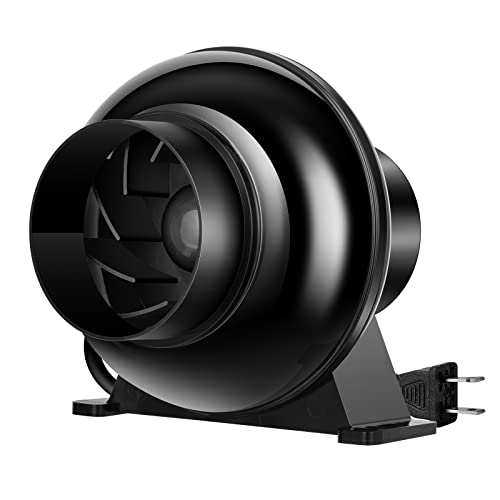
With a 195 CFM rating and a 30 dB operation level, the D4 is designed for balanced performance and noise suppression. It includes an ETL-listed motor with automatic reset and a flame-retardant junction box, adding a safety margin for various installations. Best for: grow tents and hydroponic setups where steady airflow and predictable noise are important. Caution: ensure the system’s ducting supports the 195 CFM without excessive backpressure.
mychiii 8-Inch Inline Duct Fan Overview

The 8-inch model delivers a powerful 720 CFM with a high static pressure of 813 Pa, designed for long duct runs, carbon filters, and tight hose routing. Its all-steel housing and powder-coated finish resist moisture and corrosion, supporting durable operation in demanding spaces. Best for: large grow rooms, greenhouses, or basements requiring strong extraction through multiple bends. Caution: high airflow may require more energy and generate more noise if not properly silenced or mounted with vibration isolation.
VIVOSUN 6-Inch Inline Duct Fan Overview

This 6-inch unit offers 240 CFM, combining solid airflow with a durable metal build and permanently lubricated bearings for low maintenance and quiet operation. Best for: mid-sized rooms, bathrooms, or kitchens needing consistent ventilation without rising energy costs. Caution: check that the duct diameter and length support stable performance without excessive back pressure.
Hurricane Commercial Grade Inline Fan Overview

Designed for commercial-grade use, this 6-inch inline fan delivers 435 CFM and is intended to pair with Phresh and Black Ops carbon filters, ideal-air ducting, and Titan controls for a cohesive system. Built with a steel housing and powder-coated finish for durability, it operates quietly while moving substantial air. Best for: larger installation spaces or professional ventilation systems. Caution: ensure compatibility with filters and controllers to avoid over- or under-ventilation in mixed-use environments.
Voltset 4-Inch Duct Fan Overview

This 4-inch inline fan delivers 280 CFM with a 2,200 RPM motor, balancing strong ventilation with relatively quiet operation at around 30 dB. Copper motor technology aids heat dissipation and durability. Best for: smaller grow tents, hydroponic setups, or workshop corners needing efficient exhaust without excessive noise. Caution: verify that duct length and elbows won’t reduce effective airflow below your target CFM.
VEVOR 8-Inch Inline Duct Fan Overview

VEVOR’s 8-inch model moves up to 750 CFM and features a quiet AC motor with noise output around 38 dB. It offers energy efficiency gains and strong airflow suitable for hydroponic tents, basements, or electronic rooms. Best for: large spaces needing robust ventilation with controlled noise. Caution: check power supply compatibility and ensure mounting hardware provides vibration isolation to maintain silent operation.
Buying Guide: Key Considerations for Inline Centrifugal Duct Fans
Airflow needs vary by space. Start by measuring the room size (length × width × height) and estimate the required CFM to achieve a comfortable air change rate. For most grow tents and small basements, 130–345 CFM in 4–6 inch models covers common scenarios. For larger rooms, 720–750 CFM in 8-inch models may be necessary. Consider static pressure if you have long duct runs, multiple turns, or carbon filters. Higher static pressure helps maintain airflow despite resistance.
Noise level matters for living or working spaces. Look for dB ratings and ensure the mounting plan includes vibration isolation and duct dampers. Motors with permanent lubrication reduce maintenance. Steel housings offer durability in humid environments, but ensure proper corrosion resistance for specific installations.
Energy efficiency affects ongoing costs. Models with EC (electronically commutated) motors typically provide better efficiency and longer service life than standard AC motors, especially in variable-speed configurations. If you need variable speed, verify a compatible controller or built-in speed control is available for the model.
Installation compatibility includes duct size, mounting space, and available power. Common duct diameters are 4, 6, and 8 inches. Check whether your fan includes a speed controller or if you need a separate controller. Safety features such as flame-retardant components and ETL listing add confidence in electrical installations.
Durability and maintenance should factor into long-term costs. Look for metal housings, sealed bearings, and parts designed for minimal maintenance. For humid environments, corrosion resistance is beneficial, especially in basements and kitchens.
Frequently Asked Questions
- What is the difference between a centrifugal inline fan and other inline fans? Centrifugal fans use a rotating impeller to move air with high static pressure, making them effective for long runs and filters. They typically perform better than axial fans when resistance in the ducting is high.
- How do I choose the right CFM for my space? Calculate the room volume in cubic feet and multiply by the desired air changes per hour (ACH). For grow tents, 20–60 ACH is common. Use the nearest higher CFM rating when in doubt to avoid under-ventilation.
- Is louder always better for ventilation? No. Higher noise often correlates with higher airflow, but many models offer quiet operation without sacrificing performance. Consider placement and vibration dampers to minimize sound.
- Do I need a speed controller? A speed controller helps tailor airflow to changing needs and can extend motor life by reducing wear. Some models include built-in controllers; others require an external unit.
- What maintenance is required? Most inline fans with sealed bearings require little maintenance beyond occasional cleaning and checking mounting hardware. Replace filters and inspect duct connections to prevent leaks.
- Can I install these in a bathroom or kitchen? Yes, provided the unit is rated for humidity and installed with appropriate dampers and safety measures. Stainless or coated housings may offer better corrosion resistance in steamy spaces.