Best Infrared Heaters for Chicken Coops in Winter
Find the right infrared heater for your chicken coop quickly and confidently. This guide highlights five top options designed to maintain healthy flock warmth across chick and adult growth stages. Each selection is evaluated for safety, temperature control, ease of use, and suitability for different coop sizes and layouts. Whether you need a compact panel, a durable heat lamp, or a versatile 2-in-1 heater, there’s a model that fits typical coop setups and budgets. The following table offers a quick snapshot to compare core features side-by-side.
| Product | Best For | Heating Style | Key Feature |
|---|---|---|---|
| Smart Chicken Coop Heater | Chicks and small flocks | Radiant heat panel | Smart temperature sensor with auto-adjust |
| 2026 Chicken Coop Heater | Coops with frequent outages | Radiant panel | Remote control and memory function |
| 400W Heat Lamp for 60 Chickens | Large coops or brooders | Carbon fiber bulb | High heat with fast warm-up, high efficiency |
| Smart Chicken Coop Heater (2-in-1) | All-in-one chicks to adults | Radiant panel | Adjustable temperature range and timer |
| HOPOCO 200W Coop Heater | Budget-friendly, small to medium coops | Radiant panel | Memory function and timer compatibility |
Smart Chicken Coop Heater: 200W Radiant Panel

Best for small chicks and growing flocks, this 200W radiant heat panel uses a built-in smart temperature sensor to adjust power in real time. It maintains a preset temperature, reducing frostbite risk while avoiding overheating. Suitable for flat, wall-mounted, or standing setups to fit various coop configurations. Caution: Ensure chicks stay within the recommended 70–95°F range for early growth stages.
2026 Chicken Coop Heater: 200W With Memory
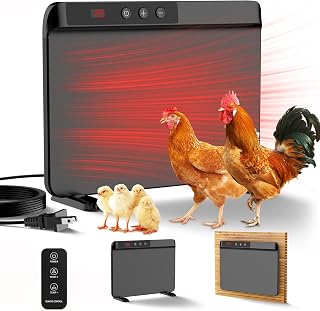
Best for coops prone to power interruptions, this model offers memory function and remote temperature adjustment. It stores prior settings and can be controlled via an LED display and remote control. The adjustable range (122–191°F) helps tailor warmth to both chicks and adults, reducing frostbite risk. Caution: Outlet timers or thermostatic plugs are not included and may require add-ons.
400W Heat Lamp for 60 Chickens

Best for larger coops or brooders that need high, fast warmth, this carbon fiber bulb heats quickly and covers a wide area with up to 5,000 cm². It delivers energy efficiency with a 90% heat conversion, and the dual power setting (200W/400W) supports different weather conditions. Caution: It uses a bulb-based heat source that may require careful placement to avoid overheating or direct contact with birds.
Smart Chicken Coop Heater (2-in-1)

Best for versatility, this 2-in-1 device serves as both a chick brooder and a coop heater. It features a 12-level temperature range (86–194°F) and a 12-hour timer. A built-in smart thermostat adjusts warmth automatically, while the remote control and peck-resistant cord support safe, hands-free operation. Choose this if you want one device to cover multiple life stages. Caution: The timer may require manual reset after outages.
HOPOCO 200W Coop Heater

Best for budget-minded buyers, this 200W model offers memory function and timer compatibility, making it suitable for small to medium coops. It supports outlet timers and thermostatic plugs for automatic operation after outages. Caution: Ensure the heater’s power range aligns with your coop’s electrical setup to avoid overloading circuits.
Buying Guide
What size coop needs infrared heating?
Coop size and ceiling height determine heat requirements. Smaller coops with tight layouts benefit from compact panels or low-wattage heaters, while larger coops may need higher wattage or multiple devices to distribute warmth evenly.
Which features matter most?
- Temperature control: Look for adjustable ranges and smart sensors that prevent overheating or frostbite.
- Power reliability: Memory functions and remote control can help manage heat after outages.
- Safety: UL certification, IP-rated enclosures, and shatterproof or ember-resistant components reduce risk.
- Installation flexibility: Mounting options (wall, ceiling, stand) improve heat distribution.
What are common limitations to watch for?
- Some heaters rely on external timers or plugs not included in the package.
- Bulbs or panels may require periodic replacements or replacements equivalent to the coop size and animal density.
- Warmth range must align with flock growth stages to avoid under- or overheating birds.
How to install safely?
Position heaters away from perches and nests to reduce burn risk, ensure proper clearance from bedding, and use guards or shields when needed. Always follow the manufacturer’s installation instructions and ensure electrical outlets are GFCI-protected in outdoor setups.
What about energy efficiency?
Carbon fiber or high-efficiency radiant panels can reduce energy use compared with traditional heat lamps. Choose devices with auto shutoff features and timers to avoid waste during mild spells or daytime escapes from cold zones.
FAQ
What temperature should a chicken coop be kept at?
Chicks prefer 70–95°F depending on age. Adult birds are comfortable around 90–190°F depending on how they use the space, but aim to maintain a consistent range appropriate for the flock’s life stage.
Are infrared heaters safe around chickens?
Yes when properly installed with appropriate guards and away from direct contact with birds. Use models with auto shutoff and UL certification as a baseline for safety.
Can I use multiple heaters in a single coop?
Yes, for large coops or multi-zone layouts. Distribute heat to avoid cold spots and monitor temperature in each zone to prevent overheating.
Do these heaters require professional installation?
Most installations are DIY, but ensure electrical wiring meets local codes and use a GFCI outlet for outdoor or damp areas. Follow manufacturer guidelines for mounting.
How do I choose between a heat lamp and a radiant panel?
Radiant panels provide uniform warmth with less risk of overheating, while heat lamps can deliver higher heat quickly for larger spaces. Choose based on coop size, bird density, and energy considerations.