Best Industrial Water Cooled Air Conditioners for Large Spaces and Tough Environments
Answering the demand for powerful, reliable cooling in industrial settings, this guide highlights top industrial water cooled air conditioners and related cooling equipment. It targets buyers seeking robust spot cooling, consistent performance in warehouses, factories, and garages, and equipment that can run with a steady water supply. The selections emphasize units best for permanent or temporary cooling, easy mobility, and clear maintenance needs. The buyer can expect options for high BTU outputs, large air volumes, and durable construction.
| Product | Best For | |
|---|---|---|
| Global Industrial Water-Cooled Portable Air Conditioner | Large enclosed spaces needing permanent or temporary cooling | Water-cooled design for steady spot cooling with mobility |
| BILT HARD 25,000 BTU Portable Air Conditioner | Industrial facilities and warehouses | High cooling capacity and mobility with 230V operation |
| BILT HARD 6,800 BTU Industrial Spot Cooler | Smaller industrial zones or retrofit spots | Compact, efficient with water tank and 115V power |
| Amarite Industrial Spot Air Conditioner – 6000 BTU | Garages, workshops, and outdoor indoor-use scenarios | Industrial-grade copper components with R32 refrigerant |
| Hessaire MC37M Evaporative Cooler | Wide-area cooling in dry climates | High airflow with evaporative cooling for large spaces |
Global Industrial Water-Cooled Portable Air Conditioner
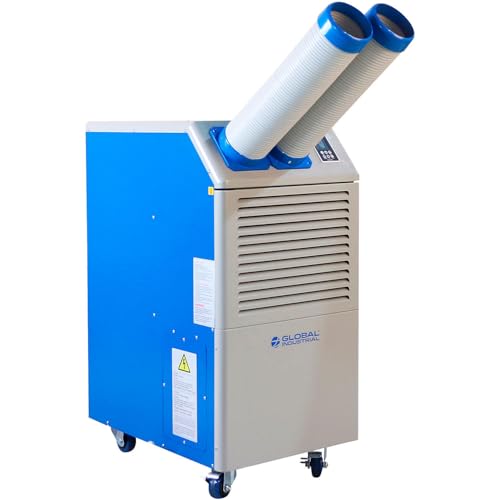
Overview: This unit is designed for enclosed areas with no vented exhaust and supports permanent or temporary spot cooling. It uses a water supply and a drain, offering steady cooling in spaces up to around 410 square feet. The durable metal housing and caster wheels enhance portability within industrial environments. Best for facilities that can maintain a constant water connection and require flexible cooling placement.
- Best for: Enclosed workspaces without venting options, maintenance shops, or utility rooms needing reliable spot cooling.
- Better for: Environments where a dedicated water supply and drain are readily available.
- Caution: Requires constant water source; consider plumbing accessibility and drainage planning.
BILT HARD 25,000 BTU Portable Air Conditioner

Overview: A high-capacity portable air conditioner built for heavy-use industrial settings. It delivers 25,000 BTU with 3-column cooling and 720 CFM, suitable for sizable workshops and warehouses. The unit includes mobility features and a condensate management system with a 4-gallon internal tank. Best for: facilities needing strong, scalable cooling with flexible transport around the site.
- Best for: Large spots where powerful, consistent cooling is required.
- Better for: Environments that can accommodate a 230V power supply and prefer R32 refrigerant.
- Caution: Heavier unit; ensure floor loading and transport routes accommodate its size.
BILT HARD 6,800 BTU Industrial Spot Cooler
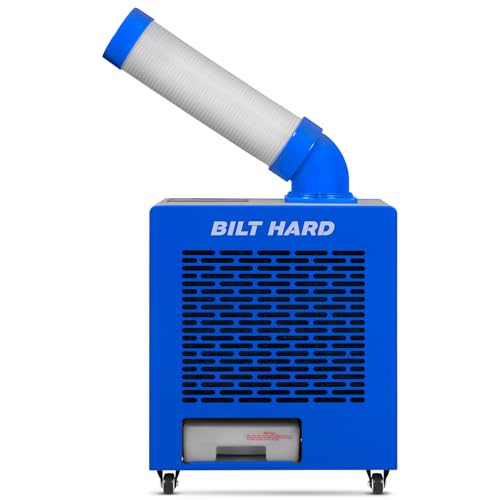
Overview: This 6,800 BTU unit provides robust spot cooling for smaller industrial zones. It features a fully enclosed rotary compressor and aluminum fan blades for efficient airflow. It operates on 115V power and uses R32 refrigerant, supporting reliable performance in warm environments. Best for: smaller bays or workstations where a compact, dependable cooling solution is needed.
- Best for: Smaller shops or intermediate-size spaces requiring portable cooling.
- Better for: Settings with 115V service and space constraints.
- Caution: Lower BTU than larger units; may require pairing for very hot or large spaces.
Amarite Industrial Spot Air Conditioner – 6000 BTU

Overview: Amarite targets industrial spot cooling with copper-wired compressors and R32 refrigerant. The unit emphasizes low noise and balanced airflow, suitable for garages and warehouses where quiet operation is appreciated during business hours. Best for: compact spaces where stable, efficient cooling is needed without excessive noise.
- Best for: Industrial garages or small warehouse bays requiring dependable, quieter operation.
- Better for: Environments valuing copper components for durability.
- Caution: BTU output is modest; may not meet extreme heat loads in very large spaces.
Hessaire MC37M Evaporative Cooler

Overview: The Hessaire evaporative cooler provides high-velocity air and moisture-driven cooling suitable for dry climates. It does not use refrigerants but relies on evaporation for cooling, making it a different category from water-cooled air conditioners. Best for: large outdoor or semi-outdoor spaces where evaporative cooling is practical and economical.
- Best for: Large, dry environments where humidity can be leveraged for cooling.
- Better for: Open workshops, garages, and outdoor areas needing rapid air movement.
- Caution: Cooling effectiveness drops in high humidity; heavier humidification may be less effective.
Buying Guide: Industrial Water Cooled And Related Cooling Options
What’s the difference between water-cooled and evaporative cooling in industrial settings? Water-cooled units circulate water to carry away heat, typically offering stable cooling in enclosed spaces when a water supply and drainage are available. Evaporative coolers use outside air to evaporate water, providing high-volume airflow and relying on dry climate conditions to maximize effectiveness. Consider space size, humidity, electrical service availability, and maintenance needs when choosing a solution.
- Cooling capacity: BTU and CFM numbers indicate how much heat a unit can remove and how much air it moves. Larger spaces usually require higher BTU ratings and airflow.
- Power requirements: Industrial spaces may need 230V or specialized electrical circuits. Ensure compatibility with site power.
- Water management: Water-cooled units require a reliable water source and drainage; plan for plumbing and potential water treatment.
- Mobility: Wheel configurations and mounting options affect how easily you can position cooling units across large facilities.
- Maintenance: Look for ease of condensate handling, filter access, and refrigerant type (R32 is common for lower environmental impact).
Frequently Asked Questions
- What is the advantage of water-cooled cooling in an industrial space?
Water-cooled systems typically deliver more stable cooling with higher efficiency in enclosed spaces and can handle larger loads when a constant water source is available. - Can evaporative coolers be used indoors?
Evaporative coolers are best in dry, open or semi-open environments. They require ventilation and are less effective in high humidity. - Which cooling option is best for garages and workshops?
A compact industrial spot cooler or evaporative cooler can be ideal depending on space, climate, and noise constraints. - Do these units require professional installation?
Water-cooled units may need plumbing connections; portable units with standard electrical plugs typically require minimal setup. - Are R32 refrigerants common in these devices?
Yes, several models use R32 for lower environmental impact and efficient cooling. - What should I consider for maintenance and drain management?
Check condensate drainage, water tank access, filter cleaning, and regular checks on water quality to prevent mineral buildup.