Best High Efficiency Propane Heaters for Instant Hot Water
Answer: These high efficiency propane tankless water heaters deliver hot water on demand with less energy waste, making them ideal for homes that want reliable supply and lower operating costs. The top picks here are best for whole-house use, compact indoor or outdoor installations, and quick hot water recovery. This guide targets homeowners seeking energy savings, space efficiency, and flexible installation options.
Buyer profile overview:
– Best for outdoor installers who want a compact unit with robust flow.
– Best for indoor spaces that require a compact, high-efficiency unit with smart control options.
– Better for homes needing multiple simultaneous fixtures without high energy waste.
– Choose this if you prioritize WiFi or app-based control for convenience.
– Avoid this if your space requires a non-condensing unit in a tight budget scenario.
Summary table of chosen products
- APUS 190,000 BTU Outdoor Tankless Water Heater — 8.1 GPM — Best for outdoor, high-demand homes
- Rheem Liquid Propane Condensing Tankless — Up to 6.8 GPM — Best compact indoor option
- Rinnai RX199iN Condensing Smart Sense — Up to 11.1 GPM — Best overall multi-fixture performance
- Rinnai RX160iN Condensing Smart Sense — Up to 9 GPM — Best for mid-size homes
- Rheem RTG-84XLP-3 High Efficiency Non-Condensing Outdoor — Up to 8.4 GPM — Best outdoor non-condensing option
APUS 190,000 BTU Outdoor Tankless Water Heater

The APUS unit delivers 190,000 BTU with 8.1 GPM, designed for whole-house use with multiple outlets. It supports 3 showers plus 2 faucets simultaneously and remains reliable at low flow thanks to a minimum of 0.79 GPM. This outdoor model is best for homes that need strong performance in an outdoor installation and straightforward 120V power hookup. It suits larger households or homes with higher hot water demand.
Best for: outdoor installations with concurrent hot water needs. Rationale: high BTU input and robust GPM make it a strong match for busy households. Caution: ensure adequate venting and weatherproof mounting for outdoor use.
Rheem Liquid Propane Condensing Tankless Indoor Unit
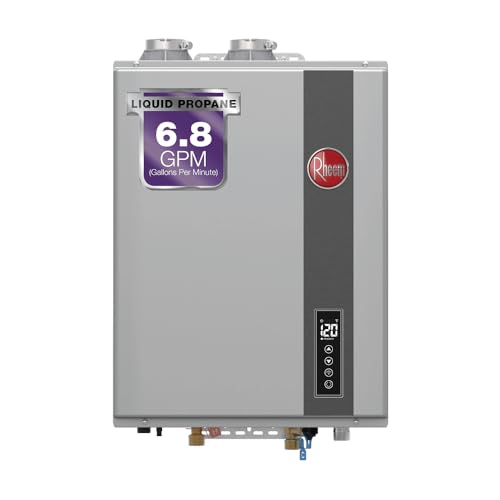
This indoor condensing model provides up to 6.8 GPM and 120,000 BTUs, with a compact footprint suitable for tight spaces. Its condensing design helps extract more heat and increase efficiency, while the unit’s straightforward installation supports a clean interior layout. It’s a practical choice for mid-sized homes needing reliable hot water without occupying a large footprint.
Best for: compact indoor installs with moderate hot water needs. Rationale: condensing efficiency helps lower energy use in typical homes. Caution: performance may vary with very high simultaneous demand; consider a larger option if you expect multiple showers at once.
Rinnai RX199iN Condensing Smart Sense

This condensing model runs on propane or natural gas and can deliver up to 11.1 GPM, making it suitable for larger homes or households with high simultaneous hot water needs. It includes a Versa Vent and a Smart Sense gas control system for flexible installation, plus a Quick Flush feature. It is designed to maximize energy efficiency with a high UEF rating. Controlr module enables WiFi control if purchased separately.
Best for: large homes or high-demand scenarios. Rationale: high GPM and dual-fuel capability provide strong performance. Caution: outdoor installations require the RX-OVC vent cap and compatible controls for full functionality.
Rinnai RX160iN Condensing Smart Sense

The RX160iN offers up to 9 GPM and 160,000 BTUs, with indoor or outdoor install options and Smart Sense gas control. It emphasizes energy efficiency, quick flush, and a compact footprint suitable for moderate homes. The model supports WiFi control options via Controlr module (not included) and provides a reliable balance between capacity and space requirements.
Best for: mid-sized homes needing solid performance with flexible placement. Rationale: good balance of GPM and BTU for many households. Caution: ensure compatibility with your existing venting and electrical provisions for the installation site.
Rinnai RE180iP Non-Condensing Propane Tankless

This indoor non-condensing unit delivers up to 8.5 GPM with 180,000 BTUs, positioned as a practical option for spaces where condensing hardware is not required. It features a clean internal layout for easier service and a WiFi control capability through a separate module. It supports multiple fixtures with dependable flow for typical households.
Best for: homes seeking strong performance with a straightforward indoor install. Rationale: higher GPM supports several outlets. Caution: non-condensing design may be less efficient in some scenarios; consider condensing models for ongoing efficiency gains.
Rheem RTG-84XLP-3 Outdoor Tankless

Rheem’s outdoor propane unit provides up to 8.4 GPM and 180,000 BTUs. It is designed for outdoor installation, featuring a rugged metal cabinet and ease of wall mounting by a qualified installer. This option targets homes that prefer outdoor placement for space savings while maintaining strong hot water performance for multiple fixtures.
Best for: outdoor installations requiring reliable performance in a weather-ready enclosure. Rationale: the robust BTU and GPM support multiple outlets outside. Caution: outdoor units require weatherproof venting and protection from the elements.
Buying Guide
- What size is right for you? Consider GPM needs and peak simultaneous usage. Larger homes may benefit from higher GPM ratings (7–11+ GPM) and condensing technology for efficiency.
- Condensing vs non-condensing: Condensing units reclaim heat from exhaust to improve efficiency; non-condensing units can be simpler and lower upfront cost but may use more energy over time.
- Installation location: Indoor units save outdoor exposure but may require venting and space planning; outdoor units require weatherproofing and appropriate clearances.
- Fuel flexibility: Some models operate on propane or natural gas; choose a model compatible with your existing fuel supply and venting requirements.
- Control options: Look for WiFi or app compatibility, and whether a separate control module is needed for remote operation.
- Maintenance considerations: Quick Flush, cleaning features, and service access influence long-term ease of upkeep and reliability.
- Space and mounting: Ensure there is enough clearance for service and venting, plus wall mounting considerations for outdoor units.
Frequently Asked Questions
- Do all propane tankless heaters require venting? Yes, most require venting to exhaust combustion byproducts, with outdoor units needing proper venting provisions too.
- What does GPM stand for and why is it important? GPM stands for gallons per minute; it measures how much hot water the unit can deliver at once, affecting how many fixtures can run concurrently.
- What is the advantage of condensing models? Condensing units are typically more energy efficient by reclaiming heat from exhaust, lowering operating costs over time.
- Can these units be used indoors and outdoors? Several models offer indoor or outdoor installation via Versa Vent or similar configurations; check the specific model requirements.
- Is WiFi control worth it? It can add convenience for temperature scheduling and monitoring, but a separate control module may be required.
- What maintenance steps are recommended? Regular flushing, inspecting venting, and following manufacturer service reminders help maintain efficiency.