Best Gas Wall Unit Heaters for Safe, Efficient Home Heating
Gas wall unit heaters provide targeted heat for spaces like garages, workshops, and sunrooms. This guide highlights five top options, suitable for different spaces, budgets, and fuel preferences. Whether you need a compact radiant model or a high-capacity forced-air system, these picks help you compare performance, safety features, and installation considerations.
Summary table of chosen products:
| Product | Type | BTU | Best For |
|---|---|---|---|
| Mr. Heater 30,000 BTU Vent Free Blue Flame | Vent-free radiant | 30,000 | Medium spaces, budget-friendly upgrades |
| JEWUNO 30,000 BTU Dual Fuel Wall Heater | Vent-free dual fuel | 30,000 | Gas or propane, versatile heat |
| Comfort Glow 17,000 BTU Direct Vent Wall Heater | Direct vent | 17,000 | Smaller rooms, efficient vented heat |
| Mr. Heater 50,000 BTU Forced-Air Unit Heater | Forced-air | 50,000 | Large spaces, high heat demand |
| Mr. Heater 20,000 BTU Vent Free Radiant | Vent-free radiant | 20,000 | Compact, affordable radiant option |
Mr. Heater 30,000 BTU Vent Free Blue Flame Natural Gas Heater

Best for: Medium-sized spaces where vent-free installation is preferred. This heater emits 30,000 BTU/hr and can warm up to about 1,000 square feet, depending on insulation and climate. It uses a battery-operated electronic ignition, with the battery included for quick setup. Best for budget-conscious buyers seeking reliable, steady heat without venting.
- Vent-free operation means no exhaust vent is required.
- Electronic ignition simplifies startup, even in colder months.
- Ideal for attached garages, basements, and living spaces with proper clearance.
Caution: Ensure installation complies with local codes and maintain adequate clearances from combustibles.
30,000 BTU Natural Gas/Propane Wall Heater for Indoor Use – Dual Fuel
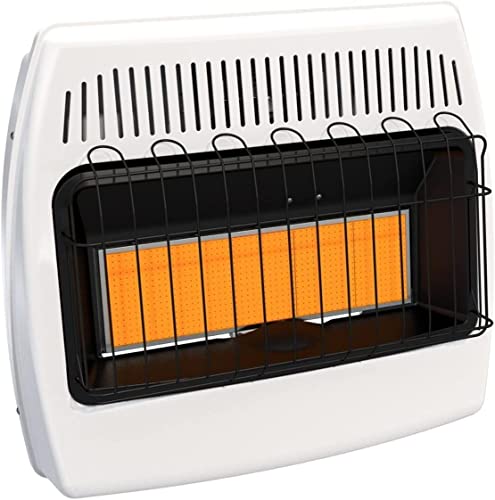
Best for: Homes needing flexibility with fuel source. This dual-fuel model delivers 30,000 BTU and heats up to 1,000 square feet. It features infrared heat, electronic spark ignition, and thermostatic control, plus an oxygen depletion sensor and automatic safety shut-off. CSA certified for trusted safety standards.
- Supports propane or natural gas, depending on fuel availability.
- Thermostatic control helps maintain consistent comfort.
- Automatic safety shut-off reduces risk in case of pilot issues.
Limitation: Dual-fuel operation requires correct fuel type installation and gas line setup; verify compatibility with your home’s gas supply.
Comfort Glow 17,000 BTU Direct Vent Natural Gas Wall Heater

Best for: Small to mid-sized rooms where vented, sealed combustion is preferred. This 17,000 BTU heater heats up to 500 square feet efficiently. It uses a sealed burn system with electronic ignition and a built-in pressure regulator to shut flow if the pilot extinguishes. Mounts on walls to save floor space.
- Direct vent design vents exhaust outdoors while pulling in fresh air for combustion.
- Thermostatic heat control aims for steady room temperatures.
- Compact dimensions support unobtrusive installation in tight spaces.
Caution: Smaller room size means lower heat output; appropriate sizing is important for comfort.
Mr. Heater 50,000 BTU Forced-Air Unit Heater

Best for: Large spaces requiring rapid, high-capacity heating. This ceiling-mounted unit delivers 50,000 BTUs and can heat up to about 1,667 square feet—roughly a three-car garage. It’s compatible with standard 24-volt thermostats (sold separately) for modern control. Ideal for spaces where airflow and speed of heat matter.
- Forced-air design moves warm air quickly through the space.
- High BTU output suits larger areas with higher heat demand.
- Compatibility with newer thermostats enables remote or programmable control.
Caution: Larger BTU models may require professional installation and proper venting considerations for safe operation.
Mr. Heater 20,000 BTU Vent Free Radiant Natural Gas Heater

Best for: Budget-conscious buyers seeking compact vent-free warmth. This 20,000 BTU radiant heater heats up to 700 square feet. It provides straightforward, quick heat without a vent but requires careful placement and clearance from combustibles. Suitable for attached spaces where modest areas require warmth.
- Vent-free design enables easy installation in appropriate spaces.
- Electronic ignition improves startup reliability in varying conditions.
- Compact footprint fits tight walls or utility rooms.
Limitation: Vent-free units can impact indoor air quality if used in poorly insulated areas; ensure adequate ventilation and follow local guidelines.
Buying Guide
What size and type should you choose?
- Space size and insulation: For larger areas, opt for higher BTU units (50,000 BTU class) or multiple smaller heaters. For smaller rooms, 17,000–30,000 BTU options are typically sufficient.
- Vent-free vs direct vent: Vent-free models are easier to install but require good indoor air quality management. Direct vent models pull in outside air and vent exhaust outdoors, supporting safer combustion in enclosed spaces.
- Fuel flexibility: Dual-fuel units offer versatility if you switch between natural gas and propane. Confirm gas line compatibility and regulator requirements before purchase.
- Installation considerations: Ceiling-mounted vs wall-mounted units need appropriate clearances, mounting hardware, and wiring. Some units support thermostat integration for precise control.
- Safety features: Look for oxygen depletion sensors, automatic shut-off, sealed burn systems, and sturdy ignition systems to minimize risk and improve reliability.
FAQs
- Are gas wall heaters safe to use indoors? Yes, when installed and vented correctly according to manufacturer instructions and local codes. Vent-free models must be installed with proper clearances and, if necessary, with ventilation in the room to maintain air quality.
- Do I need a professional to install a gas wall heater? Some models are designed for DIY installation in line with local codes, but many installations—especially venting, gas supply, and thermostat integration—benefit from licensed professional help.
- What space size is appropriate for a 30,000 BTU heater? Roughly 1,000 square feet in typical conditions, but actual performance depends on insulation, climate, and ceiling height.
- Can I use a dual-fuel heater if I only have natural gas? Dual-fuel units can be configured for natural gas; check the installation instructions to ensure proper fuel type and regulator setup.
- What safety features should I look for? Oxygen depletion sensors, automatic shut-off, sealed burn systems, and reliable ignition are key to safe operation and easy maintenance.
- Is venting necessary for all gas wall heaters? No; vented direct vent models require external venting, while vent-free models do not vent to the outside but need adequate indoor air flow and clearance.