Best Exterior-Style Air Conditioners for Home Comfort and Energy Efficiency
Answering the common buyer question: what outdoor-friendly or window-style cooling options deliver reliable performance for exterior-facing spaces? This guide highlights five well-suited options, focusing on compact rooms, large living areas, and multi-room setups. Each product is best for a specific scenario—whether you need a small window unit for a bedroom, a high-capacity portable for an open-plan living area, or a heat-capable model for seasonal use. The summary table below helps you compare core strengths at a glance.
| Product | Best For | BTU / Capacity | Key Advantage |
|---|---|---|---|
| GE Window Air Conditioner 5,000 BTU | Small rooms | 5,000 BTU | Quiet mechanical controls; simple install |
| Garvee 3-in-1 Portable Air Conditioner, 8,000 BTU | Mid-size rooms | 8,000 BTU | Dehumidifier and fan modes; easy setup |
| Midea Inverter Window AC With Heat, 12,000 BTU | Large rooms with heat | 12,000 BTU | Heat optional; energy-saving inverter |
| AGTANA 14,000 BTU Portable AC | Large living spaces | 14,000 BTU | Self-evaporating; auto-swing air distribution |
| QZMDSM 16,000 BTU Portable Smart AC | Very large rooms / smart control | 16,000 BTU | WiFi app control; sleep mode |
GE Window Air Conditioner 5,000 BTU AC Unit

Best for small rooms, this GE unit cools up to 150 sq ft with 5,000 BTU. It uses simple mechanical controls with two cooling modes and two fan speeds, delivering a reliable, distraction-free experience for bedrooms, home offices, or dorms. The compact 16.4″ W x 13.4″ D x 12.6″ H footprint fits tight spaces and offers auto restart after power outages. Choose this if you want a straightforward installation and predictable performance without smart features.
Best for: small bedrooms, studios, or compact offices. Why selected: reliable cooling for limited spaces and quiet operation. Caution: no Wi-Fi or digital controls; adjustments require manual dials.
Garvee 3-in-1 Portable Air Conditioner, 8,000 BTU

Best for mid-sized rooms up to 350 sq ft, this Garvee unit combines cooling, dehumidification, and fan modes. Its 8,000 BTU capacity provides versatile year-round comfort, with a sleep-friendly design and a 24-hour timer. The included window kit and exhaust hose simplify setup. Choose this if you want a portable option that handles humidity and cooling in one package. Caution: window kit may require trimming for narrower windows.
Midea Inverter Window AC With Heat – 12,000 BTU

Best for large rooms up to 550 sq ft and seasonal use, this Midea unit provides cooling and heat with an inverter system for energy savings. It includes digital controls, a remote, and smart capabilities via app and voice assistants. It’s suitable for spaces that require both cooling in summer and supplemental heat in shoulder seasons. Caution: heat function may not operate below 41°F outside temperatures.
AGTANA 14,000 BTU Portable Air Conditioner
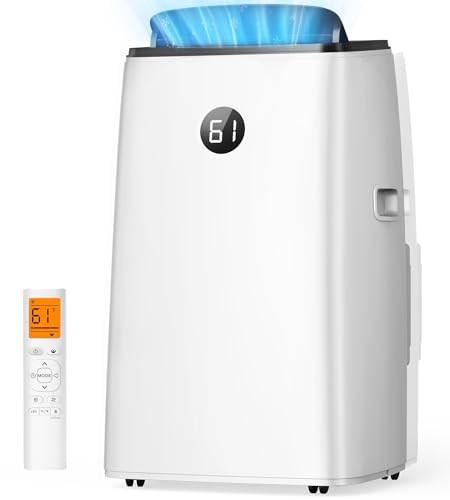
Best for very large rooms up to 700 sq ft, this portable AC offers 14,000 BTU capacity with auto-swing airflow and a self-evaporating system. It provides a quiet operation mode around 48dB in Sleep Mode and a 24-hour timer for scheduling. Consider this model if you need rapid cooling across an open space. Limitation: high BTU units may require more venting and window kit space.
QZMDSM Portable Smart AC, 16,000 BTU

Best for very large spaces or home offices that require smart control, this 16,000 BTU portable unit cools up to 750 sq ft. It supports WiFi app management, remote control, and multiple modes, including a sleep setting. Choose this when you want app-based climate control across a larger area. Caution: higher energy use potential; ensure proper venting and window sizing for maximum efficiency.
Buying Guide: Exterior-Style And Portable AC Purchasing Considerations
- Room size and BTU capacity: Match BTU to the space. Underpowered units will struggle in hot days; oversized units may cycle frequently and waste energy.
- Installation and portability: Window units are typically easier to install with minimal setup. Portable units offer flexibility but need venting through a window.
- Controls and smart features: Basic mechanical controls offer reliability; inverter and smart features provide energy efficiency and remote control convenience.
- Energy efficiency: Look for Energy Star ratings or CEER values for portable units to estimate long-term operating costs.
- Heat functionality: If you need heating in shoulder seasons, consider a unit with a built-in heat option and understand temperature limitations for heat.
- Dehumidification: In humid climates, dehumidifier modes can improve comfort even when cooling capacity is moderate.
- Maintenance: Check filter accessibility and ease of cleaning. Self-evaporation can reduce drainage tasks in portable models.
FAQ
- What size of portable AC is best for a 350 sq ft room?
A portable unit around 8,000 BTU is typically suitable for spaces up to 350 sq ft, depending on insulation and sun exposure. - Do I need window kits for portable air conditioners?
Yes, most portable units require a vent through a window or venting kit to exhaust hot air outside. - Is inverter cooling worth it for a window AC?
Inverter systems can save energy and provide steadier temperature control, especially in larger spaces or multi-room setups. - Can a heat-capable AC operate in very cold outdoor temperatures?
Some units have temperature limits for heat function; check the listed operating temperature range for accurate usage. - How important is noise level when choosing a unit?
Quieter models improve comfort in bedrooms and offices; look for dB ratings and Sleep modes for low-noise operation. - Are 16,000 BTU units suitable for 700 sq ft rooms?
For very large or sun-exposed spaces, a 16,000 BTU unit can be appropriate, but assessment of insulation and airflow is still essential.