Best Commercial-Grade Dehumidifiers for Basements
If you’re dealing with persistent basement moisture, a commercial-grade dehumidifier can protect your space from mold, musty odors, and structural water damage. This guide highlights five top options suited for large basements, crawl spaces, and other expansive areas. Each product section explains who it’s best for, why it’s a strong pick, and any practical limitations to consider before purchase.
Buyer-friendly snapshot: below is a quick reference to the five highlighted units. The table focuses on capacity, typical spaces, special features, and ideal use scenarios to help you compare at a glance.
| Product | |||
|---|---|---|---|
| Airecoler GT-X5 125 Pints | 125 (Max) / 60 AHAM | Large basements and crawlspaces | R32 refrigerant Auto defrost |
| Waykar 150 Pints | 150 | Very large spaces up to 7,000 sq ft | Energy Star; built-in pump option |
| Airzentti 155 Pints | 155 (Max) / 70 AHAM | Industrial or warehouse spaces | Built-in pump; auto defrost |
| Moiswell 155 Pint | 155 (Max) / 70 AHAM | Crawl spaces and basements up to 6,000 sq ft | Auto restart; timer are user-friendly |
| Yaufey 155 Pints | 155 | Very large basements up to 8,000 sq ft | Pump drainage; automatic humidity control |
Airecoler 125 Pints Commercial Dehumidifier
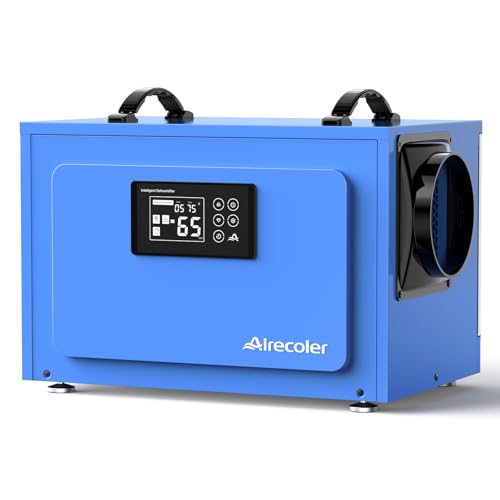
Best for large, damp spaces like crawl spaces and basements that require robust moisture removal. This unit can extract up to 125 pints daily, with AHAM-rated 60 pints, making it suitable for expansive areas such as commercial garages or industrial spaces. It uses an energy-efficient R32 system and includes a 24-hour auto ON/OFF timer to save on energy costs. Best for buyers prioritizing a compact footprint with flexible placement options. Caution: check clearance for installation and ensure adequate drainage compatibility with your setup.
Waykar 150 Pints Dehumidifier With Pump

Best for very large rooms or basements up to 7,000 sq ft and spaces requiring pump drainage. This model delivers up to 150 pints per day and is Energy Star certified for efficiency. It supports auto defrost and self-drying, reducing maintenance. Choose this if you need pump drainage for unattended spaces. Limitation: pump installation height and line routing must fit your space’s layout, and regular pump maintenance is advised.
Airzentti 155 Pints Commercial Dehumidifier

Best for industrial-scale spaces up to about 7,500 sq ft, with high airflow (220 CFM) and a built-in water pump. This unit is well-suited for environments where continuous drainage is needed. It features a digital control panel with humidity setting, timer, and gravity drain. Caution: ensure space allows for the 8.2 ft power cord and make sure the drain line is secure to prevent leaks.
Moiswell 155 Pint Commercial Dehumidifier
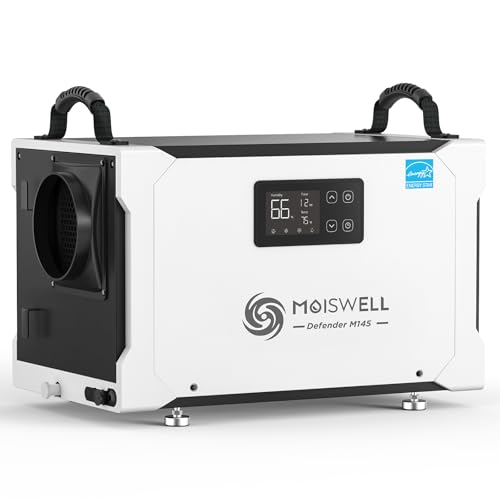
Best for crawl spaces and basements up to 6,000 sq ft with a compact horizontal design. It delivers up to 155 pints per day and includes auto defrost, memory starting, and a 24-hour timer for uninterrupted operation. Choose this if you need a space-efficient unit with easy maintenance and reliable auto-start after outages. Limitation: performance may vary in high-temperature, high-humidity environments; plan for stable basement temperatures.
Yaufey 155 Pints Commercial Dehumidifier
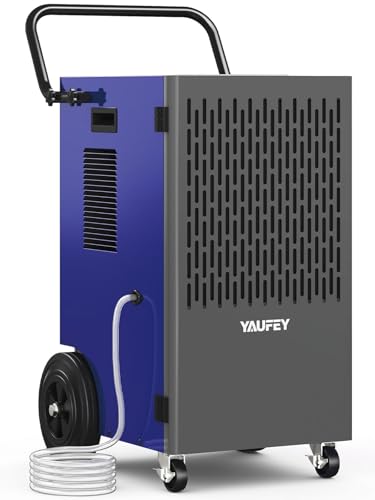
Best for large basements up to 8,000 sq ft, with a built-in condensate pump and option for gravity drainage. It provides automatic humidity control and pumps out water up to a 16.4 ft lift, making it ideal for unattended spaces. Caution: ensure the pump is primed and the drain hose is correctly routed to a suitable drain to avoid overflows.
Buying Guide: Key Purchase Considerations
- Basement size and humidity level: Larger spaces typically demand higher pint-per-day ratings and sometimes a built-in pump for unattended drainage.
- Drainage method: Choose between gravity drainage, built-in pump, or external drain hose based on how accessible your drainage point is.
- Energy efficiency: Look for Energy Star certification and features like auto defrost to minimize operating costs over time.
- Installation space: Check clearance, height, and weight; some units are designed for low-clearance crawlspaces or ceiling-mounted installations.
- Maintenance needs: Removable filters and easy-to-clean coils help with long-term performance; consider units with memory starting and auto restart for reliability after outages.
- Climate considerations: In hotter basements, auto defrost helps maintain efficiency; in cooler spaces, ensure the unit operates effectively within low-temperature ranges.
Frequently Asked Questions
- Q: What capacity do I need for a basement of about 2,000 square feet?
A: A unit in the 100–155 pint-per-day range is typically appropriate, depending on humidity levels and climate. - Q: Do I need a pump or can I use gravity drainage only?
A: If the space lacks a nearby floor drain, a pump helps drain water to a suitable location. Gravity drainage works when a drain is below the unit’s outlet. - Q: Is Energy Star certification important for a basement dehumidifier?
A: Yes, it indicates higher efficiency and potential energy savings, especially for continuous operation. - Q: Can these units operate in cold basements?
A: Many models include auto defrost and low-temperature operation features; verify the minimum operating temperature for each model. - Q: Do these dehumidifiers remove odors caused by humidity?
A: While primarily designed to remove moisture, many units reduce musty odors indirectly by lowering humidity and preventing mold growth.