Best Barn Fans for Horses: Powerful, Durable Airflow for Stables
Answering the top question for barn owners: choose high-velocity, durable fans that move substantial air while resisting dust and moisture. The best options below are ideal for barns, stalls, and other horse spaces where steady airflow helps comfort, ventilation, and odor control. Each pick is suitable for different barn layouts, from wall-mounted setups to floor-to-wall conversions, and is chosen for reliability, maintenance ease, and effective cooling. Use the product table to compare key specs at a glance.
| Product | Airflow (CFM) | Mount Type | Best For |
|---|---|---|---|
| BILT HARD 18″ Industrial Wall Fan | 2600–4300 | Wall Mount | Smaller stalls, limited floor space |
| BILT HARD 20″ Industrial Wall Mount Fan (4600 CFM) | 3000–4600 | Wall Mount | Mid-to-large barns, general airflow boost |
| hykolity 20″ Industrial Wall Mount Fan (4600 CFM) | 3000–4600 | Wall Mount | Heavy-use barns, workshops |
| iLiving 20″ Heavy Duty Floor & Wall Mount Fan | 5750 | Floor or Wall Mount | Large stalls, flexible placement |
| VENTISOL 20″ Waterproof Wall Mount Fan (4650 CFM) | 4650 | Wall Mount | Humid/barn environments requiring water resistance |
BILT HARD 18 Inch Industrial Wall Fan

Best for: smaller barns or stalls with limited floor space. This 18″ wall-mounted unit features three speeds (4300, 3400, 2600 CFM) and a 2 ft pull chain for easy adjustments. The heavy-duty, powder-coated steel construction resists barn dust and debris, while aluminum blades keep airflow efficient. The 180° tilting head directs air where you need it, making it suitable for stalls and tight corners. Limitation: not rated for outdoor use, so place away from weather exposure to extend life.
BILT HARD 4600 CFM 20″ Industrial Wall Mount Fan

Best for: mid-to-large barns needing robust air movement. This 20″ wall fan delivers up to 4600 CFM with three speeds and a 180° tilting mechanism to target air precisely. It has a fully enclosed ball-bearing motor, powder-coated steel housing, aluminum blades, OSHA-compliant grilles, and a 6 ft grounded power cord. Caution: not outdoor-rated; protect from direct weather to maximize lifespan. Use for overhead circulation or high-ceiling barns where wall mounting frees floor space.
hykolity 20″ Industrial Wall Mount Fan (2 Pack)

Best for: larger barns or multiple stalls requiring consistent airflow. The 20″ unit offers up to 4600 CFM with three speeds and a 180° tilt. It uses a fully enclosed ball-bearing motor and a powder-coated steel shell with aluminum blades, designed to withstand workshop dust. Best for dedicated barn spaces or shop areas. Limitation: not suitable for outdoor use; position away from rain and humidity to protect motor and electrical components.
iLiving 20 Inch Floor & Wall Mount Fan

Best for: large stalls or flexible layouts where move-and-position airflow matters. This fan delivers up to 5750 CFM with three speeds and a 360° tilt head. It can be freestanding for a floor setup or wall-mounted with the included hardware, enabling quick reconfiguration as horses or stalls change. The design includes a handle on the grill for easy transport. Limitation: high airflow may be louder in small spaces; consider placement to avoid direct吹ing into horses’ faces.
VENTISOL 20″ Waterproof Wall Mount Fan
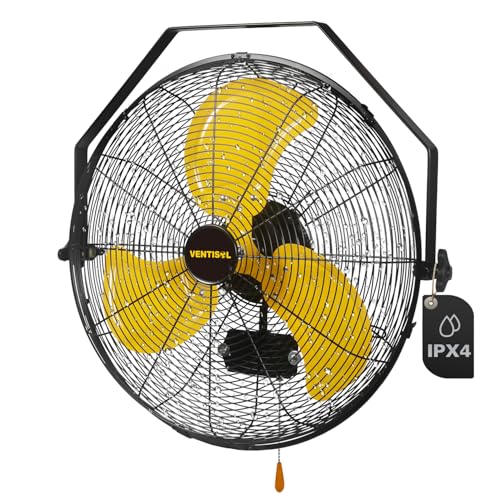
Best for: barns with higher humidity or exposure to rain, thanks to an IPX4 waterproof dual ball bearing motor. It provides 4650 CFM across three speeds and offers 180° vertical tilting for directional airflow. The design is suited for humid environments like milking barns or washed-down stalls. Caution: ensure proper indoor use; not designed for continuous outdoor weather exposure; protect motor from direct water spray to preserve longevity.
Buying Guide
How do I choose the right barn fan?
Consider space, airflow needs, and mounting options. Wall-mounted fans save floor space in narrow barns, while floor-and-wall hybrids offer flexibility for changing layouts. Measure stall width and ceiling height to pick an appropriate diameter and CFM range. Higher CFM is better for hot days and large barns, but may be louder—balance airflow with noise tolerance and horse comfort.
What about weather and durability?
Look for powder-coated steel housings and aluminum blades for durability in dusty barns. If exposure to rain or humidity is possible, prioritize models with waterproof or weather-resistant builds. Ensure units have enclosed motor designs to protect bearings from dust.
Maintenance and safety considerations
Choose fans with accessible grills and simple filter-free designs for easy cleaning. A grounded three-prong power cord reduces shock risk. Always mount fans securely to walls or sturdy brackets and keep cords clear of horse pathways. If you operate multiple units, staggered placement helps distribute airflow evenly across stalls.
Installation tips
Install at stall height or slightly above to avoid direct airflow into horses’ faces. For floor models, use stable bases or brackets to prevent tipping. When mounting, leave space for cord routing and motor heat dissipation. Test airflow by walking the barn and noting stalls with stagnant air before finalizing placement.
Special considerations for horse comfort
Consistent airflow reduces humidity and ammonia buildup, supporting stall hygiene. Avoid creating drafts directly on horses, especially young or sensitive animals. Use a mix of lower and higher CFM units if you have a long barn to ensure even ventilation throughout the space.
FAQ
Q: How many fans do I need for a standard barn? A: The number depends on barn size, stall count, and ceiling height. Start with one high-CFM unit and add more if some stalls remain hotter or damper than others.
Q: Are these fans safe to use around horses? A: Yes, provided they are properly mounted, maintained, and do not blow directly into horse faces. Use models with sturdy grills and enclosed motors.
Q: Can I use a floor fan in a stall? A: Floor fans can work in larger spaces or as a movable option, but wall-mounts save floor space and reduce the chance of tipping.
Q: Do these fans help with dust? A: Fans improve air movement and reduce stagnant air, which can help with dust dispersion but do not remove dust by themselves. Regular cleaning of stalls remains important.