Best Air Filters for Industrial Use: Top 5 Purifiers and What to Choose
Answering the question “which air filters work best in industrial settings?” this guide highlights five top options designed for large spaces, construction sites, restoration projects, and other demanding environments. Each model is evaluated for suitability, filtration depth, and practical limitations. Ideal buyers include contractors, facility managers, restoration specialists, and industrial space operators seeking robust, stackable air scrubbers with 550–750 CFM capabilities. The table below compares core specs to streamline your initial assessment.
| Product | Best For | ||
|---|---|---|---|
| VEVOR Air Scrubber 550 CFM | General industrial cleanup and restoration | 3-stage (MERV-10 pre-filter, carbon, HEPA H13) | 550 CFM |
| CADPXS Shield-550 | Construction sites and water/fire restoration | 3-stage with carbon; HEPA | 550 CFM |
| ALORAIR 3-Stage Scrubber | Heavy-duty industrial and commercial spaces | 3-stage; MERV-10, HEPA, carbon | Up to 550 CFM (stackable) |
| Abestorm 4-Stage UV-C Scrubber | Odor control and remediation projects | 4-stage; MERV-10, HEPA, carbon, UV-C | 550–750 CFM |
| Air Scrubber 600 CFM (Zynovate) | Large spaces requiring robust airflow | 4-stage; MERV-10, carbon, HEPA | 600 CFM |
VEVOR Air Scrubber 550 CFM

Best for mid-size industrial cleanups and restoration work where reliable 3-stage filtration is needed. The unit uses a pre-filter (MERV-10), carbon filter, and H13 HEPA to capture 99.97% of particles down to 0.3 microns. With a 550 CFM maximum airflow and a 5,500 cubic feet filtration area, it suits warehouse break rooms, workshop bays, and job sites requiring quick IAQ improvements. The copper motor design supports longer life and stable operation. A user-friendly control panel enables adjustable airflow, a resettable timer, and an overheat circuit breaker. A filter-change indicator helps maintenance planning.
Best for: general industrial cleanup and restoration teams needing solid, all-around filtration in a stackable form factor.
Limitations: 550 CFM may be insufficient for very large open spaces or multi-room restorations without daisy-chaining multiple units.
CADPXS Shield-550 Air Scrubber

Designed for commercial and restoration work sites, the CADPXS Shield-550 delivers robust 550 CFM with a 3-stage filtration including an activated carbon filter for odor and VOC reduction. The unit is aimed at contractors and property restoration teams needing efficient odor control and particle removal on job sites, including water damage projects. Large airflow and durable construction support heavy-duty use, and the MERV-10 pre-filter helps extend the life of the main HEPA stage.
Best for: construction sites, sewage remediation, and restoration crews needing strong odor control and dependable filtration.
Limitations: The emphasis on heavy-duty use can come with a heavier footprint; consider space when stacking or moving units.
ALORAIR Air Scrubber 3-Stage
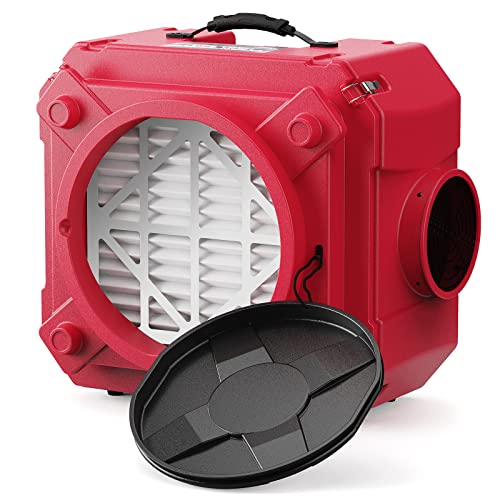
This model emphasizes stackability and versatility with a 3-stage filtration setup. It uses a MERV-10 pre-filter, a carbon filter for odor control, and a HEPA filter capable of trapping 99.97% of particles larger than 0.3 microns. The shell is rotomolded, contributing to durability, and the unit offers a 270–550 CFM range. The design supports up to three units daisy-chained for higher total airflow, making it suitable for larger renovation sites and multi-room cleanups.
Best for: work environments requiring scalable airflow and durable construction, such as multi-room renovation crews.
Limitations: Stacking adds height and weight; ensure floor load capacity and access for multiple units.
Abestorm 4-Stage UV-C Scrubber V2

The Abestorm V2 combines a four-stage filtration system with UV-C light. Its 550 CFM airflow supports effective purification in medium to large spaces. The four-stage setup includes a MERV-10 pre-filter, HEPA, activated carbon, and UV-C for additional odor and contaminant reduction. The unit is designed for commercial and industrial environments like renovation sites and water/damage restoration projects. The UV-C feature targets remaining microbial and odor concerns beyond conventional filters.
Best for: settings needing additional odor reduction and microbial control alongside standard filtration.
Limitations: UV-C requires proper safety considerations and may add maintenance steps for bulbs over time.
Air Scrubber 600 CFM (Zynovate)

The Zynovate 600 CFM unit delivers robust airflow suitable for large industrial spaces. Its four-stage filtration includes MERV-10, carbon, and HEPA filters to manage dust, smoke, and odors. The higher airflow makes it a strong candidate for open-plan workshops, warehousing, or restoration projects requiring rapid air turnover. The unit emphasizes a durable build and practical control features for sustained operations.
Best for: large spaces needing sustained, high-volume air purification with reliable filtration.
Limitations: Higher airflow units may require more power and create greater noise; confirm site tolerances and acoustics before deployment.
Buying Guide
What to consider when selecting industrial air filters:
- : More stages (MERV-10 pre-filter, carbon, HEPA, and UV-C) improve odor control and contaminant capture. Balance need for odor removal with cost and maintenance.
- : Calculate room volume (Cubic Feet) and aim for about 6–8 air changes per hour. Higher CFM suits larger spaces; consider daisy-chaining for multi-room coverage.
- : Stackable designs save floor space and enable multi-unit setups. Heavier units may require assistance for relocation.
- : For harsh job sites, choose rotomolded or metal shells rated for rough handling and moisture exposure.
- : Filter indicators, ease of filter replacement, and availability of replacement parts affect long-term cost and uptime.
- : UV-C units require caution, and electrical features (circuit breakers, GFCI outlets) improve safe operation in damp environments.
Frequently Asked Questions
- What airflow is enough for an industrial space? For most restoration or construction sites, aim for 6–8 air changes per hour. Multiply room volume by this factor to estimate total CFM needed.
- Is UV-C necessary in an air scrubber? UV-C helps reduce microbial load and odors, but check site safety and maintenance needs; it’s optional in many use cases.
- Can I mix different brands in a single project? Yes, but ensure similar filtration levels and compatible electrical requirements to avoid uneven performance.
- How often should filters be replaced? Follow the device’s indicator and manufacturer guidance; performance degrades as filters load with dust and contaminants.
- Are these units suitable for residential use? They are designed for industrial and commercial contexts; for home use, select smaller, quieter units and match to room size.
- Do I need a professional to install or operate these scrubbers? Basic operation is straightforward, but large multi-unit setups or complex job sites may benefit from professional planning and placement guidance.