Best Air Conditioner Temperature Sensor &Amp; Thermometer Picks for Accurate Readings
Answer: For precise air conditioner temperature sensing, choose devices that measure ambient and duct temperatures accurately, are easy to install, and suit your environment—whether you’reDiagnosing HVAC performance, troubleshooting, or performing DIY maintenance. The following five products cover infrared and contact temperature sensing, offering clear advantages for different scenarios, from home HVAC checks to appliance diagnostics.
| Product | Best For | Key Benefit | Notes |
|---|---|---|---|
| Wintact Infrared Thermometer Gun | Non-contact surface temps (kitchens, grills, ovens) | Fast readings from 14.17 inches with 12:1 distance-to-spot | Not ideal for continuous ambient HVAC duct readings |
| Klein Tools ET05 Digital Pocket Thermometer | General purpose HVAC and appliance temps | Backlit display, wide range, easy Celsius/Fahrenheit switch | Best for quick spot checks in low-light areas |
| uxcell 2 Pcs 10K NTC Thermistor Probe | Permanent temperature sensing in ducts/panels | Long probe with epoxy waterproof coating | Requires compatible wiring and integration |
| DROK 10K Temperature Sensor Probe (3 pcs) | Remote temperature monitoring for HVAC systems | 1 m waterproof lead, stainless steel probe | Digital transmitter extension cable for longer runs |
| TIEXYE 4Pcs NTC 5K Thermistor Probes | Multiple point sensing in ductwork or units | Wide measuring range with copper probes | Requires proper installation for accuracy |
The table above highlights a mix of infrared and contact sensors designed to fit different HVAC tasks. Use non-contact meters for quick surface checks and contact probes for continuous monitoring, duct temperature, or integration with control systems.
Wintact Infrared Thermometer Temperature Gun

Best for: quick, non-contact surface temperature checks on cooking surfaces, grills, oven fronts, and other hot objects. This model measures -58℉ to 1094℉ (-50℃ to 590℃) in under 0.5 seconds with an accuracy of ±1.5% (±2.7℉). The 12:1 distance-to-spot ratio enables a safe reading distance of about 14 inches. The sensor is ideal when you need fast confirmation of surface temps without touching hot surfaces.
Why selected: It offers fast, user-friendly readings with a broad range suitable for kitchen tasks and light HVAC checks around hot equipment. It helps confirm surface temperatures before handling or cooking, reducing risk of burns or damage to surfaces.
Best for whom: Home cooks, barbecue enthusiasts, and technicians needing rapid surface temp confirmation without contact. Caution: The measurement spot is offset by 2 cm below the laser sight line; aim slightly above the target to ensure the reading reflects the true surface.
Klein Tools ET05 Digital Pocket Thermometer

Best for: HVAC technicians and DIYers needing a reliable, handheld temperature check with a clear display. It offers Fahrenheit and Celsius options and a wide measurement range from -40 to 482°F (-40 to 250°C) with room temperature accuracy around ±27°F. The backlit display makes readings easier in dim environments.
Why selected: The ET05 provides a compact, straightforward tool for frequent spot checks on ducts, vents, and equipment surfaces. Its dual-unit capability is useful in regions that require both Fahrenheit and Celsius readings. Caution: It has a broader error margin at the extreme ends of the range; for critical diagnostics, corroborate with additional sensors.
Certified A/C Pro Car AC Test Thermometer

Best for: diagnosing car AC performance and checking outlet duct temperature and ambient temperature. It features a magnified 1-inch dial with a 5-inch probe and protective cover for easy use in tight spaces around automotive HVAC components.
Why selected: It focuses on automotive AC diagnostics, helping verify performance and detect abnormal temperatures in ducts and ambient air. Caution: Designed for automotive use; performance readings in non-automotive environments may vary slightly due to airflow differences.
uxcell 2 Pcs 10K NTC Thermistor Probe

Best for: permanent temperature sensing in air conditioners, ducts, and control panels where a durable probe is needed. The 10K NTC sensors include an epoxy waterproof probe and a 15.7-inch wire length for flexible placement, with a 2P XH2.54 plug for easy integration.
Why selected: This pair provides a reliable sensing option that can be wired into control circuits or monitoring systems to track ambient and duct temperatures. Caution: Requires proper wiring and calibration to ensure consistent readings across environments.
DROK 10K Temperature Sensor Probe
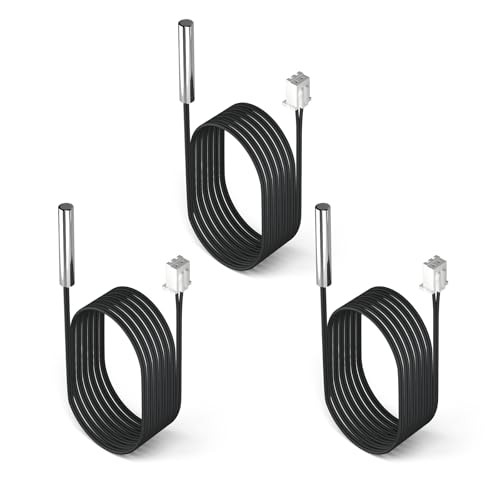
Best for: remote temperature monitoring with a digital transmitter setup. The package includes three probes with a 1-meter waterproof lead, featuring a stainless steel probe that resists moisture and corrosion, suitable for HVAC environments and automotive applications.
Why selected: The long lead and waterproof design enable flexible placement for ambient or duct temperature monitoring. Caution: Ensure correct installation and protection from physical damage to maintain accuracy over time.
TIEXYE 4Pcs NTC 5K Thermistor Probes

Best for: multi-point sensing in larger HVAC installations or experimental DIY projects. Each 15.7-inch probe uses 5K 3950 NTC thermistors with copper and waterproof design for resilient temperature sensing.
Why selected: The four-pack offers flexibility for distributing sensors across ducts or zones. Caution: Ensure each probe is correctly positioned to avoid near-field interference that could skew readings.
Buying Guide
What type of temperature sensor should I choose?
Non-contact infrared thermometers are ideal for quick surface checks on grills, ovens, or exposed HVAC components. Contact thermistors and probes excel for continuous monitoring, duct temperature, and integration with control systems. Consider a mix if you need both quick checks and stable, long-term readings.
What range and accuracy matter for HVAC work?
For most home HVAC tasks, a wide range with reasonable accuracy (±1.5% or better) is sufficient. If you handle delicate appliances or require precise temperature control, prioritize sensors with documented accuracy ranges and calibration notes. Remember that ambient airflow and emissivity factors influence infrared readings.
How should I install and position sensors?
Place infrared meters at an optimal distance to avoid reflected heat and aim for representative surface areas. For probes, position the sensing tip in the duct or near the measured area, while protecting wires from damage and ensuring waterproofing where moisture is present.
Are there installation considerations for multi-point sensing?
Yes. In larger systems, use multiple probes to map temperature across zones or along ducts. Ensure compatible connectors (XH2.54, 2P plugs) and consistent calibration among all sensors to maintain reliable comparisons.
What are common limitations to expect?
Infrared readings may be affected by emissivity and surface appearance. Probe readings require proper placement and may need insulation to reduce heat exchange. Some devices have broader error margins at extreme ends of their ranges; corroborate readings with secondary sensors when possible.
Maintenance and calibration tips
- Regularly inspect probes for wear, corrosion, or waterproof seal integrity.
- Calibrate infrared meters against known reference temperatures when feasible.
- Keep sensor tips clean to avoid measurement interference.
- Store devices away from direct sunlight and extreme temperatures to preserve accuracy.
Frequently Asked Questions
- What’s the difference between infrared and thermistor probes? Infrared meters measure surface temperature without contact, while thermistor probes provide direct temperature readings through a wired sensor, suitable for duct or ambient monitoring.
- Can I use these for my home air conditioner? Yes. Infrared tools help with quick checks on external components, and thermistor probes support longer-term monitoring of ducts or equipment temperatures.
- Is a longer cable better for probes? Longer leads enable placement away from the main unit, but ensure signal integrity and protection from moisture and mechanical damage.
- Do these devices require calibration? Basic readings are typically reliable, but calibrating against known references improves long-term accuracy, especially for critical diagnostics.
- Which sensor is best for DIY HVAC projects? A combination of an infrared thermometer for quick checks and NTC thermistor probes for fixed monitoring provides flexibility and depth.