Best 2.5 Ton Air Conditioners for Home Comfort
Answering the common search for a reliable 2.5-ton cooling solution, these units fit medium-sized homes and central systems. This guide highlights five 2.5-ton options that balance efficiency, performance, and value. Best for: families seeking solid cooling without overcommitting to oversized equipment, and homeowners upgrading from older 1.5–2 ton systems.
| Product | Best For | Key Benefit |
|---|---|---|
| ACiQ 2.5 Ton 14.3 SEER2 Central Air Conditioner Condenser | Medium Homes | High efficiency with R32 refrigerant |
| ACiQ 2.5 Ton 14.3 SEER2 Central Air Conditioner Split System | Small to Medium Homes | Integrated evaporator coil for compact installs |
| Goodman 2.5 Ton 13.4 SEER2 GLXS3BN3010 Condenser | Budget-conscious Packages | Solid baseline efficiency and compatibility |
| Goodman 2.5 Ton 14.3 SEER2 Partial Split System GLXS4BA3010 | Flexible Installations | Vertical coil and complete system components |
| ACiQ 2.5 Tons 15.2 SEER2 Split System | High Efficiency Needs | Two-stage inverter performance with R454B options |
ACiQ 2.5 Ton 14.3 SEER2 Central Condenser

Best for: homes needing strong central cooling with energy efficiency. This 2.5-ton unit delivers about 30,000 BTU for medium-sized spaces. It uses R32 refrigerant and 14.3 SEER2 efficiency, helping reduce energy use while providing dependable cooling. Suitable for single-zone, central-air setups with existing ductwork. Caution: installation requires compatible outdoor and indoor components to form a complete system.
ACiQ 2.5 Ton 14.3 SEER2 Split System With 17.5″ Evaporator Coil
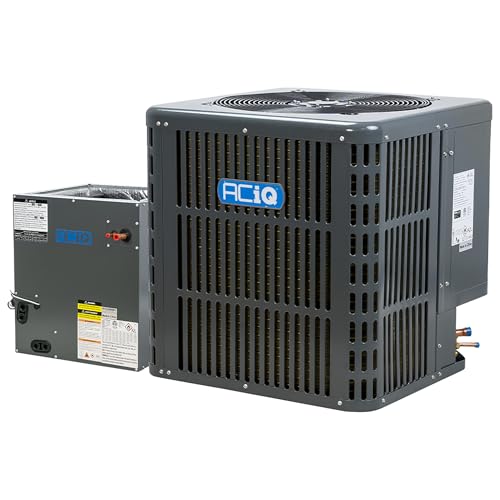
Best for: compact installations where an evaporator coil is integrated with the condenser. This 2.5-ton unit offers a 17.5-inch evaporator coil (aluminum) with TXV and AHRI certification, compatible with R32. It’s suitable for smaller homes that still demand reliable cooling. Limitation: the system assumes a matching indoor unit and proper duct sizing to realize full efficiency.
ACiQ 2.5 Tons 15.2 SEER2 Split System

Best for: homeowners seeking higher efficiency with inverter-style cooling. This two-stage system uses inverter cooling for precise temperature control and potential energy savings. It features a multi-position evaporator coil and R454B compatibility for flexible refrigerant options. Caution: two-stage operation may require more advanced controls and installation accuracy to maximize benefits.
Goodman 2.5 Ton 13.4 SEER2 Classic GLXS3BN3010

Best for: budget-focused buyers wanting reliable baseline performance. The GLXS3BN3010 condenser emphasizes efficiency with R-32 refrigerant and a robust coil design. It pairs well with a compatible furnace or blower to form a complete system. Limitation: a furnace or blower is required to complete the system and realize full cooling capacity.
Buying Guide
What matters most when choosing a 2.5-ton unit:
- Efficiency rating: SEER2 indicates energy use. Higher SEER2 saves more over time but may come with higher upfront costs.
- System type: Condenser-only vs. split system. Split systems include an evaporator coil and thermostat components—easier for new installs.
- Refrigerant: R32 is common and generally friendlier to the environment than older blends.
- Indoor compatibility: Ensure ductwork, coil, and furnace/blower match the new condenser for a complete, efficient system.
- Installation considerations: Outdoor cabinet durability and corrosion resistance matter in coastal or humid areas.
- Maintenance access: Service valves, gauge ports, and inspection points ease annual checks.
Frequently Asked Questions
- What does 2.5-ton refer to?
It denotes the unit’s cooling capacity, roughly matching a 2,500 BTU per hour cooling output per hour, suitable for medium-sized spaces. - Is SEER2 better than SEER?
Yes. SEER2 is the updated efficiency standard; higher numbers typically mean lower energy use and operating costs over time. - Do I need a furnace with a 2.5-ton condenser?
Many 2.5-ton units are paired with indoor coils and furnaces to form a complete system. Check compatibility with your existing equipment. - Can R32 refrigerant affect maintenance?
R32 is common in modern units; it generally requires standard HVAC service practices and trained technicians. - What installation factors influence performance?
Thermal load, duct design, coil configuration, and proper refrigerant charge are key to achieving rated efficiency. - How do I choose between single-stage and two-stage systems?
Single-stage units are simple and affordable; two-stage units offer smoother temperature control and potential energy savings in fluctuating climates.