Best 50,000 BTU Garage Heaters for Cold-Proof Workshops and Garages
Answering the typical buyer question: which 50,000 BTU garage heater offers reliable warmth for a mid-sized space? This guide covers five solid options that are well-suited for garages, barns, and workshops, focusing on units around 50,000 BTU and nearby equivalents. The best pick depends on fuel type, installation style, and heat distribution needs. Below you’ll find straightforward comparisons, plus a practical buying guide and a short FAQ to help you decide quickly.
| Product | Fuel Type | Approx. Space | Best For |
|---|---|---|---|
| Mr. Heater 50,000 BTU Forced-Air Unit Heater | Propane or Natural Gas | Approx. 1,667 sq ft | Single-zone garages, barns, or workshops; ceiling mounted |
| Mr. Heater 80,000 BTU Forced-Air Unit Heater | Propane or Natural Gas | Up to 2,667 sq ft | Larger garages or spaces needing rapid warming |
| ALECOIL 50,000 BTU Hydronic Hanging Unit Heater | Hot water | Garage/workshop spaces with existing boiler | Energy-efficient, even heat with remote control |
| ALORAIR 50,000 BTU Hydronic Hanging Unit Heater | Hot water | Garages, workshops, and warehouses | Efficient, programmable heating with remote |
| Comfort Zone 5000W Ceiling Mounted Electric Heater | Electric | Small to mid-sized garages | Overhead heat without fuel lines or gas lines |
Mr. Heater 50,000 BTU Forced-Air Unit Heater

Type: Ceiling-mounted forced-air heater that runs on propane or natural gas. Heats up to 1,667 sq ft, roughly a three-car garage. Compatible with standard 24-volt thermostats and newer Wi‑Fi enabled models (sold separately). Best for: single-zone spaces that require fast, direct heat from above. Caution: installation must address gas lines and venting for safe operation.
Mr. Heater 80,000 BTU Forced-Air Unit Heater
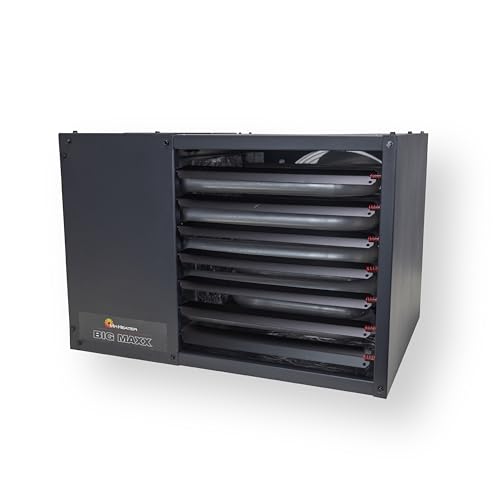
Type: Ceiling-mounted forced-air unit heater for propane or natural gas. Heats up to 2,667 sq ft. Ideal for larger garages, barns, or workshops that need quick, widespread warmth. Best for: bigger spaces where a 50k BTU unit may not reach efficiently. Limitation: higher output may require more robust venting and line size considerations.
ALECOIL 50,000 BTU Hydronic Hanging Unit Heater
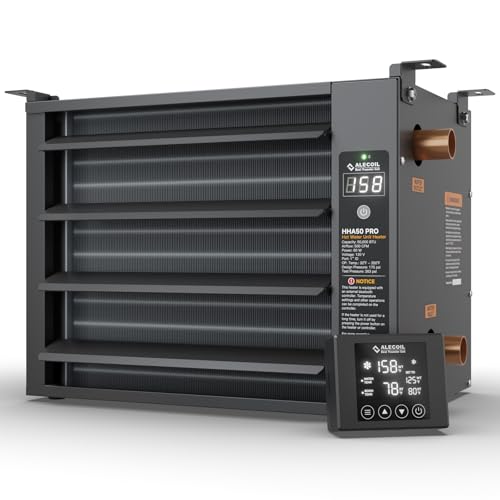
Type: Hydronic (hot-water) ceiling-hung unit that leverages an existing hot water system or boiler. Delivers rapid whole-room warmth, even in unheated garages or detached workshops. Best for: spaces with a compatible hot-water loop seeking steady, energy-efficient heating. Caution: requires a hot-water source and plumbing work for installation.
ALORAIR 50,000 BTU Hydronic Hanging Unit Heater

Type: Hydronic system using hot water with a galvanized steel housing and aluminum tubing. Heat delivery up to 30% lower energy use than typical electric heaters and includes a smart control that starts the fan at temperature and modulates water flow. Best for: users who want programmable, efficient heating with a remote. Limitation: installation complexity if you lack a compatible hot-water source.
Comfort Zone 5000W Ceiling Mounted Electric Heater

Type: 240V electric shop heater with three heat settings and overheat protection. Ceiling mounted to maximize floor space; ETL listed for indoor use. Best for: spaces where gas or water hookup is unavailable or undesired. Caution: electric heat typically has higher operating cost in very large spaces and requires a dedicated circuit.
Buying Guide: Key Considerations For 50,000 BTU Garage Heaters
- Fuel type: Decide between gas (propane/natural gas), hydronic hot water, or electric. Gas units generally deliver fast, high heat and are good for large spaces, but require venting and fuel supply. Hydronic heaters rely on existing boilers, offering steady, efficient heat. Electric options are simpler to install but may cost more to operate in large spaces.
- Space and insulation: For roughly 1,600–2,000 sq ft garages, a 50k–80k BTU range is common. Better insulation reduces continuous heat demand and improves efficiency.
- Installation considerations: Ceiling-mounted units save floor space but may require ducting, venting, or electrical work. Hydronic systems need a compatible hot-water source and plumbing connections. Electric ceiling units need a dedicated 240V circuit.
- Control and programmability: Look for thermostats and remote controls that allow scheduling and zone control. Smart controls can reduce energy use by modulating heat based on room temperature.
- Maintenance and safety: Gas units require venting, gas line safety, and regular inspection. Hydronic units depend on the hot-water system’s condition. Electric heaters should be inspected for overheating protection and wiring integrity.
Frequently Asked Questions
- What governs 50,000 BTU suitability for a space? – Space size, insulation, and climate determine if 50,000 BTU provides adequate warmth. Larger or poorly insulated spaces may need higher BTU or supplemental heat.
- Are hydronic heaters more efficient than gas units? – Hydronic heaters can be more energy-efficient in well-insulated spaces since they leverage a central boiler, but efficiency depends on the entire system.
- Is ceiling mounting better than wall mounting? – Ceiling mounting saves floor space and can distribute heat more evenly in a workspace, but installation access and clearance matter.
- Do I need professional installation for gas heaters? – Yes. Gas heaters require proper venting, gas line sizing, and code-compliant mounting. Electric heaters require a licensed electrician for hardwiring in many cases.
- Can I mix heating methods in one garage? – It’s possible, but ensure load management and safety considerations are addressed, especially with gas and electric devices operating concurrently.
- What should I consider about remote controls? – Remote and programmable thermostats improve comfort and energy savings by adjusting heat to actual usage patterns.