Best 50 Ft Copper Tubing for HVAC and Refrigeration Projects
When selecting copper tubing for HVAC, refrigeration, or DIY cooling projects, choose lengths of 50 feet for easy handling and fewer joins. This guide highlights five versatile options in 50-ft coils, all made from premium UNS C12200 copper and compliant with ASTM-B280. The right pick depends on your system size, bend radius, and required ID. The top choices are best for home repair technicians, DIYers, or professional contractors who need reliable, corrosion-resistant tubing with strong thermal performance.
Summary at a glance:
- GOORY 3/8″ OD x 50 ft: Best balance of size and flexibility for compact HVAC runs.
- GOORY 1/2″ OD x 50 ft: Better for medium-diameter refrigerant lines with higher flow.
- TAUROX 1/4″ OD x 50 ft: Ideal for tight bends and small-system connections.
- GOORY 3/4″ OD x 50 ft: Best for larger cooling loops with higher volumetric needs.
- BELLA BAYS 3/8″ OD x 50 ft: Consistent quality with nitrogen-treated processing for durability.
GOORY Copper Tubing 3/8″ OD 50 Ft

Specification: UNS C12200 seamless copper, 3/8″ OD x 0.328″ ID, wall 0.024″, length 50 ft. This tube is annealed for flexibility and easy installation. It passes ASTM-B280 and is nitrogen-filled to minimize impurities and oxidation. Best for compact refrigerant runs in small-to-medium HVAC systems.
Best for: Diy installers and professionals needing a compact, flexible line with reliable thermal performance for standard air conditioning and refrigeration circuits. Choose this if your project involves standard 3/8″ connections and you want easy bending without kinking.
Caution: Moderate wall thickness means avoid sharp, repeated bending beyond its bend radius to prevent crease formation.
GOORY Copper Tubing 1/2″ OD 50 Ft
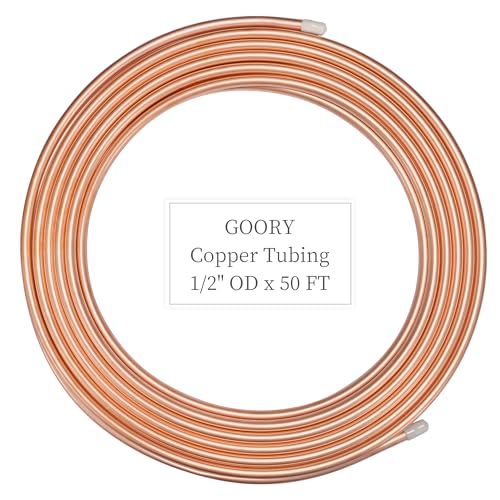
Specification: UNS C12200 seamless copper, 1/2″ OD x 0.445″ ID, wall 0.028″, length 50 ft. Nitrogen-filled and pressure-tested, compliant with ASTM-B280. Designed for higher flow and longer runs in mid-sized refrigeration and HVAC installations.
Best for: Systems requiring moderate to higher refrigerant flow in mid-sized coils. Choose this if your project has 1/2″ fittings and you need robust, durable tubing with good bending tolerance.
Caution: Slightly heavier than smaller diameters; handle with appropriate supports to avoid sag in longer runs.
TAUROX Copper Tubing 1/4″ OD 50 Ft

Specification: C12200 seamless copper, 1/4″ OD x 0.187″ ID, wall 0.031″, length 50 ft. ASTM-B280 compliant; nitrogen-charged to reduce impurities and resist oxidation. This tube is highly flexible and easy to bend by hand, with a smooth surface for tight-sealing joints.
Best for: Tight-space installations and small refrigeration connections where precise bends are needed. Suitable for DIY projects and professional work requiring a compact line with reliable leak resistance.
Caution: Smaller diameter can be more susceptible to limiting refrigerant capacity; ensure compatibility with your system’s design.
GOORY Copper Tubing 3/4″ OD 50 Ft

Specification: UNS C12200 seamless copper, 3/4″ OD x 0.687″ ID, wall 0.031″, length 50 ft. Nitrogen-filled and tested; adheres to ASTM-B280, delivering good thermal conductivity and corrosion resistance for larger HVAC circuits.
Best for: Large-diameter runs and higher-capacity cooling systems where fewer joints are preferred. Choose this if your design includes 3/4″ fittings and you need durable, long-length tubing.
Caution: Heavier tubing requires proper supports and tools to manage during installation.
BELLA BAYS Copper Tubing 3/8″ OD 50 Ft
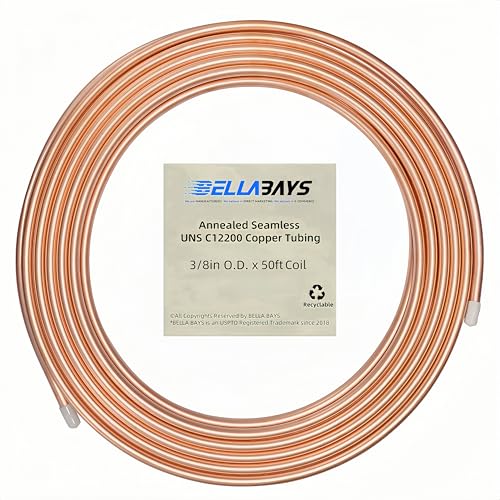
Specification: UNS C12200 copper, 3/8″ OD x 0.320″ ID, wall 0.028″, length 50 ft. Seamless coil, nitrogen-charged processing for oxidation resistance, conforms to ASTM-B280. Strong thermal conductivity and durability are highlighted benefits.
Best for: Mid-size HVAC or refrigeration projects needing reliable 3/8″ tubing with enhanced longevity. Choose this for flexible, easy-to-manage lines that resist condensate buildup.
Caution: Ensure precise OD to match fittings to avoid sealing issues in tight assemblies.
Buying Guide
What size should you choose?
3/8″ and 1/2″ are common for residential HVAC and small commercial systems, offering a balance of flow and maneuverability. Smaller 1/4″ tubes fit tight spaces, while 3/4″ tubes handle larger loads with fewer joints.
Why choose nitrogen-filled, ASTM-B280 tubes?
Nitrogen charging reduces impurities and oxidation risk, extending service life. ASTM-B280 compliance ensures the tube meets industry standards for refrigeration and HVAC use.
How important is flexibility?
Flexible tubes simplify installation, especially in tight spaces or complex runs. Annealed copper improves bendability and reduces the risk of kinks during installation.
What should you consider for installation?
- Check bend radii to avoid kinking. Use proper fittings and clamps.
- Match tubing OD to your system’s connections to prevent leaks.
- Plan for supports and heat expansion in longer runs.
Durability and longevity concerns
High-quality UNS C12200 copper with corrosion resistance and tight tolerances improves system reliability and lifespan in air conditioners, coolers, and refrigerators.
Frequently Asked Questions
- What does C12200 imply for copper tubing?
Answer: It indicates a high-purity copper grade used for refrigeration tubing with good ductility and corrosion resistance. - Is 50 ft enough for most projects?
Answer: For many residential applications, a 50 ft coil reduces joints and simplifies routing, though some installations may need longer or multiple lengths. - Can I bend these tubes by hand?
Answer: Some diameters, especially 1/4″ and 3/8″, are designed for easy bending by hand, but always follow manufacturer bend radii guidelines. - Are these tubes suitable for DIY enthusiasts?
Answer: Yes, several options are designed for DIY projects due to their smooth surfaces and flexible options, with proper safety precautions. - Do all options require nitrogen charging?
Answer: The nitrogen-filled process is common across the listed products to reduce impurities and improve longevity. - Which size is best for high-flow systems?
Answer: Larger diameters like 1/2″ or 3/4″ OD are better for higher flow and fewer required connections.