Best 50 Amp Tankless Water Heater Options for Quick Hot Water on Demand
If you’re shopping for a 50 amp tankless electric water heater, you want models that deliver reliable hot water while matching your home’s electrical capacity. This guide highlights five suitable 50 amp units, explains who they’re best for, and notes practical limits. Ideal buyers include small homes, apartments, or offices needing immediate hot water at point-of-use sinks or showers without a bulky storage tank.
Summary of chosen products:
| Product | Best For | Key Benefit | Power/Flow |
|---|---|---|---|
| WINTEMP 11kW Tankless (Model Watt) | Small homes, point-of-use | Fast hot water at up to 2.6 GPM | 11 kW, 46 A |
| Rheem 11kW 240V Tankless | Budget-friendly upgrades | Self-modulating control | 11 kW |
| Rheem 18kW 240V Tankless | Higher demand, multi-point use | Up to 4.4 GPM | 18 kW |
| EcoSmart ECOS 12 | Space-saving installs | Up to 2.9 GPM, high efficiency | 12 kW |
| WINTEMP WM12 12kW | 1–2 outlets, boosters | Stable ±1°F temperature | 12 kW |
WINTEMP 11kW Electric Tankless Water Heater

Best for compact installations needing up to 2.6 GPM. Features automatic power adjustment with a digital display from 86°F–140°F. It requires 1 x 50 Amp DP breakers and 8 AWG wiring with ground. Ideal for point-of-use needs such as bathroom sinks and small showers. Caution: verify installation clearances and breaker availability before purchase.
Rheem 11kW 240V Tankless Electric Water Heater
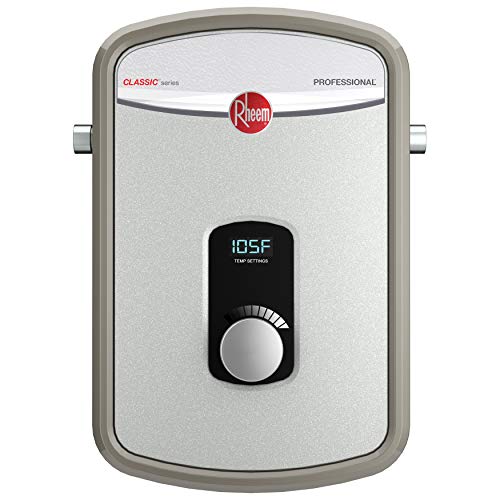
Best for small households upgrading from a storage heater. It uses an ON/OFF dial with adjustable digital temperature and self-modulating power control, delivering up to 2.68 GPM. Choose this if you want a straightforward unit with reliable modulating performance for single-point use. Limitation: only suitable for low to moderate simultaneous hot-water needs.
Rheem 18kW 240V Tankless Electric Water Heater
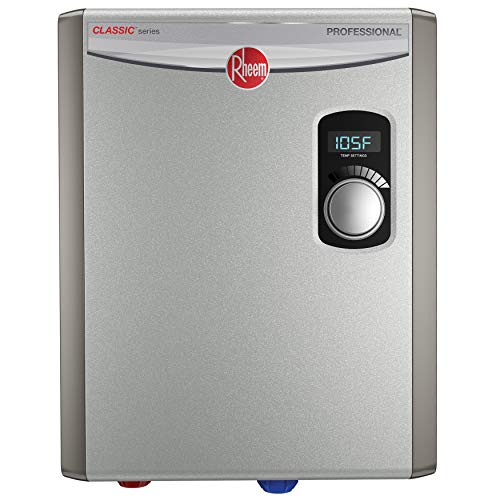
Best for higher demand or multi-point use with up to 4.4 GPM. External digital thermostatic control with LED shows precise temp, plus durable copper elements. Best for homes needing simultaneous hot water at multiple fixtures. Caution: higher initial electrical load may require upgrade to service capacity.
EcoSmart ECOS 12 Tankless Electric Water Heater

Best for space-conscious installations. It delivers up to 2.9 GPM with up to 96% thermal efficiency and 90% smaller footprint than traditional tanks. Choose this if you want a compact, high-efficiency system for one or two outlets. Limitation: performance depends on incoming water temperature and demand mix.
WINTEMP WM12 12kW Tankless Water Heater

Best for boosting or point-of-use scenarios requiring stable water within ±1°F and up to 2.8 GPM. Has a 50A requirement and uses a 1 × 50 Amp DP breaker with 8 AWG wiring. A good option for 1–2 outlets in cold climates. Caution: installation must be hardwired and water connections are 1/2″ NPT.
Buying Guide
What should I consider when choosing a 50 amp tankless electric water heater?
Key factors include power rating, flow rate (GPM), climate, number of outlets, and electrical capacity. Higher kW models deliver more GPM but require appropriate service panels and wiring. In cold locations, higher performance units prevent temperature drops at demand peaks.
How do I decide between 11kW and 18kW models?
11kW units are suitable for single-point use or light multi-point use with modest flow. 18kW models handle higher demand and can support multiple fixtures, but require a larger electrical supply (often 240V, higher amperage) and proper panel capacity.
Is self-modulating technology worth it?
Yes, self-modulating units adjust power based on flow and temperature, improving energy efficiency and reducing unnecessary heat. It helps regulate hot water when demand fluctuates.
What installation considerations are essential?
Verify required breakers (often 50A DP), wire gauge (8 AWG), and water connections (1/2″ NPT). Some units require hardwired installation. Check clearances, ventilation, and whether near-term service upgrades are needed for your home’s electrical panel.
How does climate affect performance?
Colder climates reduce available hot-water output for a given unit. In warmer regions, smaller units can meet shower or sink needs more easily, while in colder regions, higher-capacity models may be necessary to maintain comfortable temperatures.
How should I compare long-term energy use?
Focus on energy efficiency ratings (highly efficient models reduce standby losses) and flow-rate compatibility. Compare how each unit modulates power at typical household water usage scenarios to estimate annual energy savings.
What are common limitations to expect?
Limitations often include maximum GPM, required electrical capacity, and installation restrictions (hardwired only or specific breaker configurations). Some units may not support simultaneous high-flow demands across multiple fixtures.
FAQ
- Q: Do I need a professional to install a 50 amp tankless heater? A: Yes, installation typically requires electrical and plumbing expertise, including correct breaker sizing and wiring.
- Q: Can these units supply hot water to multiple fixtures at once? A: Some models handle multi-point usage; check the specified GPM rating for your needs.
- Q: Will a 50 amp heater work in a small apartment? A: It can, if your electrical panel supports the load and you have appropriate plumbing for the intended outlets.
- Q: Are 11kW models enough for a family home? A: Often suitable for single-point use; larger families may need higher-kW units or additional boosters.
- Q: Do these units maintain consistent temperature? A: Most models offer stable temperature with adaptive power control, though performance varies with incoming water temperature.
- Q: What maintenance is required? A: Regular inspection for mineral buildup and proper connections helps maintain efficiency; some units are designed to be low-maintenance.