Best 30-Inch Baseboard Heaters for Even, Quiet Heat
Answering the common search for a reliable 30-inch baseboard heater, this guide highlights five strong options that balance heat output, installation practicality, and quiet operation. Each product is best for different room sizes and installation needs. Use the quick comparison table below to pick the right model for your space.
| Product | Best For | Key Benefit |
|---|---|---|
| Dimplex LC3010W31 | Lounge or office spaces | Fast top-heat discharge and compact design |
| Mollifii 2F500W-A (120V) | Moderate power with simple plug-in option | |
| Mollifii 2F500W-A (208/240V) | Dual voltage flexibility | |
| Cadet 3F750W | Convection heat with universal wiring | |
| Cadet 2F350W | Balanced 350W profile |
Dimplex 30″ Linear Convector Electric Baseboard Heater

Model LC3010W31 provides up to 1000W of heat, suitable for mid-size rooms. It uses a shark-fin blade design on a steel tubular element to improve heat transfer, reduce noise, and extend life. The unit is described as up to 42% smaller than conventional baseboards, allowing for discreet styling and flexible placement. Best for: spaces where you want faster warm air distribution with a slim profile. Caution: ensure wall clearance and electrical outlet capacity meet installation needs.
Mollifii Electric Baseboard Heater, 30 in, 500W, 120V

This 30″ baseboard model from Mollifii delivers 500W at 120V, translating to about 1710 BTU/hour. It’s a straightforward plug-in option suitable for smaller rooms or apartments where hardwired installation is not desired. Best for: renters or rooms needing a simple, low-profile heat source. Limitation: higher-energy use can be noticeable in large spaces, and 120V operation may limit max heat output in larger rooms.
Mollifii 30″ Baseboard Heater, 375/500W, 208/240V

This Mollifii model offers dual-voltage capability with 375W or 500W at 208/240V. It allows for flexibility in heat output depending on the circuit and room size. Best for: spaces where wiring supports higher voltages or where you want adjustable heat without changing units. Caution: verify circuit capacity and panel wiring before upgrading or installing in existing setups.
Cadet F Series 36″ Electric Baseboard Heater
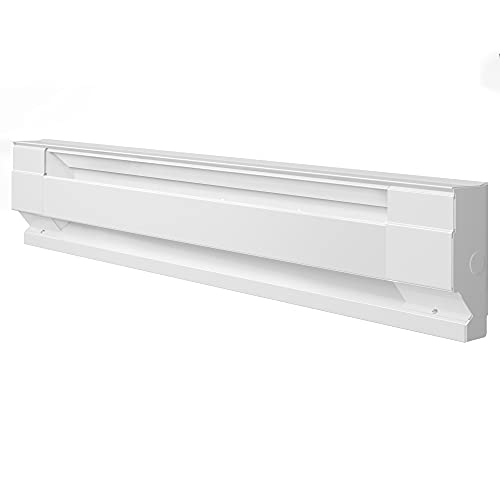
Cadet’s 3F750W model delivers 750W at 240V or 563W at 208V for strong convection warmth. It features universal wiring and pre-punched knockouts for a quick install. Best for: mid-to-large rooms that require consistent convective heat. Limitation: at 36 inches, it’s longer than the 30-inch target and may require more space in tight rooms.
Cadet F Series 24″ Electric Baseboard Heater

This Cadet 24″ model provides a compact option with 350W or 262W outputs at 240/208V. It is a good fit for smaller rooms or zones that need supplemental heat. Best for: budget-conscious projects needing a slim, unobtrusive heater. Caution: the smaller wattage reduces effectiveness in larger spaces.
Buying Guide
What to consider when choosing a 30-inch baseboard heater:
- Room size and heat requirement: larger spaces benefit from higher wattage and 240V options, while smaller rooms may be served well by 120V or lower wattage units.
- Electrical setup: verify voltage availability (120V vs 208/240V) and whether hardwired or plug-in installation is preferred.
- Installation space: measure wall clearance and consider whether a slim profile or a longer unit fits the room’s layout.
- Heat distribution: convection-based baseboards distribute warm air along the wall; look for designs that promote even airflow without noise.
- Controls and integration: consider compatibility with wall thermostats or built-in control kits for on-unit adjustment.
- Durability and materials: steel housings and enamel finishes offer long-term durability; look for thermal protection features for safety.
Practical comparison by scenario:
- Best for quick warmth: units with front heat discharge and streamlined designs (example: Dimplex LC3010W31).
- Best for flexible power: dual-voltage Mollifii models provide installation versatility across different homes.
- Best for larger rooms: Cadet 750W or 563W variants deliver sustained warmth with universal wiring.
- Best for tight spaces: 24″ Cadet or compact 30″ Mollifii options fit narrow walls or apartments.
FAQ
- What size baseboard heater should I buy for a 200–300 sq ft room?
A 500W to 750W unit at 240V commonly provides adequate warmth, depending on insulation and climate. - Is 120V better or 240V for baseboard heating?
240V units typically deliver higher heat output and are more suitable for larger rooms; 120V units can be easier to install but may require multiple heaters. - Do baseboard heaters require hardwiring?
Some models offer plug-in capability, but many higher-wattage units use hardwired installation with a thermostat. - Can baseboard heaters be controlled with a separate thermostat?
Yes. Most models support external wall thermostats or on-unit thermostat kits sold separately. - Are 30-inch baseboards suitable for open floor plans?
They can be, but for large open areas you may need multiple units to ensure even heat distribution. - Do these heaters operate quietly?
Most modern baseboards use convection and are designed to run quietly without fans.