Best 3 Phase Heaters for Large Rooms and Industrial Spaces
When you need reliable warmth in large rooms, workshops, or industrial spaces, a 3-phase heater can deliver consistent power and efficiency. This guide highlights five top performers that offer true three-phase operation, broad voltage compatibility, and robust build quality. Each product includes key features and practical usage notes to help you compare options for installation, safety, and long-term performance.
| Product | Brand | Three-Phase Capability | Notable Feature |
|---|---|---|---|
| DR-P350, 5KW_3-Phase | DR. INFRARED HEATER | Yes (208-480V) | Uniform air distribution |
| DR-P3200, 20KW_3-Phase | DR. INFRARED HEATER | Yes (208-480V) | High-capacity heating |
| DR-P3150, 15KW_3-Phase | DR. INFRARED HEATER | Yes (208-480V) | Balanced airflow |
| Global Industrial 5KW 480V 3 Phase Unit Heater | Global Industrial | Yes (480V) | Industrial-grade airflow control |
| Global Industrial 30,000W 3 Phase Salamander | Global Industrial | Yes (480V) | Direct-wire installation |
Selecting the right 3-phase heater involves balancing heat output, installation flexibility, electrical requirements, and maintenance needs. Below are five strong options with capabilities suitable for garages, warehouses, construction sites, and large living areas. Each entry provides a concise overview to support an informed buying decision.
DR-P350: 5KW 3-Phase Heater

The DR-P350 provides flexible operation as either a single or three-phase heater, compatible with 208 to 480-volt systems. It delivers uniform air distribution to evenly warm large rooms, which helps maintain consistent temperatures across spaces with varying occupancy. The motor is overheat protected and designed with permanent lubrication in a totally enclosed, heavy-duty bearing to support extended use in demanding environments. This model is well-suited for mid-sized workshops or batch processing areas where steady heat is essential.
Key features and considerations: 3-phase compatibility for scalable power, robust motor protection, and uniform airflow. The unit’s compact footprint makes it adaptable for ceiling or wall mounting in garages or shared warehouse spaces. For safety, verify electrical supply matches the 208-480V range and ensure proper ventilation to avoid overheating localized parts.
DR-P3200: 20KW 3-Phase Unit
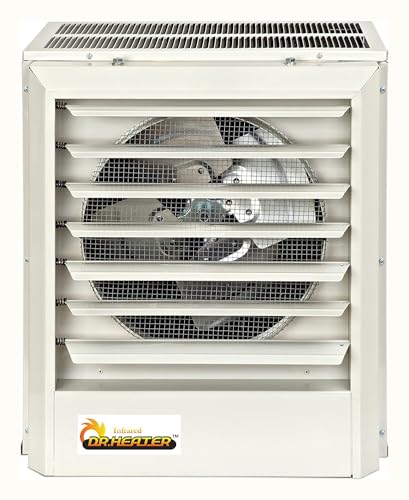
For larger spaces, the DR-P3200 model delivers substantial heating capacity with 3-phase flexibility across 208 to 480 volts. Its design emphasizes uniform air distribution to ensure even heat in expansive rooms, reducing cold spots. Like other DR Infrared Heaters in this range, it employs an overheat-protected motor with permanent lubrication and a heavy-duty, totally enclosed bearing to withstand prolonged operation in challenging environments. This unit is appropriate for commercial shops, large studios, and open-plan warehouses where high heat output is necessary.
Key considerations include electrical load management for 3-phase supply, mounting requirements to maximize airflow, and routine maintenance of bearings and protective circuits. Ensure installation conforms to local electrical codes and that the space is adequately ventilated to prevent heat buildup near sensitive equipment.
DR-P3150: 15KW 3-Phase Heater
The DR-P3150 offers a middle-ground option in the 3-phase family, delivering 15 kilowatts of heat with similar voltage flexibility (208-480V). Its design emphasizes uniform dispersion of heated air to fill larger spaces evenly, minimizing temperature gradients across a room. The overheat-protected motor with permanent lubrication and a heavy-duty bearing support reliable uptime in demanding environments such as industrial workshops or manufacturing floors.
Key considerations include scale matching to space size, ensuring the electrical panel can handle the required three-phase load, and periodic inspection of thermal protection systems. Because three-phase systems can vary by installation, work with a licensed electrician to verify wiring, breakers, and grounding for safe operation.
Global Industrial 5KW 480V 3-Phase Unit Heater

This Global Industrial heater is designed for industrial workflows with a focus on airflow control. Large dynamically balanced fan blades maximize air movement while reducing turbulence and noise. Louvers adjust up or down to direct heat precisely, and the vents on each side help manage airflow and prevent motor overheating. It delivers up to 17,000 BTU or 5,000 watts of heat, a strong match for medium-to-large spaces that require reliable, steady warmth without overheating mechanical components.
Practical considerations include placement for optimal throw, electrical requirements for 480V three-phase supply, and maintenance of the fan assembly to minimize noise and prolong service life. This unit can be wall- or ceiling-mounted, depending on how you want to shape heat distribution in a shop or warehouse environment.
Global Industrial 30,000W 3-Phase Salamander
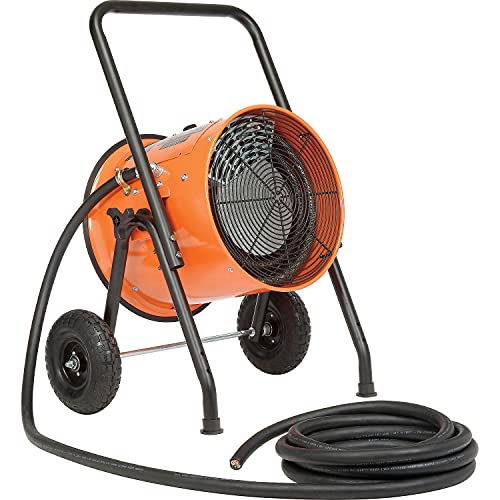
The Global Industrial salamander heater is a high-capacity option designed for robust spaces such as warehouses, garages, and construction environments. With 30,000 watts on a 3-phase 480V supply and a direct-wire installation design, this unit targets larger heat loads with a straightforward electrical hookup. The heater is built for endurance and can operate in demanding environments where heavy use is expected. It is suitable for temporary or fixed installations that require intense, consistent heat for extended periods.
Important considerations involve ensuring a suitable electrical service and proper enclosure or mounting method to suit the space. Review cable gauges, circuit protection, and local electrical codes before mounting or hard-wiring. Regular checks on connectors, wiring, and thermal protection will help sustain performance and safety.
Buying Guide: Key Purchase Considerations For 3-Phase Heaters
When evaluating 3-phase heaters, consider space size, heat output, and installation practicality to match a heating system with the space’s needs. Here are critical factors to weigh:
- Voltage and phase compatibility: Confirm the heater supports your available three-phase voltage (commonly 208V, 230V, or 480V) and verify wiring in the building meets local electrical codes.
- Heat output and room size: Calculate required BTU or wattage based on space volume, insulation, and target temperature. Larger spaces often benefit from higher-capacity units with even air distribution.
- Air distribution and ducting: Look for models with uniform airflow and adjustable louvers or fans to direct heat where it’s most needed, reducing cold spots.
- Mounting and installation: Decide between wall- or ceiling-mounted units and assess available mounting hardware, clearance, and accessibility for maintenance.
- Safety and protection: Opt for overheat protection, permanent lubrication, and rugged bearings. For portable units, consider remote thermostats and safety shutoffs where applicable.
- Electrical load and wiring: Plan for sufficient circuit capacity and appropriate breakers. In some cases, a licensed electrician is required to install three-phase equipment.
- Maintenance and reliability: Evaluate motor protection features, cooling efficiency, and ease of component access for routine servicing.
- Cost of operation: While prices aren’t listed here, larger 3-phase units generally offer greater heat output but require more power and robust electrical infrastructure. Factor energy use into total cost of ownership.
How To Choose Across The Options
For moderate spaces with consistent occupancy, models like the DR-P350 or Global Industrial 5KW can provide balanced warmth without overloading the electrical system. For larger shops or warehouses, the DR-P3200 or the 30,000W salamander bring substantial heat capacity, though they demand careful electrical planning. If you need versatility between compact and expansive areas, a mid-range model such as the DR-P3150 offers a balance of capacity and airflow control.
Installation And Safety Tips
Work with a licensed electrician to verify the three-phase supply and wiring. Ensure adequate clearance around the heater for heat dispersion and cooling surfaces. Use appropriate mounting hardware and follow manufacturer installation guidelines to minimize risk of overheating or electrical faults. Keep combustible materials away from heat sources and monitor the system during initial operation to confirm stable performance.