Best 20x20x1 Air Filter on a Budget for Clean Air
The aim is to help budget-friendly buyers find reliable 20x20x1 air filters that balance cost and performance. This guide highlights five affordable options that fit standard HVAC systems and offer solid filtration for homes with dust, pollen, or pet dander concerns. Each product section explains who it’s best for, plus practical trade-offs. Ideal for homeowners, renters, or offices seeking economical replacements without sacrificing basic air quality.
| Product | Best For | Approximate Size |
|---|---|---|
| Amazong Basics MERV 5 (6-Pack) | Budget starters; light filtration | 19.75 x 19.75 x 0.75 |
| Aerostar MERV 8 (6 Count) | Balanced efficiency; allergy-aware | 19.75 x 19.75 x 0.75 |
| Simply MERV 8 (6 Pack) | Universal compatibility; value | 19.75 x 19.75 x 0.75 |
| TRIGHTFILTERS MERV 8 | Higher pleat count; durable | 19.8 x 19.8 x 0.79 |
| Generic Fiberglass MERV 1 (4-Pack) | Very low-cost basics; quick change | 20 x 20 x 1 |
Amazon Basics MERV 5 Air Filter — 20x20x1 (6-Pack)

Best for: Renters or small spaces needing budget-friendly filtration. The MERV 5 rating captures larger particles and improves furnace airflow without high resistance. The 6-pack helps stock replacement for frequent maintenance.
- Pros: Easy on the wallet, promotes cleaner indoor air, supports efficient furnace or AC operation.
- Limitations: Lower filtration efficiency than higher MERV-rated filters; may be less effective against fine particles like smoke or fine dust.
Aerostar MERV 8 Air Filter — 20x20x1 (6 Count)

Best for: Homes with dust, pollen, or light allergies seeking better filtration without a high price. This filter’s MERV 8 rating captures more particles than a MERV 5 with enhanced media and electrostatic features.
- Pros: Higher filtration efficiency, good balance of air flow and capture, universal fit for many standard systems.
- Limitations: Slightly pricier than MERV 5 options; filtration might still miss very fine particles compared to MERV 11.
Simply 20x20x1 Air Filter — MERV 8 (6 Pack)
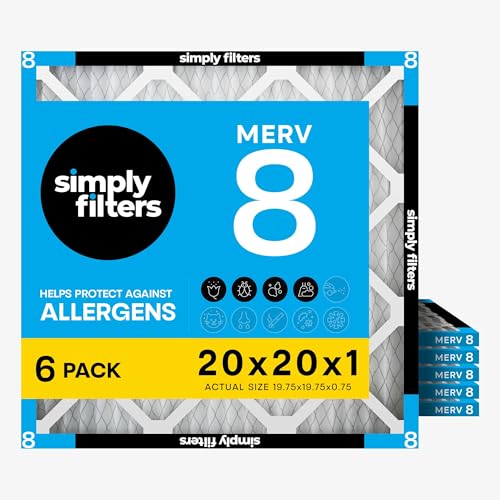
Best for: Budget-conscious buyers who want broader compatibility and reliable airflow. The Simply filters emphasize high pleat density for better particle capture without a premium price.
- Pros: Broad compatibility, strong particle capture for dust and pollen, relatively affordable for 6-pack.
- Limitations: Some systems may notice a modest pressure drop compared with premium options; check your furnace’s recommended MERV range.
Amazon Basics 20x20x1 Air Filter — MERV 11 (6-Pack)

Best for: Homes with allergy concerns or pets where higher filtration is desired. The MERV 11 rating captures finer particles and improves overall indoor air quality compared to MERV 8 or 5 options.
- Pros: Improved air quality for sensitive occupants; supports furnace efficiency by trapping more particles.
- Limitations: Higher resistance may reduce airflow in some older systems; verify compatibility with your HVAC model.
Generic Nested Fiberglass 20x20x1 (4-Pack)

Best for: Very budget-focused buyers needing quick, cost-effective replacements. These fiberglass filters provide basic protection and are easy to store in bulk.
- Pros: Lowest cost per filter; convenient 4-pack; simple to replace.
- Limitations: Lowest filtration efficiency among listed options; not ideal for allergy-prone households.
Generic 20x20x1 Fiberglass MERV 1 (4-pack)

Best for: Ultra-budget environments and temporary use where basic airflow protection is sufficient. Monthly changes are common.
- Pros: Extremely affordable; simple to replace; suitable for non-pet households or low-dust spaces.
- Limitations: Very low filtration efficiency; not advised for allergy sufferers or high-dust homes.
Generic 20x20x1 Nested Fiberglass — 4 Pack (30-Day)

Best for: Bulk buyers who want a month-to-month replacement plan with space-saving storage. The nested design helps with organization between replacements.
- Pros: Space-saving storage; consistent monthly filtration for moderate dust.
- Limitations: 30-day performance claims depend on environment; may require more frequent changes in dusty spaces.
Buying Guide: Key Considerations for 20x20x1 Air Filters
- Filtration level (MERV rating): Higher ratings capture finer particles but can increase airflow resistance. Choose MERV 5 for basic filtration, MERV 8 for general homes, and MERV 11 for allergy-prone environments if your system supports it.
- System compatibility: Ensure the actual size (often 19.75 x 19.75 x 0.75) fits your housing. The 20x20x1 designation is common, but exact dimensions matter for a proper seal.
- Pack size and replacement frequency: If you replace filters monthly or have multiple units, a 4-6 pack offers better value and convenience.
- Material and construction: Beverage board frames and wire mesh provide durability; fiberglass filters are cheaper but may have shorter lifespans.
- Allergies and pets: For homes with pets or allergy sufferers, consider higher MERV options or true HEPA filtration where appropriate, while verifying compatibility with your HVAC system.
- Price vs. performance: Balance upfront cost with filtration needs and the system’s airflow requirements to avoid under-performance or unnecessary energy use.
FAQ
- Q: Is 20x20x1 the right size for my HVAC filter? A: Check your furnace or AC’s filter size label; many standard units use 20x20x1 with an actual size around 19.75×19.75 inches.
- Q: How often should I change a 20x20x1 filter? A: Replacements typically occur every 30 days for dusty homes or pets; less frequently in clean environments. Follow the system’s recommendations and inspect monthly.
- Q: Which MERV rating is best for allergies? A: MERV 8 to MERV 11 offers better filtration for common allergens; ensure your HVAC can handle the higher resistance.
- Q: Can I use fiberglass filters in high-dust homes? A: Fiberglass options are affordable but offer lower filtration efficiency; for heavy dust or pet dander, consider higher MERV options.
- Q: Do higher-priced filters always perform better? A: Not always. Filtration needs vary by environment and system. Choose a filter that matches your dust level, airflow needs, and system compatibility.
- Q: Are multi-packs worth buying? A: Yes, if you replace filters regularly, multi-packs save time and often reduce per-filter cost.