Best 120V Tankless Water Heaters for Small Spaces
Answering the common buyer question, these compact 120V tankless water heaters are ideal for point-of-use hot water needs where space is limited. They’re best for single-sink applications, under-sink installations, or small kitchens and offices. The picks below emphasize ease-of-use, safety features, and efficiency, making them suitable for buyers who want quick hot water without bulky systems.
Overview table of selected products:
| Product | Best For | Key Benefit |
|---|---|---|
| LECLOC Mini Instant Under Sink 120V 3kW | Low-flow point of use | LED display and simple knob control |
| Rheem 3.5kW 120V POU | Compact, space-saving installs | Thermostatic control and small footprint |
| LECLOC Mini Tankless 120V 3kW (3500W version) | Under-sink applications | Hard-wired option with robust safety features |
| CAMPLUX 3500W 120V POU | Sinks and small bars | Fast hot water in 3 seconds, compact design |
| LECLOC 3500W 120V Hard-wired | Hard-wired installations | IPX4 protection and memory functions |
Rheem 3.5kW 120V Point of Use Thermostatic Tankless Electric Water Heater

This unit is designed for point-of-use installations with a compact footprint. It requires a dedicated 30-amp double-pole breaker and is wired to 120 volts. The thermostat offers 1-degree increment control from 80 to 140 degrees Fahrenheit, enabling precise delivery of on-demand hot water. Best for small sinks, breakrooms, or bedside setups where space is at a premium. Choose this if you need reliable temp control in a limited area. Limitation: only suitable for low-flow usage; multiple taps or showers can reduce output temperature.
Tankless Water Heater Electric 110V, 3000W Under Sink with Digital Display

This 110V unit uses a compact, energy-efficient design with an LED display and 3000W heating capacity. It can raise water temperature by a significant amount at low flow, suitable for a single sink. Not ideal for showers; better for quick kitchens or bathroom basins. The device highlights energy efficiency with a high thermal efficiency rating and automatic temperature controls. Best for customers who want quick, on-demand hot water at a single outlet. Caution: flow rate and inlet water temperature will affect the outlet temperature, so don’t expect full home-wide hot water.
LECLOC Mini Instant Under Sink Tankless Water Heater 120V 3kW (Plug In)
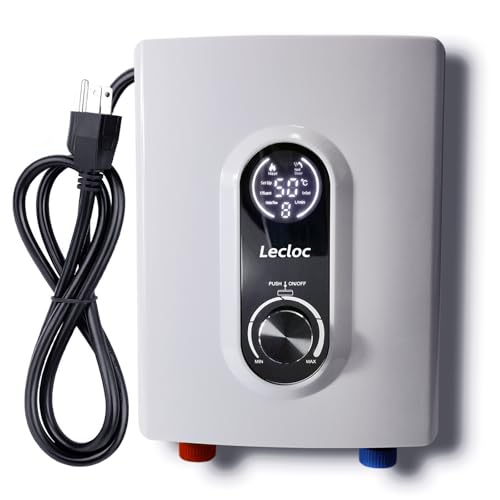
Designed for low-flow use with a plug-in 120V connection, this model features a LED digital display and a single large control knob. Thermostat range is 30°C to 55°C. It includes multiple safety protections: overheat, leakage, dry heating, over-pressure, and IPX4 waterproofing, plus automatic fault diagnosis and memory functions. Best for those who want straightforward operation and clear temperature feedback. Caution: not suitable for showers or multiple outlets simultaneously. If you need higher capacity, consider the hard-wired 6500W model instead.
LECLOC Mini Tankless 120V 3kW With Big Knob

This model mirrors the plug-in design but is noted for a robust LED display and a big control knob for easy operation. It supports a 30°C to 55°C range and includes full safety protections similar to other LECLOC units, including IPX4 waterproofing and fault-diagnosis features. Best for users who value a larger, easier-to-read interface. Caution: the 3500W hard-wired version requires a more capable electrical setup, which may not be available in all homes.
CAMPLUX Tankless Water Heater Electric 120V 3500W

CAMPLUX’s unit emphasizes rapid hot water delivery with a 3-second rise for a 1.0 GPM flow. It’s a compact, wall-mountable solution suitable for kitchens, wet bars, or boats. The self-modulating design adjusts power in real-time to conserve energy, claiming up to 98% energy savings compared to traditional heaters. Best for tight spaces where quick access to hot water at one sink is key. Caution: only suitable for small, single-sink use and not for showers or higher-flow demands.
Buying Guide
What to consider when choosing a 120V tankless water heater
- Flow rate and temperature: Most 120V units are designed for low-flow use. If your demand is higher (multiple taps or showers), choose a higher wattage model or a hard-wired option with more power.
- Electrical requirements: Plug-in units are easier to install but may require a dedicated circuit. Hard-wired models demand compatibility with your home’s electrical panel and a suitable breaker rating.
- Temperature control: Look for precise thermostats (1-degree or 0.5-degree increments) and clear displays to maintain stable hot water temperatures.
- Safety features: Overheat protection, leakage protection, dry heating protection, IPX4 waterproofing, and automatic fault diagnosis help prevent hazards and protect plumbing.
- Installation location: Point-of-use, under-sink, or small wall-mounted setups save space. Ensure clearance and venting requirements are appropriate for your area.
- Compatibility with existing plumbing: Verify inlet/outlet connections and compatibility with your faucet or sink setup to avoid flow restrictions.
Frequently Asked Questions
- Do 120V tankless water heaters work for showers?
They are generally designed for low-flow use at one or two fixtures. Showers with high flow typically require higher wattage or multiple units. - How do I choose between plug-in and hard-wired models?
Plug-in units are easier to install and suitable for limited, single-sink use, while hard-wired units support higher wattage and longer-term installations. - What temperature range do these units offer?
Most models provide adjustable ranges from about 30°C to 55°C (approximately 86°F to 131°F), with precise digital control on many models. - Are there safety features I should prioritize?
Yes. Look for overheat protection, leakage protection, dry heating protection, over-pressure protection, IPX4 waterproofing, and automatic fault diagnosis. - Will these units save energy?
Tankless designs generally consume energy only when hot water is needed, and self-modulating systems further optimize power use based on flow and temperature needs. - What installation considerations matter most?
Check electrical capacity, available space, plumbing connections, and whether you need a hard-wired or plug-in configuration for your home.