Best 10 Inch Duct Pipe Options for HVAC, Dryers, and Ventilation
Finding the right 10 inch duct pipe hinges on durability, ease of installation, and suitability for your specific application. This guide highlights five solid choices for American buyers, spanning flexible aluminum, semi-rigid, and galvanized options. Ideal buyers include DIY homeowners, hobby growers, and small contractors seeking reliable, long-lasting ventilation solutions. Below, a quick summary table helps compare core specs at a glance.
| Product | Diameter | Length | Best For |
|---|---|---|---|
| AC Infinity Flexible 10-Inch Aluminum Ducting (25 Feet) | 10″ | 25 ft | Overall ventilation runs with long reach |
| AC Infinity Flexible 10-Inch Aluminum Ducting (8 Feet) | 10″ | 8 ft | Shorter runs and tight spaces |
| Builder’s Best 10″ Semi-Rigid Aluminum Duct (8′) | 10″ | 8 ft | General venting with easy handling |
| DELISHENG Duct Connector Flange 10 Inch | 10″ | N/A | Rigid connections and mounting for fixtures |
| EXJCKLQF 10 Inch 12ft Aluminum Ducting | 10″ | 12 ft | Long flexible runs with four-layer protection |
AC Infinity Flexible 10-Inch Ducting (25 Feet)

Best for long, continuous ventilation runs where fewer joints are preferred. The four-layer design adds durability and leak resistance, while a steel-wire spiral makes the duct flexible enough for hard-to-reach paths. Suitable for HVAC, dryers, grow rooms, and tents. Best for homeowners planning extensive duct routes in basements, attics, or crawl spaces.
- Four-layer protection helps reduce rips and tears.
- Steel-wire spiral provides flexible routing without kinks.
- Designed for multiple ventilation scenarios beyond cooling and heating.
Limitations: Very long length may require careful handling to prevent sagging in unstructured spaces. Ensure adequate support brackets for vertical runs.
AC Infinity Flexible 10-Inch Ducting (8 Feet)

Best for compact spaces or shorter, targeted ventilation runs. Like the 25-foot variant, this option uses four-layer protection and a steel-wire spiral, but the shorter length makes it easier to route through closets, cabinets, or tight mechanical rooms. Ideal for smaller grow tents or focused HVAC sections.
- Four-layer construction supports durability in limited runs.
- Steels-wire spiral aids routing through tight spaces.
- Better for short, discrete venting segments than long main runs.
Caution: Shorter ducts may require more joints, which can introduce potential leak points if connections aren’t secured properly.
Builder’s Best 10″ Semi-Rigid Aluminum Duct (8′)

Best for general venting where a semi-rigid, easy-to-handle duct is preferred. This plain-ended pipe is non-insulated but suitable for moderate operating pressures. It’s a practical choice for standard venting tasks, such as basic exhaust routing in garages or workshops.
- Non-insulated, general-purpose venting duct.
- Corrugated aluminum with watertight continuous lock seams for durability.
- Best for straightforward, non-thermally extreme applications.
Limitation: Lack of insulation may reduce efficiency in very warm or cold environments; consider insulation if temperature variance is a concern.
DELISHENG Duct Connector Flange 10 Inch

Best for rigid connections and secure mounting to air cleaners, walls, or ceilings. This flange helps create a clean, secure interface between ducts and fixtures, reducing potential air leaks at joints. It’s well-suited for permanent installations in residential or small commercial settings.
- Iron construction with baking paint for a robust finish.
- Pre-formed holes for secure mounting to ducts and surfaces.
- Compact dimensioning compatible with 10″ ducting systems.
Caution: The flange is a connector part and may require compatible duct adaptors or mounting hardware for specific setups.
EXJCKLQF 10 Inch 12ft Aluminum Ducting
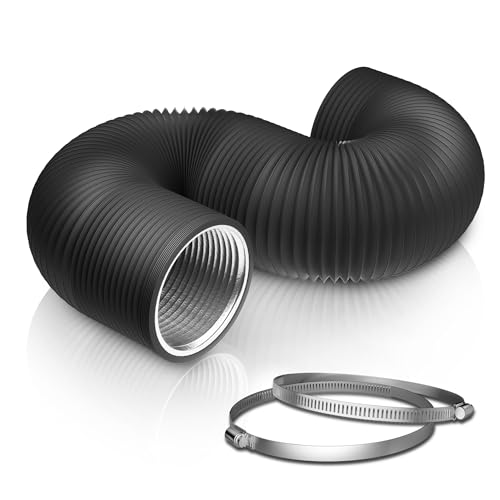
Best for long, continuous ventilation runs that require extended reach with strong protection. This 12-foot piece uses four-layer construction and is designed to resist tearing and pinholes, while stainless steel clamps ensure robust junctions. Suitable for larger HVAC or grow tent installations that demand fewer joints.
- Four-layer design minimizes leaks and damage.
- 12 ft length provides flexibility for larger runs.
- Stainless steel clamps offer secure, rust-resistant connections.
Limitation: Longer ducts may need more supports to prevent sagging and maintain optimal airflow.
Buying Guide: Key Considerations For 10 Inch Ducting
What is the intended use? For long duct runs in basements or attics, choose a longer, durable duct with strong protection. For closets or tight spaces, a shorter, more flexible option can simplify installation.
Is the duct insulated? Insulated ducts help maintain temperature and energy efficiency. Non-insulated ducts are acceptable for basic exhaust tasks or cooler environments.
What about material and construction? Aluminum ducts are lightweight and flexible; galvanized steel ducts are sturdy and rigid. Four-layer designs offer enhanced leak resistance and durability.
How important are clamps and joints? Stainless steel clamps and secure locking seams reduce air leakage. Plan for additional mounting hardware if needed for your space.
Do you need a flange or connector? A duct connector flange improves mounting stability and reduces joint weaknesses, particularly for permanent installations.
Frequently Asked Questions
- What diameter is standard for 10 inch ducting? Most options listed are precisely 10 inches in diameter, which equals common 10″ HVAC and dryer duct applications.
- Is four-layer ducting more durable than single-layer? Yes. Four-layer constructions provide better tear resistance and leak protection in challenging environments.
- Are aluminum ducts suitable for high-temperature use? Aluminum ducts handle typical HVAC and dryer temperatures well, though extreme heat should be evaluated on a case-by-case basis.
- When should I choose galvanized steel over aluminum? Galvanized steel offers rigid strength for fixed installations, while aluminum is lighter and easier to route in tight spaces.
- Do I need insulation with these ducts? Insulation is recommended in environments with temperature fluctuations to improve efficiency and reduce condensation risk.
- Can I cut these ducts to shorter lengths easily? Many ducts are designed to be cut to fit, but use proper tools and safety precautions to avoid damaging the liner or seams.