Best Whole House Propane Heaters for Reliable on-Demand Comfort
Finding the right whole-house propane heater means balancing capacity, efficiency, safety, and installation flexibility. This guide highlights five top propane tankless options that can deliver on-demand hot water or space heating efficiently for larger homes. Each model is evaluated for overall performance, safety features, and suitability for various layouts—from multi-point hot water sets to whole-home applications. Read on to compare how these units perform in real-world scenarios and what to consider before you buy.
Buying Guide Snapshot:
- Product Lineup: Five models chosen for high GPM and BTU output to serve multiple fixtures or zones.
- Key Considerations: Flow rate (GPM), BTU rating, efficiency (UEF/IF), outdoor vs indoor installation, safety protections, and warranty coverage.
- Usage Scenarios: Ideal for large households, multi-bath setups, or homes needing simultaneous hot water for showers, laundry, and kitchen tasks.
| Model | GPM / BTU | Location | Notes |
|---|---|---|---|
| CAMPLUX CA360W | ~3.6 GPM / 85,300 BTU | Indoor | 1-3 points, high efficiency |
| MIZUDO Gen 2 | Up to 5.1 GPM / 120,000 BTU | Outdoor | Self-modulating temperature |
| CAMPLUX CX422 | ~4.22 GPM / 102,000 BTU | Indoor | Multi-point use, anti-freeze |
| Nessxa 14L | ~3.7 GPM / 95,540 BTU | Indoor | Digital display, fast hot water |
| ThermoMate CZ422LP | ~4.7 GPM / 102,000 BTU | Indoor | High efficiency, safety features |
Camplux CA360W: 85,300 BTU Tankless Water Heater

The Camplux CA360W is a high-capacity propane tankless unit designed for whole-house hot water with 2-3 active zones. It delivers up to 85,300 BTU and 3.6 GPM, supporting simultaneous showers, kitchen use, and laundry without disruption. The model emphasizes continuous flow and year-round efficiency via intelligent gas control and a premium heat exchanger. A 0.93 UEF rating reflects meaningful energy savings over traditional models, and features like recirculation readiness reduce wait times for hot water. The CA360W includes preset temperature modes for family safety and convenience, with a digital display that monitors propane flow.
Key strengths: high-output capability for multi-point hot water, smart control to optimize usage, and strong efficiency gains compared to older propane heaters. Potential considerations include ensuring adequate outdoor ventilation and considering space for proper venting and line connections in retrofit applications.
MIZUDO Gen 2 Outdoor Tankless Heater

The Mizudo Gen 2 outdoor tankless heater operates up to 5.1 GPM with 120,000 BTU, making it well-suited for large families and homes needing multiple simultaneous hot-water points. It self-modulates temperature through a gas proportional valve and built-in control logic to maintain a tight ±1°F water temperature band. It claims year-round comfort and energy savings by avoiding standby heat loss inherent in storage models. The unit is UL listed and CSA certified, with a two-year full-unit warranty and five-year heat exchanger protection, underscoring its reliability for long-term use in residential settings.
Highlights include precise temperature control, efficient on-demand operation, and strong safety certifications. Installation considerations include outdoor placement, proper venting, and weatherproofing, as well as ensuring the outdoor disconnects comply with local codes.
Camplux CX422 Indoor Tankless Water Heater

The Camplux CX422 provides 4.22 GPM and 102,000 BTU, targeted at apartments, small homes, and multi-user zones. The smart chip and water flow sensors help maintain consistent hot water with fluctuations within ±1°F, delivering reliable showers across two to three fixtures. Anti-freeze protection allows safe operation in cooler climates, and the unit’s indoor installation makes it a versatile choice for compact living spaces without needing outdoor mounting. The CX422 is designed to balance performance with space efficiency, offering dependable on-demand water without the bulk of larger outdoor systems.
Considerations include indoor venting requirements, noise considerations from the combustion process, and ensuring the space meets minimum clearance for safe operation and service access.
Nessxa 14L Indoor Propane Tankless Water Heater
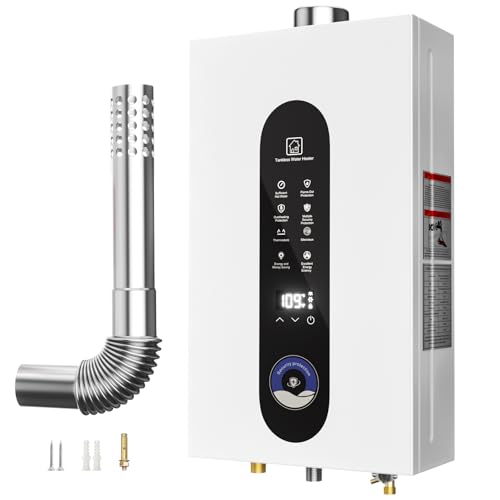
The Nessxa 14L model delivers 3.7 GPM at 95,540 BTU with an indoor installation footprint. It features a Fahrenheit/Celsius digital display for precise water-temperature monitoring, enabling rapid hot water delivery for showers, kitchens, or utility tasks. The unit emphasizes quick hot-water delivery and compact build quality, with a design that supports rapid heat response for households needing reliable on-demand heat without lengthy waits. The display and controls help homeowners quickly adjust temperatures to balance comfort and safety for children or elderly family members.
Considerations include ensuring ducting or venting compliance and verifying the unit’s temperature range aligns with your local climate and water supply characteristics. Regular maintenance of the heat exchanger will help sustain performance over time.
ThermoMate CZ422LP: Indoor 102,000 BTU Tankless

The ThermoMate CZ422LP delivers 4.7 GPM and 102,000 BTU, designed for indoor residential use with multi-point heating. It provides consistent hot water for 3-4 fixtures, supporting busy households with no cold-water shocks. A built-in water flow sensor adjusts heating power rapidly, keeping hot-water output within ±1°F. The unit includes a broad safety suite—boil-dry protection, freeze protection, flame-out protection, and overheat or over-temperature protections—helping prevent common tankless failures during heavy use or cold weather. Its oxygen-free copper heat exchanger contributes to high thermal efficiency and reduced operating costs by minimizing energy waste.
When evaluating this model, buyers should consider installation space, venting requirements, and service access for filter and sensor maintenance to preserve performance and efficiency over time.
Buying Guide: Key Purchase Considerations
- Flow Rate and Heat Output: Match GPM and BTU to your home’s hot water needs. Multi-point setups require higher GPM end-to-end to avoid temperature drops when multiple fixtures run simultaneously.
- Indoor vs Outdoor Installation: Outdoor units offer space savings indoors but require weatherproofing and robust venting. Indoor models demand proper venting and clearance for safe operation.
- Temperature Control and Safety Features: Look for precise temperature regulation (±1°F if possible) and protections such as boiler-dry, freeze protection, flame-out, and overheat safeguards to prevent scalding or system damage.
- Efficiency and Operating Costs: A higher UEF/energy efficiency rating translates to lower long-term operating costs. Consider units with advanced modulation to reduce gas consumption when demand is low.
- Maintenance and Longevity: Copper heat exchangers often offer better thermal transfer and corrosion resistance. Check warranty terms, parts availability, and access to service networks.
- Ventilation and Code Compliance: Ensure installation complies with local codes, venting requirements, and gas line sizing. Some models have CSA or UL certifications that support compliance in residential settings.
- Budget and Space: Outdoor units tend to require more initial layout planning but save indoor space. Indoor units may demand more careful placement due to venting and noise considerations.
Choosing the right propane tankless heater involves balancing capacity, efficiency, and installation constraints with household patterns. For large families or homes with multiple simultaneously used fixtures, prioritize higher GPM and BTU values alongside advanced safety features. For smaller layouts or apartments, a compact unit with precise temperature control and efficient heat exchange can minimize energy use while delivering reliable hot water across essential points.