Best Well House Heaters for Freeze Protection in Cold Weather
Keeping water systems, pumps, pipes, and equipment safe from freezing is essential in harsh climates. The following well house and utility heaters are designed to provide reliable freeze protection, efficient heat transfer, and safe operation in utilitarian spaces like pump houses, utility rooms, and greenhouses. This guide highlights five well-suited models, summarizes their standout features, and offers buying tips to help you choose the right heater for your setup.
| Product | Brand | Key Benefit | Power |
|---|---|---|---|
| AEGONAN Utility Heater with Built-In Thermostat | AEGONAN | Effective freeze protection with simple thermostat control | 600W |
| Qmark WHT500 Utility Heater | Fahrenheat | Durable, weather-resistant housing with constant protection | 500W |
| TRUSTECH Greenhouse Heater with Thermostat | TRUSTECH | Fast heat, adjustable tilt, three heat modes | 1500W |
| BEYOND HEAT Milkhouse Space Heater | BEYOND HEAT | Three heat settings with safety protections | 1300W/1500W |
| IAD 1200W Dog House Heater | IAD | Remotely and locally controllable for outdoor spaces | 850-1200W |
AEGONAN Utility Heater with Built-In Thermostat

Designed specifically for pump houses and utility rooms, the AEGONAN HPA600 provides reliable freeze protection with a built-in thermostat and a clear digital display. Its 600W heating element is adequate for small spaces where critical equipment must remain above freezing temperatures. A key advantage is its simple, low-maintenance design: no moving parts to wear out, which supports long-term operation in remote locations. The convection design uses X-shaped aluminum fins to maximize surface area for efficient heat transfer, spreading warmth quickly to reduce energy waste. This model is suitable for pump houses, relay stations, and other utility spaces where consistent temperature control is essential during frigid weather.
The built-in thermostat supports a temperature range from 40℉ to 105℉, allowing operators to preset a comfortable, safe environment. The display makes monitoring straightforward, and the heater operates quietly, minimizing disruption in surrounding areas. While compact, its rugged design emphasizes reliability in cold conditions, offering continuous operation with minimal maintenance needs. However, due to its 600W rating, it is best suited for smaller enclosures or spaces with moderate heat loss, rather than large rooms or spaces with significant air leakage.
Qmark WHT500 Utility Heater

The Qmark WHT500 is designed for utility rooms and well houses, offering 500W of heat to protect pipes and equipment from freezing. Its galvanized steel construction resists corrosion and the elements, making it a durable option for outdoor-adjacent spaces or rooms with fluctuating temperatures. A tamper-resistant thermostat inside a control box helps maintain consistent operation, allowing 24-hour protection without constant supervision. The heater’s compact footprint makes it easy to install in tight enclosures or alongside existing piping runs. Its combination of rugged build and reliable thermal control makes it a solid choice for continuous freeze protection of water lines and essential systems.
Users should consider the overall heat load of the space, as 500W may be insufficient in larger or highly insulated areas. For spaces with more heat loss, pairing the unit with additional insulation or a supplemental heater could be beneficial. The unit’s design emphasizes safety and long-term reliability, though its installation should adhere to local electrical codes and proper clearances from flammable materials.
TRUSTECH Greenhouse Heater with Thermostat
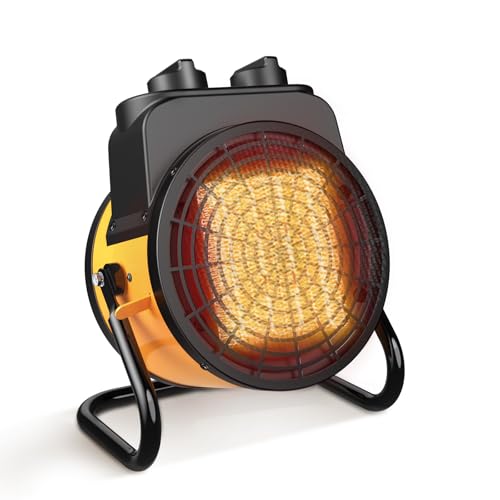
The TRUSTECH 1500W greenhouse heater provides rapid heating with a 3-second warm-up, using advanced PTC ceramic technology and a built-in fan. It supports three heat modes: High (1500W), Low (750W), and Natural Wind, enabling tailored warmth for greenhouses, flower rooms, or workshops. Safety is reinforced by an overheat protection feature and ETL certification, which helps ensure reliable operation in indoor settings. The unit offers a 90-degree tilt, allowing precise targeting of heat to plants or equipment without overheating adjacent areas. Its compact, bright yellow design makes it a visually distinct option for spaces where frequent adjustments are needed due to changing outdoor conditions.
Considerations include ensuring adequate ventilation in enclosed spaces and confirming that the heater’s exterior remains insulated from potential moisture exposure. The included thermostat supports stable temperatures, but larger spaces may necessitate multiple units or supplemental insulation to achieve uniform warmth across the area.
BEYOND HEAT Milkhouse Space Heater

The BEYOND HEAT milkhouse heater offers versatile heat settings with 1300W or 1500W options, plus a safe, automatic thermostat. A three-speed setup (including a fan-assisted mode) allows precise targeting for maintenance spaces like garages, workshops, or small warehouses. Safety features include a tip-over switch and automatic overheat protection to minimize hazards in busy environments. ETL certification further confirms compliance with safety standards for indoor use. The device employs a robust housing designed for durability in demanding settings, making it suitable for year-round operation in utility spaces where steady, moderate warmth is necessary to prevent pipe and equipment freezing.
When selecting this unit, consider the typical space temperature profile and whether a single unit suffices or if multiple heaters are required to achieve uniform warmth. The anti-freeze setting helps maintain a baseline temperature during extreme cold, but it should be paired with proper space insulation to maximize efficiency and protect vulnerable infrastructure.
IAD 1200W Dog House Heater

The IAD dog house heater provides flexible control with three heating modes (850W, 1200W, and ECO). It supports remote management via the Smart Life app, plus a traditional remote and a local control panel, enabling operators to maintain comfort for outdoor spaces such as well houses, greenhouses, or chicken coops. The heater promises rapid heating, capable of warming spaces up to 200 cubic feet, which is advantageous for small to medium-sized enclosures. The 6.6-foot external temperature probe and a chew-resistant power cord enhance practical durability for outdoor environments. This makes it a versatile option for pet zones, greenhouse corners, or utility nooks where remote oversight is valuable.
Potential considerations include ensuring reliable Wi-Fi coverage if remote control is used, and verifying that external probes are protected from direct weather exposure. The ECO mode supports energy savings but may require calibration to maintain stable warmth in varying ambient temperatures. Regular inspection of the probe and cord is recommended to maintain performance in outdoor settings.
Buying Guide
Key purchase considerations for well house and outdoor heating include heat load, space size, and insulation. Determine the required wattage by calculating the room’s volume and considering the level of air leakage. For small pump houses or utility closets, compact heaters with 500–800W can be sufficient, while larger enclosures may require 1500W or more. Consider whether you need a thermostat with a clear display, remote monitoring, or automatic safeguards such as tip-over and overheat protection.
Durability and weather resistance matter for outdoor or semi-outdoor installations. A galvanized steel housing or reinforced outer shell helps withstand moisture and temperature swings. If your space contains pipes, sensors, or other critical equipment, ensure the heater is positioned to protect against direct contact with liquids while still circulating warm air effectively. Safety certifications (ETL or equivalent) are a good indicator of compliance and reliability for indoor use.
Ease of installation and control options impact long-term usability. Built-in thermostats simplify operation, while models with remote control or app-based monitoring provide flexibility for remote sites. However, ensure that any smart features have stable connectivity and that firmware updates are available. Finally, consider cost of operation—choose the right balance between initial investment and energy efficiency, and whether multiple units are needed to achieve uniform warmth across a larger space.