Best Air Conditioners for Side-to-Side Window Installations
Choosing a window air conditioner that fits side‑to‑side installs means focusing on compact sizes, flexible mounting, and reliable cooling for tight spaces. The following models are well-suited for narrow or dual-adapter window setups, offering efficient cooling, easy maintenance, and smart features where available. This guide compares five popular options to help homeowners select a unit that blends with existing windows while delivering dependable comfort during hot days.
| Product | Brand | Approx. Capacity | Ideal Room Size | Key Benefit |
|---|---|---|---|---|
| Frigidaire 5,000 BTU Window | Frigidaire | 5,000 BTU | Up to 150 sq ft | Quiet operation with adjustable temperature control |
| BLACK+DECKER 8,000 BTU Window | BLACK+DECKER | 8,000 BTU | Up to 350 sq ft | Remote control and multiple cooling speeds |
| Midea 8,000 BTU U‑Shaped | Midea | 8,000 BTU | Up to 350 sq ft | Ultra‑quiet inverter design with smart control |
| Amazon Basics 5,000 BTU | Amazon Basics | 5,000 BTU | Up to 150 sq ft | Simple controls and washable filter |
| Amazon Basics 6,000 BTU | Amazon Basics | 6,000 BTU | Up to 250 sq ft | Digital display and easy maintenance |
Frigidaire 5,000 BTU Window AC

The Frigidaire model fits small rooms up to 150 sq ft and focuses on quiet operation with two fan speeds. Its Effortless Temperature Control helps maintain a preset comfort level, while a washable filter supports easy maintenance and long‑term performance. At roughly 52 dBA in standard mode, it is designed for bedrooms or compact spaces where quiet operation matters. Its compact profile makes it well suited to side‑to‑side window installations where space is limited, and basic remote or manual controls offer straightforward usage.
BLACK+DECKER 8,000 BTU Window AC
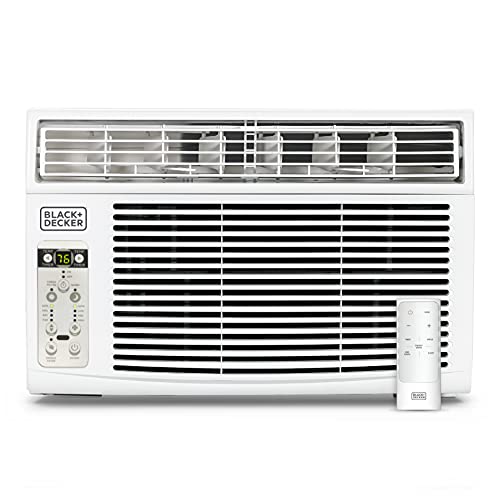
Designed for mid‑sized rooms up to 350 sq ft, this 8,000 BTU unit from BLACK+DECKER provides four cooling levels and a full‑function remote. It includes auto, low, medium, and high settings, plus a sleep mode and timer to optimize comfort and energy use. For side‑to‑side window configurations, its robust cooling capacity helps quickly reduce heat in larger spaces—making it a strong option for living rooms or home offices with dual‑pane or wider windows. The remote control simplifies operation from across the room, especially in layouts where reach to the unit is restricted.
Midea 8,000 BTU U‑Shaped Smart Inverter

The Midea U‑shaped design focuses on ultra‑quiet operation, with the open‑window noise barrier built into the unit’s frame. It delivers more than 35% energy savings with a DC inverter system and holds ENERGY STAR certification. Wi‑Fi connectivity enables control via apps, and compatibility with Alexa or Google Assistant supports voice commands. This model is ideal for side‑to‑side windows where minimal noise leakage and energy efficiency matter, even in busy urban settings. It cools effectively up to 350 sq ft and emphasizes a quiet, unobtrusive presence in the room.
Amazon Basics 5,000 BTU Small Window AC

This 5,000 BTU unit is designed for smaller spaces up to 150 sq ft, with two modes—cooling and fan. It features washable filters for easier maintenance and a set of seven temperature settings along with two‑speed cooling and fan modes. The adjustable direction control helps distribute air efficiently in tight side‑to‑side window configurations. It is a straightforward option for bedrooms or compact home offices where simple operation and dependable cooling are the priorities.
Amazon Basics 6,000 BTU Window AC

With 6,000 BTU of cooling capacity, this unit serves rooms up to about 250 sq ft. It combines cooling and fan modes with a washable filter for easy upkeep. A digital temperature display and remote control simplify adjustments from across the room, which is helpful when the window is in a narrower, side‑to‑side configuration. The two‑way air direction control helps tailor airflow to the room’s layout, making it a practical choice for medium bedrooms or small living spaces seeking reliable, user‑friendly cooling.
Buying Guide: Key Considerations for Side‑To‑Side Window Installations
When selecting a window air conditioner for side‑to‑side setups, consider these purchase factors to ensure a good fit and dependable performance:
- Window width compatibility: Check the unit’s width and any side panels or installation kits to confirm it fits nonstandard window frames. Some models ship with adjustable side panels that adapt to narrow openings.
- BTU vs room size: Match cooling capacity to the room’s square footage. Over‑ or under‑sizing can affect comfort and energy use. In side‑to‑side windows, a slightly larger unit can compensate for heat transfer around the frame, but avoid excessive BTU for small spaces.
- Noise level: For bedrooms and study spaces, look for units with low dBA ratings or quiet inverter technology. U‑shaped or insulated designs can reduce exterior noise intrusion in some models.
- Energy efficiency: Inverter technology and ENERGY STAR ratings help reduce electricity consumption, which matters if the unit will run for extended periods in mixed sunlight conditions.
- Remote and smart features: Ranging from basic remotes to app control and voice assistants, smart capabilities offer convenience for hard‑to‑reach installations or multi‑room cooling plans.
- Maintenance and filters: Washable or reusable filters simplify upkeep and help maintain air quality. Consider models with accessible filter housing for quick cleaning.
- Installation practicality: Some units provide easier mounting in side‑to‑side window frames with adjustable kits. If you rent or plan to relocate, look for units with simple removal and reinstallation steps.
- Durability and warranty: Check warranty terms and service options. Reliable after‑sales support is valuable for windows exposed to temperature swings and moisture.
For best results, measure the window opening, review your window frame’s depth, and verify whether the unit requires external side panels or a custom fit. If you have multiple rooms or a large living area, consider pairing two smaller units rather than a single large one to optimize airflow and control. Always follow the manufacturer’s installation instructions to ensure proper venting and secure mounting in side‑to‑side configurations.