Best Low-Power RV Air Conditioners for Off-Grid Comfort
Finding an RV air conditioner that won’t drain your battery or generator can be challenging. This guide highlights five low-power, roof-mounted units designed for off-grid use, light fuel consumption, and quiet operation. Each product section includes key cooling and heating capabilities, durable construction, and ease of installation to help you compare options for your trailer, van, or motorhome.
Summary of Selected Products
- Outequip RV Air Conditioner 12V 10000 BTU with Heater — 15-minute cooling, built-in heater, durable construction
- Outequip Pro 12V 10000 BTU Rooftop AC — battery-powered, long off-grid runtime, weather-resistant
- TOSOT 16000 BTU GO Cool RV AC — heat pump, WiFi control, suitable for mid-size RVs
- 12V RV AC with Heat Pump 11500 BTU — 12V direct power, quiet operation for off-grid travel
- Treeligo 12V Ultra-Quiet 7900 BTU Cooling / 3000 BTU Heating — lightweight, easy install, low-profile
Outequip RV Air Conditioner With Heater — 12V 10,000 BTU

Cooling capacity: 10,000 BTU with a 4,500 BTU heater. This unit delivers rapid cooling within approximately 15 minutes and offers a supplementary heat option for milder climates. It is designed for RVs, trucks, vans, campers, tractors, and other compact spaces. The unit emphasizes durability with UV-stabilized ABS housing, an EPDM gasket, and a zinc-coated condenser to resist weather and road exposure.
Outequip Pro 12V 10,000 BTU Rooftop AC — Off-Grid Friendly
Cooling performance mirrors the heater-equipped model at 10,000 BTU, with up to eight to ten hours of cooling on a high-capacity battery bank (12V 480Ah to 12V 600Ah). This unit is built for off-grid use, powered by your vehicle’s battery, and includes the same rugged construction features—UV-stabilized ABS, EPDM gasket, and a zinc-coated condenser—for durable outdoor operation in harsh conditions.
TOSOT 16,000 BTU GO Cool RV Air Conditioner

Designed for larger RV spaces, this non-ducted rooftop unit offers 16,000 BTU of cooling and 12,500 BTU of heating. It features WiFi control via the Gree+ app, enabling remote adjustment and monitoring. The unit is engineered to operate across wide outdoor temperatures, from 23°F to 115°F, with an indoor range of 61°F to 86°F, making it versatile for various climates and RV lengths up to about 600 sq ft equivalent in cooling space.
12V RV AC With Heat Pump — 11,500 BTU
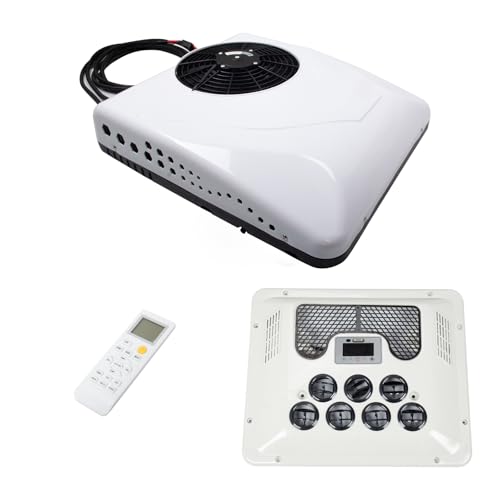
This 12V unit delivers 11,500 BTU of cooling with a heat pump for off-grid year-round comfort. It runs directly from a 12V battery system, avoiding the need for an inverter, and is designed for solar-powered installations. The system emphasizes quiet operation and efficient energy use, enabling comfortable temperatures in small to mid-sized RV interiors without excessive battery drain.
12V RV Air Conditioner With 11,500 BTU And Low Power Usage

This model focuses on high efficiency for off-grid RV travel, delivering 11,500 BTU cooling. It is a 12V DC system designed for direct battery use with minimal inverter dependence. Quiet operation ensures restful nights, and the unit is suitable for vans, trailers, or compact campers where 12V power is the primary source.
Buying Guide: Key Purchase Considerations For Low-Power RV Air Conditioners
When selecting a low-power RV air conditioner, consider how you plan to power the unit, the size of your space, climate, and installation feasibility. Here are essential factors to evaluate:
- Power source and compatibility: Determine whether the unit runs directly on 12V DC, or if it requires an inverter or auxiliary power. Off-grid setups benefit from models designed for battery banks and solar charging.
- Cooling and heating capacity: BTU ratings should align with your RV’s interior square footage. Larger RVs need higher BTUs; however, higher power often increases battery load. Consider units with heat pump capabilities for year-round comfort.
- Energy efficiency: Look for inverters, variable speed compressors, and intelligent controls. Energy-efficient models reduce battery draw and generator run time.
- Noise level: Quiet operation improves sleep and comfort on the road. Check dB ratings or user reviews for real-world performance.
- Durability and weather resistance: UV-stabilized housings, gasket quality, and corrosion-resistant condensers extend life in harsh climates and on rough roads.
- Installation and roof footprint: Compare roof dimensions and mounting requirements. Some units are compact and light, making retrofit easier on older RVs.
- Smart features and control: WiFi or app-based control can simplify operation and monitoring when you’re away from the RV or parked at a site.
- Maintenance and parts availability: Ensure the brand offers readily available filters, fans, and replacement components to avoid long downtime.
In practice, users balancing off-grid living with comfort tend to favor 10,000–12,000 BTU units for mid-sized RVs, paired with robust 12V battery banks or solar arrays. For larger trailers, 14,000–16,000 BTU units may be necessary, but require more energy management. Heat pump capabilities are a strong selling point for year-round use, particularly in mild-to-cold climates.
Installation considerations include roof clearance, mounting brackets, electrical connections, and whether non-ducted or ducted configurations suit your vehicle’s layout. Always verify compatibility with your RV’s ceiling height and existing electrical system before purchasing.