Best Stop Leak for AC Solutions: Top Refrigerant Sealants
Choosing an AC stop-leak product requires comparing effectiveness, compatibility, and ease of use. This guide highlights five reliable options designed for residential and light commercial cooling systems, explaining how they seal leaks, what refrigerants they support, and installation considerations. Readers will find clear, objective comparisons to help decide which product best fits their needs.
| Product | Brand | Key Benefit |
|---|---|---|
| BlueDevil A/C Stop Leak — 2 Oz | BlueDevil | Forms a chemical weld sealing leaks in various components |
| Leak Saver Direct Inject Ultimate 3-in-1 | Leak Saver | Seals leaks, removes moisture, adds UV dye in one kit |
| Leak Saver Direct Inject Small System | Leak Saver | Compact solution for small systems up to 1 ton |
| ERRECOM Extreme Ultra (6 Tons) | ERRECOM | Polymer-free formula with reusable cartridge |
| A/C Pro Car A/C Leak Stop Kit | A/C Pro | Split-pack with additives and metal/rubber leak sealing |
BlueDevil A/C Stop Leak — 2 Oz

BlueDevil’s Red Angel 49496 A/C Stop Leak is formulated to repair and seal leaks in condensers, evaporators, connection hoses, gaskets, and O-rings. It contains no solid or particulate matter that can clog the A/C system or harm a recovery unit, reducing the risk of downstream damage. The product forms a chemical weld sealing leaks in both R-12 and R-134a systems, making it versatile for older and newer vehicles. Typical applications include minor to moderate leaks where a persistent seal is feasible without a full system overhaul. Installation considerations include ensuring compatibility with the refrigerant type and following the product’s recommended dosage for the system size.
Leak Saver Direct Inject Ultimate 3-in-1
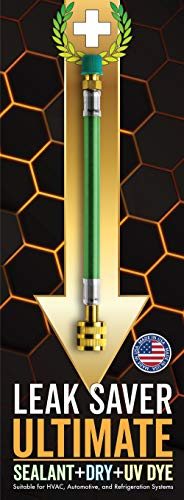
This 3-in-1 kit combines a sealant, moisture remover, and UV dye for system-wide treatment. It is designed to permanently seal refrigerant leaks where the complete charge is not lost within seven days. The product emphasizes compatibility with all systems and common refrigerants, including R410A, R22, R134A, and others. A straightforward installation approach is highlighted, suitable for professionals and DIYers with basic manifold gauge access. Notable considerations include ensuring compatibility with the vehicle or equipment’s refrigerant and following proper injection procedures to avoid over-pressurization or unnecessary dye use in small gaps.
Leak Saver Direct Inject Small System

This option targets compact configurations up to 1 ton, making it suitable for small home or automotive AC setups. It maintains the same core principle of reacting with air and moisture at the leak site to form a permanent seal. The kit emphasizes ease of use with standard equipment and compatibility across various refrigerants. When used as preventative maintenance, the active ingredient circulates to help seal future leaks, contributing to longer-term system reliability. As with all leak-stop products, verify system compatibility and follow safety guidelines for refrigerant handling.
ERRECOM Extreme Ultra (6 Tons)

ERRECOM Extreme Ultra is designed for HVAC/R systems up to 6 tons and claims compatibility with all refrigerants and lubricants. Its polymer-free formula aims to protect against system blockages and damage to components like expansion valves and Schrader valves. The product includes a 1/4 SAE and 5/16 SAE adapters and emphasizes a reusable, refillable design (US patent). Practical use involves performing a quick vacuum test to confirm leak repair feasibility and ensuring proper cartridge reuse lifecycle for cost efficiency. Consider system size and refrigerant type when selecting this option.
A/C Pro Car A/C Leak Stop Kit

A/C Pro’s leak stop kit provides a combination of refrigerant and additives designed to repair metal leaks in evaporators, condensers, compressors, accumulators, and receiver dryers, as well as seal rubber leaks in O-rings, gaskets, and hoses. The kit is positioned for automotive A/C systems and offers a practical, ready-to-use solution for minor leaks. When evaluating this option, consider the balance between additive performance and the potential need for professional recharging for certain systems, ensuring refrigerant compatibility and adherence to local regulations.
Buying Guide
- System compatibility: Confirm refrigerant compatibility (R134a, R410A, etc.) and whether the product supports both metal and rubber leaks. Some formulas are universal, while others are optimized for specific refrigerants.
- Leak size and type: Leak sealants are typically best for small to moderate leaks. Large leaks or multiple leaks may require professional service or replacement components.
- Ease of installation: Consider whether the sealant requires a simple injection, a standard manifold setup, or additional tools. Some kits offer dye for leak detection with UV light, which can aid in locating large leaks.
- Removability and future service: Some products form durable seals but may complicate subsequent repairs. Refillable or reusable cartridges can reduce long-term costs, but ensure compatibility with future service needs.
- Environmental and safety considerations: Use products as directed to avoid introducing particulates or moisture into the system. UV dye is useful for leak detection, but ensure it does not interfere with future refrigerant recovery or testing.
- Professional vs. DIY use: While many stop-leak solutions are marketed for DIY use, severe leaks or complex systems may require a licensed technician and proper refrigerant handling.
- Warranty and certification: Some brands offer warranties or guidance on system testing after application. Check for product certifications and manufacturer recommendations.
In choosing an AC stop-leak solution, assess the leak’s location, system size, refrigerant type, and whether you prefer a single-seal approach or a kit that also includes moisture removal and leak detection features. Pairing a leak-stop treatment with a follow-up vacuum test and pressure check can help validate repairs and reduce the risk of recurring leaks.