Best Nitrogen Regulator for HVAC: Top Picks for Purging, Inertization and Testing
Nitrogen regulators are essential tools for HVAC technicians, enabling safe purging, leak testing, inertization, and brazing or soldering jobs. The right regulator delivers clean, stable delivery pressures, robust construction, and reliable gauge readings. Below, you’ll find five top-rated nitrogen regulators designed for HVAC work, each with detailed features to help you compare performance, durability, and value. A quick summary table is provided to help you scan the essentials at a glance.
| Product | Brand | Inlet | Outlet | Key Benefit |
|---|---|---|---|---|
| RX WELD Nitrogen Regulator with 0-600 PSI | RX WELD | CGA580 | 1/4″ Male Flare | Clear gauges, compact design, versatile for 0-600 PSI range |
| RX WELD Nitrogen Regulator with 0-800 PSI | RX WELD | CGA580 | 1/4″ Female Flare | Longer hose option, higher max pressure |
| BETOOLL Nitrogen Regulator | BETOOLL | CGA580 | 1/4″ Male Flare | Extended hose for safe working distance |
| Victor Edge Series Nitrogen Purge/Flow | ESAB | CGA-580 | 1/4″ SAE (flare) Output | Advanced gauge protection and SLAM technology |
| SPARC Premium Nitrogen Regulator | SPARC | CGA 580 | 1/4″ SAE Flare | Lifetime warranty, robust brass construction |
RX WELD Nitrogen Regulator With 0-600 PSI

The RX WELD regulator uses a CGA580 inlet and a 1/4-inch SAE male flare outlet connection. It features easy-to-read 2-inch gauges with protective rubber boots, helping technicians monitor pressure accurately in the field. The unit supports an input range up to 4000 PSI and an adjustable output around 0-450 PSI, with the display capable of showing up to 600 PSI. This makes it suitable for purging, inertization, leakage tests, brazing, and soldering in HVAC contexts.
With its compact design, this regulator is typically paired with a nitrogen tank and a 5-foot refrigeration hose, enabling flexible positioning around equipment. The combination of rugged brass construction and protective gauge armor helps it withstand jobsite knocks. It’s particularly useful when you need a reliable regulator for both purging and pressure testing in tight spaces.
Considerations: If your work frequently demands higher infusion pressure or longer runs, you might evaluate models offering higher max outputs or longer hoses. The gauge protection is a notable benefit, reducing the risk of accidental damage during busy job days.
RX WELD Nitrogen Regulator With 0-800 PSI

This regulator extends the 0-600 PSI range to 0-800 PSI, with an adjustable output up to 600 PSI and gauges that read up to 800 PSI. It also uses the CGA580 inlet and a 1/4″ female flare outlet connection, making it compatible with a broad set of HVAC gauges and hoses. The included refrigeration hose (60 inches) offers a comfortable reach for purging and inerting tasks. It’s a practical choice for technicians working on larger systems or needing a higher pressure range for certain brazing operations.
Key benefits include a robust dual-gauge display and a flexible hose length that reduces the need to reposition tanks during work. The unit remains suitable for pressure tests, leakage checks, and brazing operations. As with lower-PSI models, ensure compatible hoses and gauges match the system’s required pressures to avoid over-pressurization.
Notes: If you routinely work at very high pressures or require maximum gauge clarity, verify the gauge visibility and whether you prefer a display rated to higher PSI for on-site safety and accuracy.
BETOOLL Nitrogen Regulator 78.7″ Hose

BETOOLL’s regulator emphasizes a long hose approach, supplying a 78.7-inch hose for greater working distance between the tank and active work area. It features CGA580 inlet and a 1/4″ male flare outlet with easy-to-read 2-inch gauges and protective boots. The nominal pressure ranges include 0-600 PSI for low pressure and 0-4000 PSI for high pressure, enabling precise control during purge, inertization, or leakage testing.
The extended hose can improve safety and convenience when installing or purging large HVAC units, or when space around the workpiece is limited. The durable brass construction supports prolonged field use. This model is well-suited for technicians who prioritize distance between the regulator and the soldering area or where hoses must traverse confined spaces.
Best practices: Pair with compatible hoses and gauges rated for your intended maximum pressure. A longer hose might slightly reduce maneuverability in tight setups, so consider your typical job footprint when choosing length.
SPARC Premium Nitrogen Regulator For HVAC
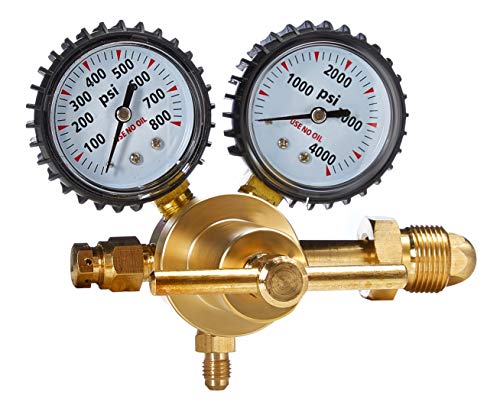
SPARC’s regulator is designed for robust HVAC use with a CGA 580 inlet and a 1/4″ SAE flare output. The unit features a full-size brass piston regulator and clear, single-scale 2-inch gauges protected by rubber guards. It delivers an adjustable output up to 600 PSI, with gauge readings that extend to 800 PSI on the display. The design emphasizes durability and user-friendly operation, including SLAM (Shock Limitation and Absorption Mechanism) technology in the adjusting knob to resist impact and provide reliable performance on rough job sites.
This model offers an industry-standard connection layout, making it easy to connect to common nitrogen tanks, gauges, and hoses. The combination of a rugged build and precise adjustment helps ensure accurate purge and pressure control during leak checks, brazing, and soldering operations. It is a strong option for professionals seeking durability and straightforward operation in a single package.
Acymner Heavy-Duty Nitrogen Regulator 0-800 PSI

Acymner’s regulator combines a solid brass body with dual gauges that show input up to 4000 PSI and delivery pressure up to 800 PSI. It features a CGA580 inlet and 1/4″ SAE male flare outlet with 7/16″-20 threads for secure connections. The double-gauge design helps technicians monitor both tank pressure and regulated delivery simultaneously, which is valuable during purge, inerting, or pressure charging tasks.
The product emphasizes durability and stable regulation in HVAC contexts, with rubber-protected dials to guard from daily wear and tear. It’s a practical choice for technicians who need reliable performance in challenging environments, including field service, installation, and service calls. Its versatility makes it suitable for a range of inert gas applications beyond HVAC too.
Buying Guide: How to Choose the Right Nitrogen Regulator for HVAC
- Inlet compatibility: Ensure the regulator uses CGA580 inlet threads, which are standard for nitrogen cylinders and most HVAC nitrogen setups.
- Outlet connection: Most common are 1/4″ SAE flare outlets. Verify that your hoses, gauges, and test equipment match these connections.
- Pressure range: For purging and inerting, a regulator with adjustable outputs up to 600 PSI is common, but higher max outputs like 800 PSI can be beneficial for certain brazing or test scenarios. Confirm your target operating range.
- Gauge design and protection: Dual gauges are preferred for simultaneous monitoring of tank pressure and delivery pressure. Protective boots or guards extend gauge life in field environments.
- Hose length and flexibility: Longer hoses reduce the need to move heavy tanks but can add clutter. Choose a length that fits your typical work area and safety guidelines.
- Durability: Look for solid brass regulators and robust construction. For frequent travel or tough conditions, SLAM technology and shock-absorbing features can reduce accidental damage.
- Certifications and warranty: A lifetime or long-term warranty indicates confidence in durability. Check for standard safety certifications and manufacturer support.
- Compatibility with gauges and tools: Confirm that the regulator’s output range aligns with your HVAC gauges, leak-test devices, and brazing equipment to avoid mismatches.
When selecting a regulator, consider the typical job site layout, the max pressure you’ll encounter, and whether you need longer hoses for safer distance between the tank and work area. For most HVAC purging and leak testing tasks, a regulator with 0-600 PSI output and a CGA580 inlet offers a reliable balance of control, compatibility, and durability. If your workflow involves larger systems or frequent brazing, models with higher max pressures and longer hoses can improve efficiency and safety.