Best Underfloor Heating Manifolds for Efficient Hydronic Heating
Choosing the right manifold is crucial for balanced, efficient radiant floor heating. This guide highlights five top underfloor heating manifolds that optimize flow, reduce air pockets, and simplify installation. Each product focuses on precise flow control, durable construction, and easy integration with common PEX systems. Read on to compare features, compatibility, and practical considerations for selecting a manifold that fits your project needs.
| Product | Brand | Key Feature | Loop/Branches |
|---|---|---|---|
| FAHKNS Floor Heating Manifold Kit | FAHKNS | Stainless steel build with automatic exhaust and precise flow control | 2 Loop (Radiant Heating) |
| Radiant Heating Manifold with Flow Meter | JurwheeR | Visual flow monitoring for easy balancing | 1/2″ adapters, various flow options |
| GPOAS 10-Loop Radiant Floor Manifold | GPOAS | 10 loops, corrosion-resistant SUS304 steel, built-in flow meter | 10 Loop |
| VEVOR 8-Branch Radiant Heat Manifold | VEVOR | Up to 5 L/min flow, dual temperature gauges | 8 Branches |
| YOTOSIRE 8-Zone Control Hub | YOTOSIRE | Smart wiring hub for independent zone control | 8 Zones |
FAHKNS 2-Loop Underfloor Heating Manifold Kit

The FAHKNS underfloor heating manifold is crafted from SUS304 stainless steel, offering a durable, corrosion-resistant frame. It features EPDM rubber seals for a strong seal and 1″ NPT ports with 1/2″ adapters to accommodate common PERT or PEX tubing. The kit includes an automatic exhaust and drain valve to purge air during filling and operation, reducing air locks and ensuring reliable performance. A visual flowmeter-type shut-off valve on the inlet branch enables precise adjustment of flow up to 0-5 liters per minute, supporting hydraulic balance across loops.
Key considerations include compatibility with standard PEX systems, the importance of proper sealing to prevent leaks, and ensuring correct valve sizing for your pipe diameters. This unit is well-suited for compact installations or retrofits where a two-loop layout is sufficient.
JurwheeR Radiant Heating Manifold With Flow Meter

The JurwheeR radiant heating manifold emphasizes precise flow regulation with an integrated flow meter to visually monitor each circuit’s performance. The system is designed to interface with standard underfloor heating manifolds and offers straightforward installation, making it a practical choice for DIY enthusiasts and professionals alike. Its compatibility with 1/2″ adapters supports common PEX piping used in residential radiant floor projects.
When evaluating this manifold, consider how the visual flow meter helps with balancing multiple zones, the ease of integration with existing manifolds, and the overall build quality. It is particularly useful in spaces where zoning accuracy directly impacts comfort and energy efficiency.
GPOAS 10-Loop Radiant Floor Manifold Kit

This GPOAS 10-loop manifold is constructed from SUS304 stainless steel for corrosion resistance and long-term durability. It includes 1″ NPT supply and return ball valves and 1/2″ adapters, with a visually monitored flow meter on the inlet branch. Its design supports precise distribution of heat across up to 100-150 square meters, providing robust performance for mid- to large-sized radiant floor installations.
Consider the need for space to accommodate 10 loops, the importance of an accurate flow meter to prevent water grabbing, and the benefit of a hardened main tube that resists demagnetization. This option is ideal for multi-zone applications requiring strong control over numerous circuits.
VEVOR 8-Branch Radiant Heat Manifold

The VEVOR 8-branch manifold offers a robust solution for mid-sized radiant floor systems. It features 1″ NPT supply and return ball valves, supporting a total flow rate up to 5 liters per minute. The unit includes 1/2″ adapters and dual temperature gauges (displaying Fahrenheit and Celsius), enabling quick temperature monitoring and adjustments. A visual flow meter on the inlet branch facilitates balancing of each loop, helping to prevent over- or under-heating specific zones.
Key considerations include ensuring compatibility with your floor area, evaluating gauge readability, and confirming adequate clearance for the installation. The combination of steel construction and gauges makes it a practical, maintainable choice for residential or small commercial radiant systems.
YOTOSIRE 8-Zone Control Hub
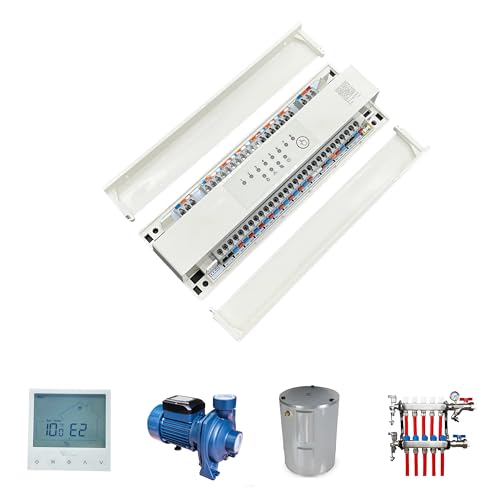
The 8-Zone Control Hub from YOTOSIRE is designed to centralize management of multiple heating zones. It provides independent control of pumps, valves, and actuators for each zone and is compatible with common smart thermostats such as Nest and Honeywell. The hub includes quick-connect terminals for tool-free wiring and built-in smart circuit protection with a replaceable 10A fuse to prevent overloads.
When evaluating this option, consider the compatibility with your preferred thermostat ecosystem, the wiring complexity, and the reliability of the protection features. This hub is well-suited for larger homes or projects with several zones that require centralized, programmable control for optimal energy use and comfort.
Buying guide: Key purchase considerations
- Flow balancing: Look for manifolds with visual flow meters or precise valves to achieve hydraulic balance across all loops, reducing cold spots and improving energy efficiency.
- Material and durability: Stainless steel (such as SUS304) offers corrosion resistance and longevity, beneficial for long-term radiant systems.
- Valves and connections: Ensure the manifold includes compatible valve sizes (commonly 1″ NPT for supply/return and 1/2″ adapters for PEX). Verify seal types and gasket reliability to minimize leaks.
- Capacity and zoning: Match the number of loops or zones to your installation size. A larger manifold with more loops provides greater flexibility for future expansion.
- Installation and compatibility: Check compatibility with your piping (PERT, PEX, or similar) and with your chosen smart thermostats or control hubs if you want zone-level automation.
- Maintenance and diagnostics: Features like automatic exhaust valves and clear flow monitoring can simplify maintenance and system diagnostics over time.
- Physical footprint: Consider space required for mounting, preferred orientation, and accessibility for future servicing.