Best Dehumidifiers for Crawl Spaces: Top Picks for Damp Areas
Crawl spaces can trap moisture, leading to mold, odors, and structural concerns. The right dehumidifier speeds up dry-out, protects stored items, and improves indoor air quality. This guide highlights five highly capable crawl space dehumidifiers that balance capacity, energy efficiency, and installation flexibility. Each product focuses on spaces up to several thousand square feet with features like built-in pumps, gravity drainage, and low-temperature operation to handle damp basements, warehouses, and utility rooms alike.
Summary of chosen products:
- EUHOMY 130 Pint Crawl Space Dehumidifier — Large 5500 sq ft dehumidification with timer and automatic features.
- Waykar 125 Pint Crawl Space Dehumidifier — Strong 300 CFM, pump drainage, and dual drainage options.
- Airecoler 125 Pints Commercial Dehumidifier — Compact design with R32 system and auto on/off timer.
- Moiswell 145 Pint Commercial Dehumidifier — High airflow for large spaces, compact footprint, auto features.
- CADPXS 80 Pint Crawlspace Dehumidifier — Built-in pump, dual drainage modes, compact portable design.
EUHOMY 130 Pint Crawl Space Dehumidifier
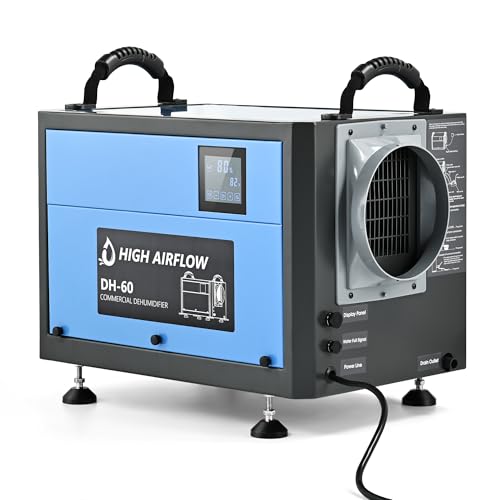
EUHOMY’s 130-pint unit delivers strong daily moisture removal and broad coverage, suitable for large basements, storage areas, or underground spaces. It features a high airflow of 210 CFM, enabling rapid humidity reduction in environments up to 5500 square feet. The unit includes a timer function for on/off scheduling and an automatic defrost feature to maintain performance in cooler conditions. A built-in filter helps improve air quality, while the compact footprint allows installation in tight crawl spaces.
Waykar 125 Pint Crawl Space Dehumidifier

This model brings 125 pints per day extraction with up to 300 CFM circulation, designed for spaces up to 6,500 square feet. It supports a wide RH range (10%–98%) for precise humidity control and has a dual drainage setup: a 16.4 ft pump hose plus a gravity hose. The rotary compressor design improves energy efficiency and reliability, with a tested build that aims for durable long-term performance. The pump allows flexible installation for elevated or distant drainage, making it a strong option for larger crawl spaces and commercial zones.
Airecoler 125 Pints Commercial Dehumidifier

The Airecoler GT-X5 stands out with its 125 pints per day capacity and a compact 19.2 by 12.2 by 13.4 inch form factor, making it adaptable for tight crawl spaces. It uses an R32 refrigerant system to boost efficiency and reduce energy consumption. A 24-hour auto ON/OFF timer provides scheduling flexibility, while the unit’s design supports stable operation in larger damp environments like crawl spaces and basements. This model is well-suited for commercial drying tasks and frequent use scenarios where space is at a premium.
Moiswell 145 Pint Commercial Dehumidifier

This Moiswell unit emphasizes high capacity and space efficiency, offering up to 145 pints per day removal and a compact horizontal design that fits between floor joists or in narrow crawl spaces. It supports auto defrost, memory starting, and a heavy-duty airflow of 265 CFM for rapid indoor drying. The unit is designed to handle up to 6,000 square feet, making it a solid choice for larger crawl spaces, basements, or industrial settings seeking robust moisture control with flexible installation options.
CADPXS Crawl Space Dehumidifier With Pump

The CADPXS model offers an 80-pint capacity with an integrated pump for automatic drainage. It suits crawl spaces, basements, and warehouses up to 1,000 square feet. The built-in pump can lift water up to 19.6 feet, and the unit supports gravity drainage as an alternative method, giving flexible installation options for varied layouts. Its compact dimensions facilitate placement in tight spots, and the dual drainage approach helps maintain uninterrupted operation during long dry-out phases.
Buying Guide: Key Purchase Considerations
- Space size and humidity level: Match the unit’s daily moisture removal (pints per day) and coverage area to your crawl space size. Larger areas may benefit from 125–145 pints per day and higher airflow (CFM).
- Drainage options: Choose models with a built-in pump for vertical drainage or choose those with gravity drainage. Pumps are essential for high installations or long runs, while gravity drainage simplifies setup in low-difficulty layouts.
- Energy efficiency: Look for Energy Star certification and refrigerant efficiency (R32 systems are common). Efficient units save operating costs over time in damp spaces that run continuously.
- Low-temperature operation: Crawl spaces can stay cool; select units rated for low-temperature operation to avoid internal freezing and maintain dehumidification performance.
- Controls and scheduling: Timers, memory starting, and automatic defrost help automate operation, reduce energy waste, and simplify maintenance in spaces that require long-term moisture management.
- Physical footprint and installation: Consider unit dimensions, mounting options, and whether the dehumidifier can fit in tight crawl spaces or be ceiling-mounted where needed.
- Maintenance needs: Look for accessible filters and straightforward cleaning routines to maintain efficiency and prevent mold buildup around the unit itself.
In evaluating these models, users should weigh the trade-offs between capacity, drainage flexibility, and footprint. For highly damp environments with limited space, a 125–145 pint unit with pump drainage provides robust performance and installation versatility. For smaller or narrow crawl spaces, compact 70–80 pint models with gravity drainage offer reliable dehumidification without crowding the area. Across all options, energy efficiency and automated features help maintain consistent humidity levels while keeping ongoing costs reasonable.