Best Condensate Pumps for Mini Splits: Quiet, Reliable Drainage Solutions
Choosing a condensate pump for a mini split system ensures efficient drainage, quiet operation, and safe overflow protection. The following hand-picked models are designed to handle the unique demands of mini-split installations, including ceiling or wall-mounted setups and tight line-set enclosures. Each option offers solid lift, dependable auto-start features, and practical maintenance access to keep your cooling or heating system running smoothly.
Summary Of Selected Products
| Brand | Model | Flow (GPH) | Max Head (ft) | Voltage | Special Feature |
|---|---|---|---|---|---|
| AQUASTRONG | Mini Split HVAC Condensate Pump (9.6 GPH) | 9.6 | 33 | 115V/230V | Automatic safety switch; quiet operation |
| FUJIWARA | Condensate Pump (24S) | 24 | 33 | 100-240V | Low noise; plug connection setup |
| Knocokie | Mini 100-240V White Split Condensate Pump | 38 | 20 | 100-240V | Ultra-quiet; independent tank and body |
| TURBRO | Mini-Split Condensate Pump | 10.5 | 66 | 100-240V | Float switch; low noise (≈19 dB) |
| WATNOVA | Automatic Undermount Mini Split Condensate Pump | 10 | 37 | 100-240V | Removable reservoir; dual-side installation |
AQUASTRONG Mini Split Condensate Pump

The AQUASTRONG unit delivers 9.6 GPH maximum flow with a 33-foot head, making it suitable for typical mini-split installations where vertical lift is modest. It features a thermally protected motor for reliable operation and a low-noise profile around 20 dB, minimizing sounds in living spaces. A hall switch enables auto operation, while a safety switch connection can alarm or shut the system if water rises undesirably. Its compact mini-split form fits line-set covers, wall cassettes, or ceilings with removable tank and filter for straightforward upkeep.
FUJIWARA Condensate Pump (24S)

FUJIWARA’s 24S model for mini splits offers a flow rate of 24 L/h with a 33-foot discharge head, designed for 1-3 HP air conditioners and related equipment. It uses a 100-240V wide-voltage design and consumes about 3 W, delivering quieter operation (below 16 dB). The plug-and-connect wiring simplifies installation, reducing the need for extensive rewiring. Suitable for HVAC, dehumidifiers, furnaces, and similar systems where automatic drainage is required, it maintains a compact footprint that blends with standard indoor decor.
Knocokie Mini Reversible Condensate Pump
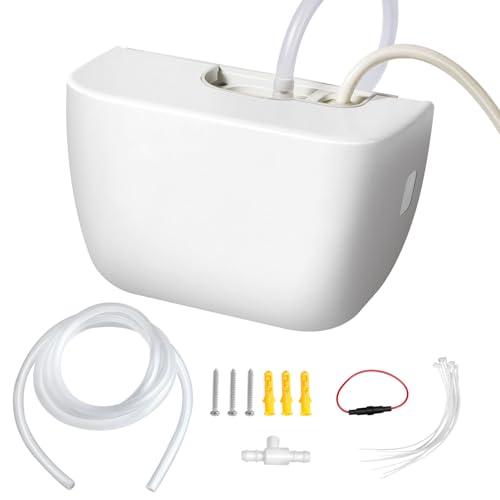
Knocokie’s model is a compact, ultra-quiet unit designed for micro-split installations, with a 38 L/h flow and up to 20 m of head. It operates on 100-240V AC and includes practical accessories like pipes and mounting hardware for easy setup. The independent water storage and a small footprint make it ideal for tight installations where a discreet, low-noise drain pump is necessary for HVAC, dehumidifier, or ice-maker applications.
TURBRO Mini-Split Condensate Pump

With a maximum head of 66 feet and a 10.5 GPH flow, TURBRO’s unit pushes water efficiently while maintaining quiet operation at about 19 dB. It includes a float switch for automatic control and safety shutoff, with recommended signal wiring to trigger alarms or shut down the AC in overflow scenarios. Its small footprint allows installation within ceilings, line-set covers, or evaporator units in many mini-split configurations.
WATNOVA Automatic Undermount Condensate Pump

WATNOVA offers a 10 GPH capacity with a 37-foot lift, featuring universal 100-240V compatibility and an 80 mL removable reservoir for simple maintenance. The detachable dual-side design helps conceal hoses and pumps for a cleaner appearance in homes or offices. The large capacity and straightforward cleaning cycles minimize downtime in busy environments, making it a practical choice for mini splits requiring dependable drainage without frequent servicing.
Buying Guide: Key Purchase Considerations For Mini Split Condensate Pumps
- Flow rate and lift: Match the pump’s GPH and maximum head to the mini split’s expected drainage volume and vertical distance to the drain. Higher heads are beneficial for installations with long line runs or ceiling placements.
- Voltage compatibility: Most mini split pumps operate on 100-240V AC. Ensure your electrical setup aligns with the device’s requirements to avoid voltage issues or added installation work.
- Noise level: Quiet operation is important for living areas and offices. Look for pumps advertising dB levels in the low teens to high teens for unobtrusive performance.
- Safety features: Auto-start/stop, float switches, and safety shutoffs protect against overflow and equipment damage. Some models offer audible alarms or shutoff to trigger HVAC systems if water is detected in the reservoir.
- Installability: Consider the installation environment—upmounting on walls, within line-set covers, or near ceiling spaces. Removable reservoirs and easy-access filters simplify maintenance.
- Maintenance and serviceability: Look for removable tanks, accessible filters, and clear documentation for routine cleaning to minimize downtime.
- Tank capacity and monitoring: A larger reservoir reduces maintenance frequency but may require more space. Reservoir design that allows quick inspection helps ensure timely cleaning.
- Durability and materials: Corrosion-resistant housings and robust motors extend life in humid environments typical of condensate drainage applications.
- Warranty and support: Check the warranty length and availability of customer support or replacement parts to protect your investment.
- Compatibility with existing equipment: Ensure the pump’s fittings, tubing size, and discharge connections align with your mini split’s condensate line and any existing drainage setup.