Best Clip Fans for Grow Tents: A Curated Guide to Quiet, Flexible Ventilation
Choosing the right clip fan for a grow tent is essential for consistent plant growth, temperature control, and energy efficiency. This guide highlights five reliable clip-on fans that offer adjustable airflow, quiet operation, and versatile mounting options. Each profile includes key features to help you compare between models and decide which setup best fits your tent size and plant needs.
Summary at a glance: the following table lists five top clip fans for grow tents, including their airflow flexibility, mounting capabilities, noise level, and notable design features. This quick reference helps you balance performance with budget and space considerations.
| Product | Main Benefit | Key Feature | Best For |
|---|---|---|---|
| Genesis 6-Inch Clip Fan | Quiet, versatile conversion | Clip-to-table design, dual speed | Small to medium tents, personal workspaces |
| VIVOSUN AeroWave A6 | Strong airflow, silent | Patented clamp, 80° horizontal, 120° vertical | Structured grow rooms, tents with poles |
| Simple Deluxe Clip Fan | Budget-friendly, adjustable angles | 6-inch, 2 speeds, 90° tilt | Beginners, smaller setups |
| AC Infinity CLOUDRAY S6 | Low-maintenance, precise control | EC motor, 10 wind speeds, IP54 | Larger tents, long-term use |
| VIVOSUN AeroWave E6 Gen2 | Smart control, flexible coverage | 10 speeds, 5-level auto oscillation | Advanced airflow management |
Genesis 6-Inch Clip Convertible Fan

- Two quiet speeds for cooling without noise
- Converts from clip-on to table-top use
- Adjustable head for directing airflow
The Genesis clip fan is designed for flexibility in compact spaces. Its two quiet speeds help maintain comfortable environmental conditions around a grow tent or desk area, while the clip-to-table conversion support enables multi-position placement. The adjustable head enables precise airflow direction, which is helpful when targeting warmer corners of a tent or a workstation nearby. This model balances basic performance with ease of use for smaller grow setups.
VIVOSUN AeroWave A6 Grow Tent Clip Fan

- Powerful airflow at low noise (about 40 dB)
- Patented clamp with non-slip rubber pad
- 80° horizontal oscillation and 120° vertical adjustment
The VIVOSUN AeroWave A6 focuses on strong, adjustable airflow with a quiet footprint, making it well-suited for medium-sized tents. Its patented clamp can grip round, square, and flat surfaces securely, reducing the risk of slips. The fan’s wide oscillation range allows targeting multiple plant zones, while head-adjustment helps position airflow exactly where it’s needed for efficient ventilation and leaf cooling.
Simple Deluxe Clip Fan, 6-Inch
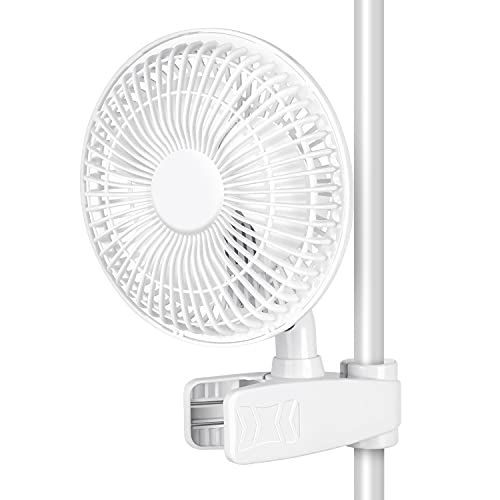
- Clamp fits 0.8–2 inch tent poles
- Two speeds for flexible air movement
- Max wind speed around 10.5 ft/s with low noise
The Simple Deluxe unit emphasizes a strong clamp grip paired with straightforward speed control. Its 6-inch blade size suits tighter grow tents, providing reliable airflow without taking up floor space. The combination of a firm mount and simply adjustable speed makes it a practical entry-level option for growers who want dependable, easy-to-use airflow without extra features.
AC Infinity CLOUDRAY S6 Clip Fan

- Long-life EC motor and IP54 weatherproofing
- 10 dynamic wind speeds and 10-level oscillation
- Optimized for hydroponics ventilation in larger tents
The CLOUDRAY S6 combines a robust, energy-efficient EC motor with weatherproofing to withstand grow tent environments. Ten adjustable wind speeds and ten oscillation levels offer precise control for different plant growth stages, while IP54 protection adds durability in humid or spray-prone settings. This model is suited for growers who need consistent performance in larger tents or extended cycles.
VIVOSUN AeroWave E6 Gen2

- 10 speeds, smart control with timer
- 5-level auto oscillation for targeted or broad coverage
- EC motor with strong airflow at low noise
The AeroWave E6 Gen2 advances clip fan technology with smart control features and a comprehensive oscillation range. The local timer supports programmable cycling, making it easier to maintain stable environmental conditions over time. With a powerful yet quiet EC motor and 10 speed options, this model adapts to different plant growth stages and tent layouts while maintaining energy efficiency.
Buying Guide: Key Purchase Considerations for Clip Fans in Grow Tents
- Airflow and noise balance: Look for fans that deliver adequate CFM for your tent size while keeping noise levels low to avoid stressing plants or disturbing your environment.
- Mounting versatility: Clip-on designs should offer secure poles or surfaces and, ideally, conversion between clip and table mounting to adapt to changing spaces.
- Oscillation and direction control: Consider models with adjustable oscillation angles (horizontal and vertical) or tilt features to maximize coverage and avoid hotspots.
- Motor longevity and durability: EC or brushless motors tend to offer longer lifespans and energy efficiency, especially in humid tent environments.
- Durability and IP rating: For damp tent conditions, IP ratings and splash resistance reduce long-term wear and failure risk.
- Smart features and timers: Timers and preset speeds help automate ventilation cycles, supporting healthy plant cycles and energy savings.
- Size and power compatibility: Ensure blade size fits your tent dimensions and that the power adapter length suits your setup without clutter.
- Maintenance needs: Look for fans with simple disassembly for cleaning and minimal parts that are prone to wear.
- Budget vs. performance: Higher-priced models often offer better durability, more precise control, and longer lifespans—evaluate total cost of ownership.
Across these options, users should weigh the need for quiet operation, precise airflow control, and reliable mounting in their forming grow tent environment. For small tents, a simple dual-speed model that clamps securely and can pivot might suffice. For larger tents or hydroponic setups, higher airflow with multiple speeds, timed operation, and robust oscillation becomes more valuable to sustain even airflow and temperature control.