Best Ventilation Systems for Restaurants: Efficient, Quiet Solutions for Commercial Kitchens
When selecting restaurant ventilation systems, prioritize high airflow, durability, and ease of maintenance. This guide highlights five well-suited options for American commercial kitchens, from rooftop exhaust fans to under-hood canopies. Each product is best for different space sizes and usage patterns, helping owners choose based on canopy size, noise tolerance, and installation type. The following table provides quick, side-by-side insights on key specs and typical applications for the featured units.
| Product | CFM Range | Best For | Installation Type | |
|---|---|---|---|---|
| PeakPursuit 1400 CFM Upblast Roof Exhaust Fan | 1400 | Smaller commercial kitchens, rooftop setups | Upblast roof mount | Weather-resistant, low-noise |
| FICBXRA Restaurant Canopy Hood Grease Rated Exhaust Fan | 1900-2600 | Busy kitchens with grease-heavy output | Under-hood canopy system | High-speed, grease-rated |
| HYITCL Food Truck Low Profile Exhaust Hood System | 0.25 HP rated fan, high CFM | Mobile or compact kitchens with canopy | Under-hood hood | Stainless steel, robust |
| VEVOR Commercial Kitchen Exhaust Fan | 612 | Small to medium canopies, outdoor setups | Direct-drive, wall or canopy mount | Weather-resistant, quiet |
| Intermetro RPHM20-2103 Blower | OEM replacement part | OEM replacements, custom builds | Internal blower | Genuine OEM |
PeakPursuit 1400 CFM Upblast Roof Exhaust Fan

Best for small to midsize rooftops, this PeakPursuit unit delivers 1400 CFM with a direct-drive motor for consistent performance. The upblast design helps push air away from the roof, reducing recirculation in busy kitchens. It is weather-resistant and uses spun aluminum housing to stand up to outdoor conditions. Choose this if you require reliable rooftop exhaust with lower noise levels in a compact footprint. A potential limitation is that 1400 CFM may not fully cover larger, grease-heavy kitchens without additional canopies or supplemental fans.
FICBXRA Restaurant Canopy Hood Grease Rated Exhaust Fan

This high-volume 1900–2600 CFM ceiling-to-cooktop exhaust fan is designed for grease-laden commercial kitchens. It’s paired with a 4-foot-wide canopy hood to capture smoke and odors efficiently, supporting multiple stoves and preventing smell spread. Best for busy restaurants or commercial kitchens with heavy plate throughput. It’s a strong choice when you need rapid air turnover and grease resistance. Limitation: Data notes a single-phase 110V motor; verify electrical compatibility on site.
HYITCL Food Truck Low Profile Exhaust Hood System

Best for mobile or compact kitchen setups, this 4-foot hood with a 0.25 HP direct-drive fan provides robust smoke and odor removal. It features NSF-certified stainless steel construction for durability in demanding environments. Ideal for food trucks or small kitchens needing a sturdy canopy and reliable airflow in a tight footprint. Caution: Ensure the motor and ducting are sized to handle the canopy’s air movement to prevent backdrafts or noise spikes.
VEVOR Commercial Kitchen Exhaust Fan
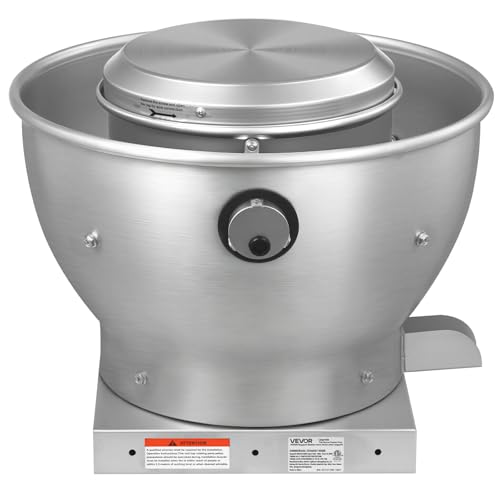
With 612 CFM and a weatherproof IP54-rated design, this unit suits outdoor-ready kitchen canopies and smaller restaurant spaces. Its direct-drive configuration provides solid airflow with relatively low noise. Best for operators who need a weatherproof option that won’t take up excessive ceiling or roof space. Limitation: 612 CFM may require multiple units or larger hood systems in very busy kitchens with high grease output.
Intermetro RPHM20-2103 Blower

The Intermetro RPHM20-2103 is a genuine OEM blower option suitable for replacement or custom ventilation configurations. This unit is best for kitchens that require OEM parts to maintain a consistent performance baseline and compatibility with existing systems. Opt for this if you operate a facility that relies on standard OEM components. Limitation: It functions as a blower component rather than a complete exhaust fan, so it may require integration with other system parts.
Buying Guide
Ventilation decisions hinge on space, throughput, and maintenance needs. When selecting a system, consider these practical questions:
- What is the peak cooking output and corresponding required CFM for your hood and kitchen layout?
- Is the system roof-mounted, under-hood, or a combination to optimize air capture and space use?
- How important is weather resistance for outdoor installations, and what is the expected noise tolerance?
- Do you need grease-rated options or rust-resistant materials for high-fat cooking environments?
- Will you require OEM parts compatibility for long-term maintenance and replacements?
Key considerations by installation type
- Rooftop exhaust fans: Ideal for steady, large-volume air removal and rooftop ducting, with weather-resistant housings and quiet operation as a priority.
- Canopy hood exhaust fans: Best for high-output kitchens with multiple burners; grease-rated and designed to capture smoke efficiently at the hood level.
- Under-hood or inline duct fans: Suitable for compact spaces, food trucks, or targeted odor control; prioritize stainless or corrosion-resistant materials.
- Direct-drive vs. belt-drive: Direct-drive units generally offer lower maintenance and quieter operation; belts may be preferred where speed control and load handling are critical.
- Materials and finishes: Stainless steel or aluminum housing improves durability in hot, greasy environments; weatherproof ratings matter for outdoor installations.
FAQ
- What CFM do I need for a medium-size restaurant kitchen?
Answer: It depends on the kitchen size, hood type, and cooking equipment; calculate using hood capture requirements and local codes, then select a unit within that CFM range. - Are grease-rated fans necessary for all restaurants?
Answer: For kitchens with high grease output, grease-rated fans reduce buildup and improve safety; smaller operations may manage with standard exhaust if properly maintained. - Is outdoor installation more expensive?
Answer: Yes, due to weatherproofing, corrosion resistance, and potential climate considerations, outdoor systems often cost more upfront and require robust installation. - How often should exhaust ducts be cleaned?
Answer: Regular cleaning depends on usage, but high-heat, high-grease kitchens typically benefit from quarterly to semi-annual professional cleanings. - Can I mix components from different brands?
Answer: Compatibility depends on mounting, electricals, and duct sizing; consult a licensed HVAC professional to ensure safe, compliant integration. - Do these systems meet common safety standards?
Answer: The listed items include grease-rated options and UL/ETL references in product descriptions; verify local codes and certifications during purchase.