Best Trailer a/C Units for RVs and Campers
Yes, you can cool a trailer or camper efficiently with a dedicated A/C unit designed for mobile use. This guide highlights five top-rated trailer A/C units, chosen for reliability, energy efficiency, and suitability for varying off-grid or on-road camping needs. They’re best for different buyers: lightweight trailers needing quiet operation, off-grid travelers seeking 12V flexibility, or larger campers wanting higher BTU cooling with heat pump capability.
Summary of selected products:
| Product | BTU / Type | Best For | |
|---|---|---|---|
| TOSOT 16000 BTU RV Air Conditioner | 16,000 BTU cooling / 12,500 BTU heat pump | Mid-size travel trailers needing year-round comfort | Whisper-quiet, WiFi & remote |
| Furrion Chill Cube 18k BTU | 18,000 BTU / Variable speed | Campervans and larger RVs, off-grid use | Lightweight, high efficiency |
| Xenjum 11k BTU 12V RV AC | 11,000 BTU cooling | Off-grid boondocking, battery-powered setups | Ultra-low energy, quiet |
| OutEquip 10k BTU 12V Rooftop | 10,000 BTU, 12V DC | Ultra-light trailers, trucks, or vans needing 12V | Off-grid ready, durable housing |
| Jrswin 15k BTU 12V DC A/C | 15,000 BTU cooling / 12V | Mid to large trailers and motorhomes, 12V reliance | High cooling with 3-speed fan |
TOSOT 16000 BTU RV A/C With Heat Pump

Product overview: This non-ducted rooftop unit offers 16,000 BTU cooling and a 12,500 BTU heat pump for year-round comfort. It operates across a wide ambient range from 23°F to 115°F, making it suitable for varied camping climates. It’s designed for RVs 16–24 feet, including Class B/C and travel trailers. The model emphasizes quiet operation at 43 dB, and includes WiFi and remote control for convenient management.
Best for: Campers and trailers that need strong cooling while staying quiet at night. Choose this if you want year-round comfort with a heat pump and smart control features. Caution: check compatibility with your roof and installation components; data suggests a straightforward bolt-on approach but installation specifics vary by RV model.
TOSOT 16000 BTU GO Cool RV A/C (Black)

Product overview: This Go Cool model mirrors the standard TOSOT performance with 16,000 BTU cooling and 12,500 BTU heat pump, designed for mid-sized RVs and trailers. It emphasizes quiet operation (43 dB) and includes smart features like WiFi and remote control, enabling convenient adjustments from anywhere.
Best for: Buyers seeking a balanced power-to-quiet ratio with smart controls for longer camping sessions. Consider if you want the same reliability as the other TOSOT unit but in a black, non-ducted package designed for easy rooftop mounting.
Xenjum 12V RV A/C, 11k BTU

Product overview: This 11,000 BTU unit runs on 12V DC, designed for off-grid boondocking. It claims rapid cooling (up to 3 minutes to reach target temperature) with a soft-start feature that reduces startup power surges by about 70%. It supports extended runtime on battery systems, and is compatible with solar setups for extended off-grid adventures. Quiet operation at about 35 dB adds to nightly comfort.
Best for: Off-grid campers who rely on battery banks and solar power. Choose this for low startup power and long runtime, but be mindful of its 11,000 BTU rating which is lower than some larger units.
OutEquip 12V RV Rooftop A/C With Heater

Product overview: This 10,000 BTU 12V DC unit provides cooling and a 4,500 BTU heater. It’s designed for off-grid use with quick cooling in about 15 minutes and claims up to 8–10 hours of runtime on typical battery setups. The housing uses UV-stabilized ABS with EPDM gasket and a zinc-coated condenser for weather resistance.
Best for: Light-to-midweight trailers and trucks needing a compact, weather-tough unit with integrated heating for shoulder seasons. Caution: heater is supplementary and not intended as a primary heat source in extreme cold.
OutEquip 12V 10000 BTU RV A/C With Heater

Product overview: This 10,000 BTU unit cools efficiently in about 15 minutes and includes a 4,500 BTU heater for mild warmth. It emphasizes weather-resistant construction with UV-stabilized housing and a durable condenser assembly for tough outdoor conditions.
Best for: Buyers prioritizing a compact, budget-friendly 12V option for trailers and vans that still offers heating for milder days. Limitation: heater capacity is supplementary; plan for additional heat if needed in colder conditions.
Jrswin 15k BTU 12V DC A/C
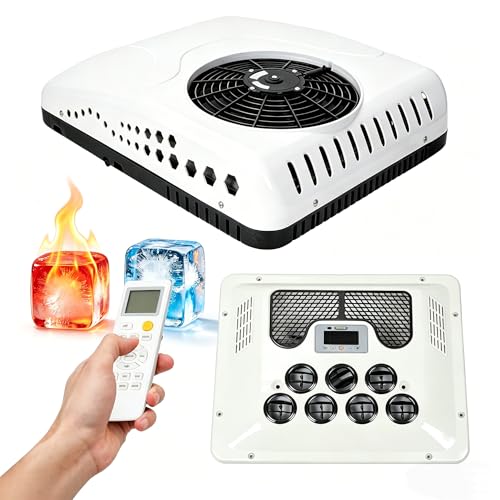
Product overview: A 15,000 BTU cooling unit designed for 12V DC operation, suitable for vans, trailers, motorhomes, and similar platforms. It features a digital control panel and three-speed fan. It’s positioned as a higher-capacity option for 12V setups, enabling strong cooling on off-grid trips.
Best for: Campers and trailers needing robust cooling with 12V dependence, where higher BTU cooling is a priority. Caution: note that installation and refrigerant requirements should be confirmed for your vehicle’s system.
Buying Guide: How to Choose the Right Trailer A/C Unit
What size trailer needs which BTU?
BTU requirements scale with space and ceiling height. A rough guideline: smaller trailers (under 18 feet) often do well with 10,000–12,000 BTU units; mid-size trailers (18–24 feet) commonly use 15,000–16,000 BTU systems; larger (over 24 feet) may require higher capacity or dual units. Consider insulation, window area, and climate when selecting BTU.
Do you need a heat pump?
Heat pumps provide both cooling and electric heating, valuable for shoulder seasons. Units with heat pumps remove the need to run a furnace for mild mornings or evenings. If you camp in cold but not extreme conditions, a heat pump can improve comfort and energy use.
Off-grid and 12V considerations
For boondocking, 12V DC units or those with soft-start tech reduce battery draw and extend runtime. Check battery bank capacity, solar availability, and inverter capability. Remember that 12V models may deliver less cooling power than 120V counterparts, so balance expectations with power availability.
Noise level and comfort
Quiet operation improves night-long comfort, especially in small trailers. Look for decibel (dB) ratings around 35–43 dB for rooftop units. Quieter models often cost more but significantly enhance sleep quality in compact spaces.
Installation and compatibility
Rooftop units require a compatible roof opening and mounting kit. Some units come as “AC unit only,” with installation components sold separately. Ensure you have the right rooftop thickness, sealant, and electrical connections for a secure, weatherproof fit.
Energy efficiency and running costs
Variable-speed or inverter-driven compressors use power more efficiently, especially on battery systems. A higher efficiency unit can reduce duty cycle and extend battery life during camping trips.
Warranty, service and parts availability
Choose brands with accessible customer service and available replacement parts. Rooftop A/Cs in RVs are a long-term investment; ensure you can source capacitors, fans, and seals if needed in the future.
Summary checklist
- Trailer length and layout alignment with BTU rating
- Need for heat pump and shoulder-season use
- Off-grid power availability and 12V compatibility
- Quiet operation for nightly comfort
- Installation requirements and roof compatibility
Frequently Asked Questions
- What is the advantage of a heat pump RV A/C?
- Can I run a rooftop A/C on 12V power?
- Which A/C unit is best for off-grid camping?
- Do all RV A/C units fit all trailer roofs?
- Is a higher BTU always better for a small trailer?
- What maintenance is needed for rooftop RV A/C units?