Best Tiny House Heat Solutions: Portable Water Heaters and Pumps for Compact Living
To meet the needs of compact homes, tiny houses often require reliable hot water and space-saving heating options. This guide highlights five compact, portable water heating and circulating solutions ideal for tiny living. Each product is evaluated for who it suits best, why it’s a good fit, and any practical limitations to consider.
Summary Table of Selected Products
| Product | Best For | Why It Stands Out | Limitations |
|---|---|---|---|
| CAMPLUX BW158G Tankless Water Heater | Tiny homes with propane access | Lightweight, 1.58 GPM on-demand hot water, battery-powered, no electricity needed | Requires propane and battery setup |
| CAMPLUX F5 Pro 1.32 GPM | Ultra-portable setups | Very light and compact, fast hot water, easy carry handle | Low flow compared to larger models |
| CAMPLUX BD422P120 4.22 GPM | Off-grid cabins and tiny houses needing higher flow | High hot-water output, pump kit included for better pressure | Heavier and larger footprint |
| GASLAND Goshower G5 Pro | Camping showers and off-grid outdoor use | Ultra-slim design with safety features and battery ignition | Lower flow at 1.32 GPM |
| bayite BYT-7A015 12V Solar Pump | Solar-powered circulation for solar-heated systems | Low-noise DC pump, 12V operation, long service life | Not a heater; supports solar loop circulation |
CAMPLUX Tankless Water Heater BW158G 1.58 GPM
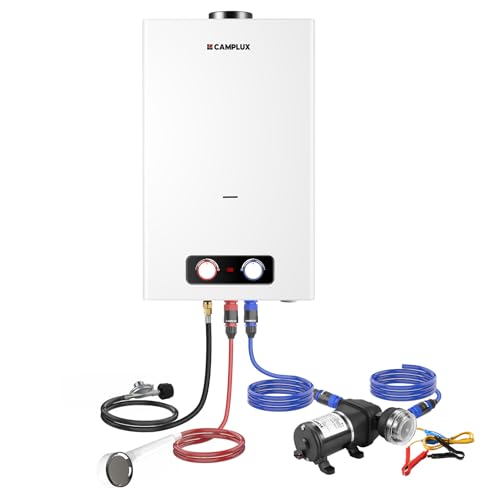
Best for: Tiny homes and RV setups where propane is available and electricity is limited. This unit is lightweight (about 13 lbs) and designed for portability, enabling on-demand hot water without needing a fixed electrical hookup. The BW158G uses a battery-powered ignition and runs on 20 lb propane tanks, with a foldable handle for easy hanging or storage. The supported temperature range (hot water) helps plan showers or dishwashing in compact spaces.
Why selected: It combines propane independence with on-demand performance, making it a practical choice for off-grid or mobile living. The pre-installed regulator and quick-connect fittings simplify installation, while a 1.58 GPM flow supports basic hot-water needs in a tiny house. The 41,000 BTU/h capability ensures quick heating, useful when water is preheated or when demand spikes briefly.
Best for: Buyers who want a compact, electricity-free hot water option with straightforward setup for outdoor or semi-indoor tiny homes. Caution: This model relies on propane and a battery-powered system; ensure safe outdoor venting and proper storage for propane components.
1500W Portable Garage Heater (Poople) Outdoor Heater

Best for: Tiny-house spaces needing fast, flexible space heating in cooler months. This unit offers three heating modes and rapid warmth within minutes, making it suitable for garages, workshops, or covered outdoor areas adjacent to a tiny home.
Why selected: It provides a compact electric heating solution with built-in overheat protection, which is valuable in small, insulated spaces. The trio of modes supports varying weather and use cases, from fan-only circulation to low and high heat. The main caveat is higher energy draw, so plan electrical capacity accordingly in a tiny-house electrical panel.
bayite BYT-7A015 DC 12V Solar Hot Water Pump

Best for: Tiny houses with solar panels that want to circulate water in a solar-heated system. This 12V DC pump is designed for low-noise operation and a long service life, making it a good fit for off-grid or energy-conscious builds.
Why selected: A circulating pump is essential if you rely on solar-heated water or gravity-fed systems. The BYT-7A015 provides a quiet, durable option that integrates with standard 1/2″ tubing. It complements other heating components by moving water efficiently, enabling more consistent hot water distribution in a compact home.
CAMPLUX Tankless Water Heater 1.58 GPM BW158G (Second Model Reference)

Best for: Tiny houses that require a compact, portable heater with on-demand hot water and minimal electrical dependence. This variant reinforces the popularity of the BW158G approach in small-footprint living.
Why selected: The BW158G family remains appealing for its portability and quick heating capability. It supports the core tiny-house need for on-demand hot water without large infrastructure changes. The main limitation is the propane and battery dependency, which requires careful handling and outdoor venting in some installations.
CAMPLUX F5 Pro 1.32 GPM Portable Water Heater
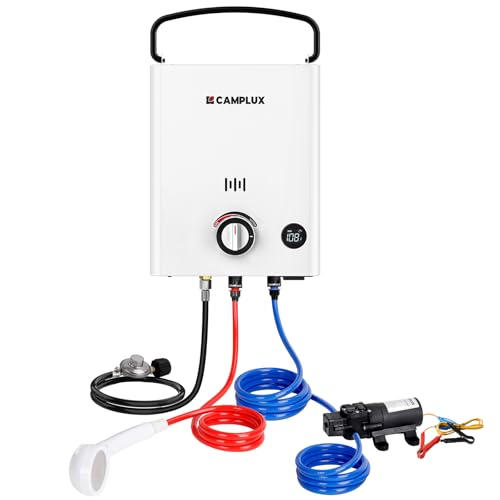
Best for: Tiny houses that prioritize ultra-portable design and quick install. The F5 Pro delivers on-demand hot water with a compact footprint, ideal for mobile living, RVs, or cabins with limited space.
Why selected: It’s notably light (about 11.8″ by 5.3″ by 14.6″ with a 10.8 lb weight) and simple to carry. The model uses a two-in-one knob for water flow and heat control, simplifying operation. Caution: Lower output at 1.32 GPM means slower showers or dishwashing if several hot-water tasks occur simultaneously.
CAMPLUX 4.22 GPM BD422P120 Tankless Heater Bundle
Best for: Tiny houses or cabins needing higher hot-water throughput and a complete kit. The BD422P120 includes a pump, pipe strainer, and the 110,000 BTU output for faster, stronger heating, even in off-grid conditions.
Why selected: This bundle optimizes everyday hot-water needs with a higher flow rate, which helps when multiple outlets (shower, sink, and kitchen) rely on hot water. It’s a practical choice for tiny homes expanding their comfort without upgrading space. Caution: Heavier and larger than handheld units, so ensure adequate mounting space and support for the heavier setup.
Buying Guide: Key Considerations for Tiny-House Heat Solutions
- Water flow needs: Tiny homes typically require 1.0–1.58 GPM for basic showers and dishes. For more demanding use, consider higher-flow options like the 4.22 GPM BD422P120 bundle.
- Fuel and power availability: Propane models work well off-grid but require venting and storage. Electric models demand electrical capacity; check panel space and circuit limits.
- Portability vs. fixed installation: Lightweight, battery-powered units suit mobile living; heavier bundles suit stationary tiny homes with dedicated space.
- Cold-weather performance: Look for quick-heat models and sufficient BTU ratings to prevent long waits in cold months. Consider insulation around hot-water lines to minimize heat loss.
- Safety features: Overheat protection, flame-out protections, and anti-dry burning safeguards are essential in compact living spaces with limited ventilation.
- Installation simplicity: Models with pre-installed regulators and quick-connect fittings save setup time. For off-grid use, battery or solar compatibility adds flexibility.
Frequently Asked Questions
- Can a tiny house use propane water heaters safely? Yes, with proper venting, outdoor positioning, and adherence to clearance requirements from the manufacturer.
- Is an electric heater better for a tiny house than propane? It depends on your available power and climate. Electric models avoid gas handling but require sufficient electrical capacity.
- Do these heaters provide continuous hot water? On-demand units supply hot water as long as water is flowing and the unit has fuel or power; continuous hot water depends on flow and fuel supply.
- What maintenance is required? Regularly inspect hoses, fittings, and venting; check for leaks; replace batteries or burners as recommended by the manufacturer.
- Are these suitable for outdoor use? Many models are designed for outdoor or semi-outdoor use, but ensure weather resistance and appropriate mounting before deployment.
- Can I use a solar pump to improve water pressure in a tiny house? A solar circulating pump can help move hot water through a solar-heated loop and improve efficiency in off-grid setups.