Best Solar Powered Attic Fan With Thermostat for Efficient Home Ventilation
If you’re searching for a solar powered attic fan with thermostat, you’ll want a model that automatically regulates airflow, preserves energy, and cools your space without constant monitoring. This guide highlights five top picks that balance power, reliability, and price. It’s ideal for homeowners seeking year‑round attic ventilation, warehouses, garages, or sun-exposed spaces. The listed products are best for different needs: smart control, weatherproof design, hybrid power options, and quiet operation. A quick buyer’s table follows to compare core specs at a glance.
| Product | CFM | Power | Smart/Auto Features | Best For |
|---|---|---|---|---|
| VEVOR 42W Solar Attic Fan | 2800 | 42W | Smart temp/humidity control, remote | Hot attics with remote operation |
| iLiving Hybrid Ready Solar Roof Fan | 1150 | 40W | Smart thermostat control, 29–50°F range | Homes needing tight thermostat control |
| BINGLUX 55W Solar Attic Fan | 1300 | 55W | Smart thermostat with auto on/off | Energy‑saving, variable sun |
| Hon&Guan Solar Attic Fan | 2000 | 40W | Thermostat control, dual power auto-switch | High airflow with weather resilience |
| DuskSnug 40W Solar Attic Fan | 1800–2000 | 40W | Controller‑free auto ventilation | Simple, reliable solar venting |
VEVOR 42W Solar Attic Fan – 2800 CFM

The VEVOR 42W model uses an MPPT regulator to maximize sunlight and exhaust hot air up to 2800 CFM. A brushless DC motor provides quiet operation, and it is designed for metal or masonry roofs. Best for large attics or garages with strong sun exposure, where rapid cooling and energy savings matter most.
Who it’s best for: homeowners needing strong solar cooling and remote control access from up to 9.75 meters away. Why selected: high airflow per watt, weatherproof build, and integrated temperature/humidity sensing for automated adjustments.
Note: While it shifts to electric power at sunset, performance depends on daylight intensity. Consider sun angle and roof type for optimal results.
iLiving Hybrid Ready Smart Thermostat Solar Roof Attic Exhaust Fan

This 14″ fan combines a 40‑Watt solar panel with smart thermostat control (50°F–122°F) and an adjustable solar panel angle for dusk til dawn efficiency. It cools up to 2900 sq ft and includes IP68 waterproof motor protection, plus a long warranty window. Best for spaces needing consistent temperature control and weatherproof performance.
Who it’s best for: buyers prioritizing precise temperature control and reliability in variable weather. Why selected: robust motor, adjustable solar angle, and broad cooling coverage with a simple control scheme.
Caution: The system relies on solar input; performance may dip on overcast days despite the hybrid design.
BINGLUX 55W Solar Attic Fan With Thermostat

This 55W model offers 1300 CFM with a smart thermostat that starts at 77°F and shuts off at 68°F, promoting energy efficiency. It provides a hybrid option with automatic switching to AC when solar is insufficient, ensuring continuous ventilation. It’s a good fit for climates with inconsistent sunlight.
Who it’s best for: homes needing predictable on/off cycles and a smooth transition between solar and grid power. Why selected: strong solar output, automatic startup/shutdown, and hybrid capability for reliability.
Limitations: The 1300 CFM figure is a mid‑range airflow; consider attic size to determine if this suffices for rapid heat removal.
Hon&Guan Solar Attic Fan With Thermostat
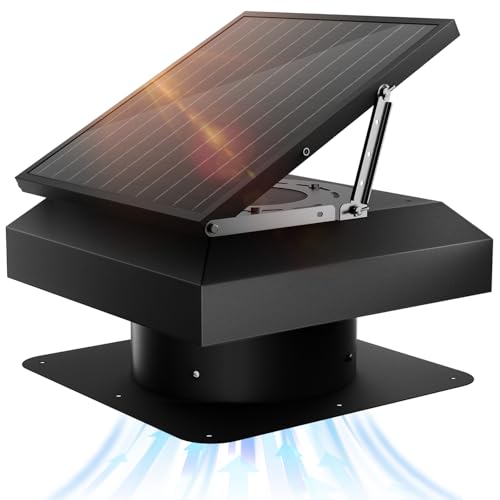
Hon&Guan’s 40W design delivers up to 2000 CFM and can cool spaces up to 2500 sq ft. It features a dual‑power auto‑switch and a thermostat with adjustable range (68–113°F), plus a multi‑angle solar panel for better exposure. Best for larger attics needing strong airflow and flexible operation modes.
Who it’s best for: buyers seeking higher airflow and a two‑mode thermostat system. Why selected: efficient cooling, adjustable tilt for solar capture, and reliable auto‑start functionality.
Limitation: No explicit remote control; rely on thermostat settings for automation rather than a handheld unit.
DuskSnug 40W Solar Attic Fan

This controller‑free model uses a 40W solar panel to deliver 1800–2000 CFM with a heavy‑duty copper motor. It’s weatherproof (IP65), hail resistant, and designed for simple, set‑and‑forget installation. Best for quick install and minimal maintenance scenarios.
Who it’s best for: homeowners who want straightforward, solar‑only operation without thermostat setup. Why selected: high airflow, durable build, and plug‑and‑play design.
Limitations: Lacks automatic thermostat control; performance is tied to solar availability and may not adjust to indoor temperature automatically.
Buying Guide: Key Considerations For Solar Attic Fans
- Airflow needs (CFM). Larger attics require higher CFM. Compare models by CFM per watt to gauge efficiency.
- Power source options. Pure solar, hybrid solar/AC, or with remote control. Hybrid models offer reliability during cloudy days.
- Thermostat and humidity control. Auto on/off based on temperature or humidity reduces energy use and protects attic materials.
- Weather resistance and durability. Look for IP ratings, corrosion‑resistant housings, and brushless motors for longevity.
- Installation and compatibility. Consider roof type (metal vs masonry), mounting style (gable vs roof), and panel adjustability for best solar capture.
- Noise and vibration. Brushless motors and balanced blades minimize sound, important for living spaces near attics.
- Remote and smart features. Remote control ranges and thermostat integrations improve convenience and zoning.
Frequently Asked Questions
Do solar attic fans require roof wiring?
Most models operate primarily on solar power and include some have an AC backup option or external adapters. Check the product’s electrical requirements before installation.
Will a thermostat solar attic fan lower cooling costs?
Yes, by automatically venting hot air only when needed, reducing heat transfer into living spaces and lowering AC workload.
How many CFM do I need for my attic?
Calibrate by attic size and ceiling height. A common rule is 1 CFM per square foot for moderate heat, but larger or hotter spaces may need more.
Are hybrid solar fans better than pure solar?
Hybrid models offer continuous ventilation during low sun, which can be advantageous in variable climates.
Do these fans require maintenance?
Most are low maintenance, but periodic cleaning of vents and checking seals helps sustain performance.
Can I install these myself?
Many are designed for DIY installation, but consult a professional for complex roofs or integration with existing electrical systems.