Best Server Room Portable Air Conditioners for Rack Rooms
Need portable air conditioning to cool a hot server rack or network closet? This guide identifies the five best options for server rooms and data closets, focusing on compact, self-contained units with easy mobility, reliable cooling, and low maintenance. Ideal buyers include small data rooms, IT managers leasing space, and tech-savvy operators seeking immediate, flexible cooling without permanent installation. Below is a quick comparison table of the selected models to help you decide at a glance.
| Product | BTU | Best For | Key Benefit |
|---|---|---|---|
| Tripp Lite SRCOOL12KE | 13,000 | Small server rooms and hot racks | Self-contained, evaporative cooling, no drain needed |
| Garvee 3-in-1 | 8,000 | Affordability with multi-function cooling | Cooling, dehumidifying, fan in one unit |
| MEPTY 8000BTU | 8,000 | Compact spaces with self-evaporation | Self-evaporation, remote control, timer |
| QZMDSM 16000 BTU | 16,000 | Large rooms and open racks | 6-in-1 smart control, high cooling capacity |
| VACOOR 14,000 BTU | 14,000 | Large rooms with efficient operation | Upward airflow, energy efficiency, quiet mode |
Tripp Lite SRCOOL12KE Spot Cooler for Server Racks

Best for: small server rooms or hot racks needing targeted cooling. This compact, self-contained unit includes caster wheels for easy movement and uses a 71-inch hose to direct cooled air toward hotspots. It operates with a built-in evaporator, dehumidifier, and air filter, eliminating the need for external plumbing and water tanks. Data-center staff can position it near critical equipment to reduce hotspots without complex installation. Limitation: 13,000 BTU may be overkill for very tiny closets and can require wider clearance to vent hot air effectively.
Garvee 3-in-1 Portable Air Conditioner

Best for: cost-conscious spaces needing cooling, dehumidification, and ventilation in one package. This unit provides cooling, dehumidifier, and fan modes with a remote and a 24-hour timer. It ships with an exhaust hose and window kit for quick setup. Best when you need multi-function operation in a single, portable unit. Limitation: 8,000 BTU may be insufficient for larger server rooms or densely packed racks in hot climates.
MEPTY 8000BTU Portable Air Conditioner
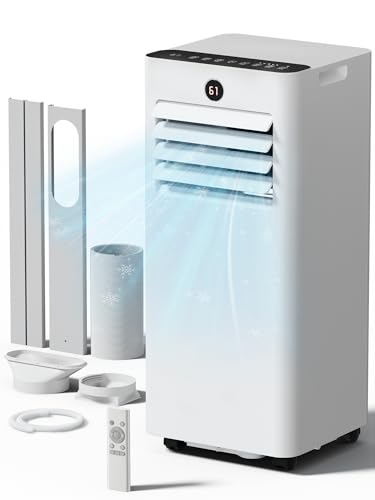
Best for: spaces up to 350 sq.ft needing reliable cooling with self-evaporating operation. MEPTY emphasizes a high-efficiency self-evaporation cycle to minimize manual draining, plus a 24-hour timer and remote control for flexible management. It also supports continuous gravity drainage for high-humidity environments. Limitation: 8,000 BTU may not meet the needs of very hot climates or large server closets without supplemental cooling.
AGTANA 14000 BTU Portable AC
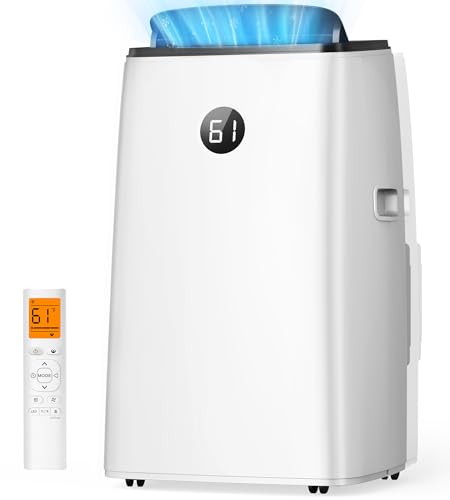
Best for: large server rooms or open-plan data spaces up to 700 sq. ft. AGTANA offers a 14,000 BTU capacity with a self-evaporating system and a 48 dB Sleep Mode. A continuous drainage port and auto-stop sensor enhance unattended operation. Suitable for IT teams prioritizing drainage-free operation and quiet performance. Limitation: High BTU units can be bulkier and heavier to move without assistance.
QZMDSM 16000 BTU Smart Portable AC

Best for: large rooms and open server closets requiring robust cooling and smart control. This 16,000 BTU unit features six operating modes, WiFi control, and a high-efficiency setup suited for smart homes and IT spaces with fluctuating heat loads. It offers energy-saving options and a wide operating range. Limitation: Higher energy consumption potential if used at maximum capacity for extended periods; ensure proper ventilation and power capacity.
VACOOR 14,000 BTU Portable AC

Best for: large rooms and multi-zone setups where upward airflow improves circulation. VACOOR emphasizes 14,000 BTU cooling with an upward vent design and energy-efficient operation. It also includes sleep mode and a 24-hour timer for convenience. Limitation: Upward airflow design may require careful placement to maximize effectiveness depending on room layout.
Buying Guide
What size of unit do you need? For server rooms around 100–350 sq.ft, 8,000–13,000 BTU models are often sufficient with proper venting and targeted airflow. For rooms closer to 700 sq.ft or open server layouts, consider 14,000–16,000 BTU units to maintain safe temperatures under peak loads.
Should you prioritize self-evaporation? Yes for low-maintenance operation. Self-evaporating units recycle condensate to cool coils and vent through the exhaust hose, reducing the need for manual drainage in most conditions. In humid environments, look for a model with a continuous drainage option.
Is portability important? If you need to relocate frequently or reconfigure a rack area, choose models with caster wheels, light weight, and simple setup kits (exhaust hoses and window kits). Always verify vent routing distance and room clearance around the unit.
What additional features help? Remote control, timers, sleep modes, and adjustable fan speeds improve daily usability. Smart connectivity (WiFi) can simplify control from a centralized IT console, especially in mixed-use spaces.
Key purchase considerations
- Room size and target cooling temperature
- Ventilation path and hose length flexibility
- Drainage requirements and self-evaporation capability
- Portability (casters, weight, handle) and setup ease
- Noise level in 24-hour operating environments
Common buyer questions
- What BTU do I need for a server room? Answer: Match BTU to room size and heat load; 8,000–13,000 BTU suits small rooms, 14,000–16,000 BTU for larger or open layouts.
- Do these units require permanent installation? Answer: No; most are portable with exhaust hoses and window kits.
- Is self-evaporating cooling reliable in humid climates? Answer: Generally reliable, but a continuous drainage option is recommended for high humidity.
- Can I use these in residential spaces? Answer: Yes, many models support residential use, but ensure power capacity and noise levels fit the space.
- Which features optimize data-center comfort? Answer: Targeted airflow, quick venting, and reliable dehumidification help maintain stable rack temperatures.
Buying guide takeaway: For rack rooms and network closets, prioritize portability, appropriate BTU for room size, drainage options, and airflow direction to efficiently cool hot spots without overcooling the entire space. The five products above provide a spectrum from compact, low-BTU spot cooling to higher-capacity, smart-enabled units suitable for larger rooms and data environments.