Best Plug-in Temperature Controllers for Home Heating and Cooling
Discover reliable plug-in temperature controllers that simplify climate control for greenhouses, incubators, reptile habitats, homebrew setups, and more. This guide highlights five top options, noting who each product is best for, why it stands out, and any important limitations. Whether you need precise dual-stage control or a simple countdown timer, these devices help maintain stable temperatures with minimal effort.
Summary of selected products
| Product | Brand | Temperature Range | Best For |
|---|---|---|---|
| DEWENWILS Digital Temperature Controller (B0D1FZFZQ4) | DEWENWILS | -40℉ to 210℉ | Greenhouse or incubator requiring high-power control |
| BN-LINK Digital Cooling Thermostat Controller | BN-LINK | 40–108°F | Attic fans, exhaust or cooling devices |
| Inkbird ITC-308 Digital Temperature Controller | Inkbird | Programmable, dual-relay | Heating and cooling in any dual-system setup |
| DEWENWILS Digital Temperature Controller (Black) | DEWENWILS | -40℉ to 210℉ | Heavy-duty heating/cooling with VA display |
| Diymore 1800W Plug-in Thermostat Controller | diymore | -40℉ to 248℉ | Powerful, versatile thermostat for RVs, greenhouses, terrariums |
DEWENWILS Digital Temperature Controller, 15A/1800W

This heavy-duty thermostat outlet plug handles up to 1800W with a 15A output, making it suitable for larger heaters and incubators. The VA display updates clearly, even in low light, which helps when monitoring in dim spaces. The unit supports a wide range from -40℉ to 210℉ with 0.1℉ precision, enabling precise temperature targets for sensitive environments.
Who it’s best for: buyers needing robust power handling and precise readings in challenging settings, such as greenhouses or incubators. Why selected: combines strong electrical capacity with clear readings and dual heating/cooling modes. Caution: ensure wiring and safeguards meet local electrical codes when running high-wattage devices.
BN-LINK Digital Cooling Thermostat Controller

Designed primarily for cooling setup control, this BN-LINK unit offers a simple three-button interface with Fahrenheit and Celsius options. It includes a sensor probe for accurate temperature measurement and a bright display inside a rugged housing. A hanging tab adds convenient mounting options, making it straightforward to monitor attic fans or exhaust devices.
Who it’s best for: homeowners or hobbyists focusing on reliable cooling control rather than heavy heating. Why selected: easy setup, clear indicators, and a focus on passive cooling applications. Caution: best used with compatible cooling devices; not ideal for high-power heating loads beyond its rating.
Inkbird ITC-308 Digital Temperature Controller

The ITC-308 offers dual relays to support both heating and cooling devices, with a dual-display window showing the current and set temperatures. It supports °C/°F display and is straightforward for quick setup. This model suits environments needing simultaneous control of two separate systems or zones.
Who it’s best for: users needing reliable dual-relay control for mixed heating/cooling needs. Why selected: widely compatible with many appliances, easy readouts, and flexible display options. Caution: ensure your loads do not exceed the 110V/10A rating for safety and longevity.
DEWENWILS Digital Temperature Controller (Black)
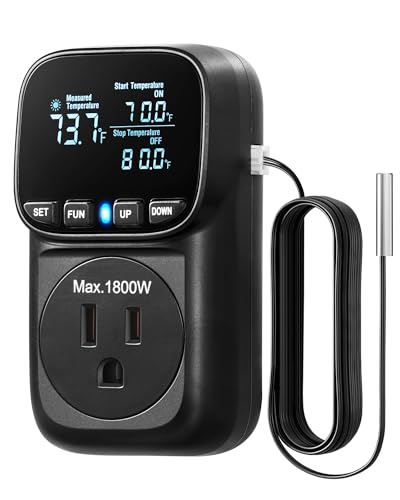
This black version mirrors the functionality of the other DEWENWILS model with a 15A capacity and a broad -40℉ to 210℉ range at 0.1℉ precision. It features a clear VA display for easy readings in dim lighting and supports cyclic timing and countdown modes for automated temperature control.
Who it’s best for: users seeking a robust, visually clear thermostat with timing versatility for greenhouses or incubators. Why selected: strong safety features, reliable power handling, and straightforward operation. Caution: like similar high-wattage devices, proper electrical installation is essential to prevent overloads.
Diymore 1800W Plug-in Thermostat Controller

Diymore’s 1800W unit supports a wide range from -40℉ to 248℉ with ±1% accuracy, making it suitable for strong heating or cooling needs. It offers multiple modes including cycle timing and countdown modes, and a data storage function so settings persist after power loss. The 6-foot sensor cord provides flexible placement for accurate readings.
Who it’s best for: users needing a versatile, high-capacity controller for RVs, greenhouses, or terrariums with dependable memory for settings. Why selected: broad temperature range, durable build, and practical timing options. Caution: note that the temperature and timing functions cannot be used simultaneously, which may limit certain setups.
Buying Guide: What to consider when choosing a plug-in temperature controller
- Power handling: Match the device’s maximum wattage to your heater or cooler. If you anticipate high-power loads, prioritize 15A/1800W units.
- Temperature range and accuracy: Choose a range that covers your environment with tight precision (±0.1–±1%).
- Control features: Dual-relay, cycle timer, countdown modes, and data storage affect how you can automate environments.
- Display clarity: VA displays or bright LCDs improve readability in dim spaces; consider display units (°F vs. °C).
- Durability and mounting: Rugged housings and probe length matter for attic, greenhouse, or outdoor use; ensure probes are suitable for your application.
- Safety and installation: Follow electrical codes and ensure devices are used within ratings to prevent overload and equipment damage.
FAQ
- What is the main difference between single-stage and dual-relay controllers?
Answer: Dual-relay models can independently manage heating and cooling devices, enabling tighter climate control in variable environments. - Can I use these controllers with any heater?
Answer: Most are rated for up to 1800W; check your heater’s wattage and ensure compatibility with the controller’s outlet rating. - Do these devices remember settings after power loss?
Answer: Several models include a data storage function to preserve parameters after power-off. - Is a longer probe better?
Answer: A longer probe provides placement flexibility but ensure it remains within the device’s rated specifications and is suitable for your environment. - Can I use temperature and timer functions at the same time?
Answer: In some models, these functions cannot be used simultaneously; consult product notes for specific limitations. - Which is best for a greenhouse incubator?
Answer: Look for a high‑power model with a wide range (-40℉ to over 210℉) and reliable dual-mode or timer options for automation.