Best Insulation for AC Pipes: Effective Solutions to Prevent Freezing and Condensation
Answering the common question, these insulation options help reduce heat loss, prevent condensation, and protect outdoor and indoor air conditioning lines. This guide highlights five practical choices suited for homeowners, renters, and maintenance pros. Each product targets specific needs like outdoor UV resistance, easy installation, or high-temperature tolerance.
Summary table of selected products:
| Product | Best For | Key Benefit |
|---|---|---|
| Duck Brand Foam Pipe Covers | Indoor hot/cold water pipes and AC lines | Pre-slit, self-sealing edges for quick, curved-pipe fit |
| XFasten Foam Pipe Insulation Tape | Outdoor AC lines and exposed pipes | Extreme adhesion and weather durability |
| Nkiy Quen 5 Layers HVAC Copper Pipe Insulation Cover | Outdoor copper lines and ducts | Three-layer outer with 600D Oxford, UV/weather resistant |
| Huntoshon 1/4″ x 3/8″ Insulated Foam Tubing | AC units and general piping | High temperature tolerance and easy cut-slide installation |
| CARGEN Pipe Insulation Foam Tube | Sharp edge protection and general insulation | Nitrile rubber foam; good surface grip |
Duck Brand Foam Pipe Covers

Duck Brand foam pipe stick covers are designed for both hot and cold water pipes. They come pre-slit for easy opening and installation on curved pipes, with self-sealing edges to secure the fit. Best for interior maintenance or light indoor HVAC lines where simple installation matters. Note the temperature tolerance up to 212 F; avoid high-heat applications beyond this range. Ideal for buyers prioritizing quick, tool-free installation and a snug fit on odd-shaped runs.
XFasten Foam Pipe Insulation Tape

XFasten insulation tape offers extreme adhesion and strong weather resistance. With a tensile strength around 100 lbs/inch and a low thermal conductivity of 0.11 BTU, this option is strong for outdoor lines and areas with temperature swings. It is best for exposed or exterior pipes where a wrap-around tape is preferred and longer service life is desired. Choose this if you need higher durability in windy or wet environments and flexible wrap around complex pipes. A potential limitation is the need for clean edge preparation on rough surfaces for maximum adhesion.
Nkiy Quen 5 Layers HVAC Copper Pipe Insulation Cover

This outdoor-ready insulation sleeve features a five-layer design with a waterproof 600D Oxford outer shell and protective inner layers. It’s UV and weather resistant, making it suitable for outdoor copper pipes and ducts. Best for external piping facing sun exposure or freezing conditions, offering durable protection and reduced heat gain or loss. A potential drawback is a larger installation footprint due to its sleeve design, which may require more space around the pipe.
Huntoshon Insulated Foam Tubing

Huntoshon insulation foam is made from durable EPDM material, rated for -50°C to 110°C. It’s designed for easy installation—cut and slide onto pipes without extra tools. Best for a versatile range of piping systems, including water and HVAC lines. It offers solid fire resistance and good temperature tolerance, making it a reliable all-rounder. A limitation is that rigidity may vary with temperature, so ensure a proper fit for irregular pipes.
CARGEN Pipe Insulation Foam Tube
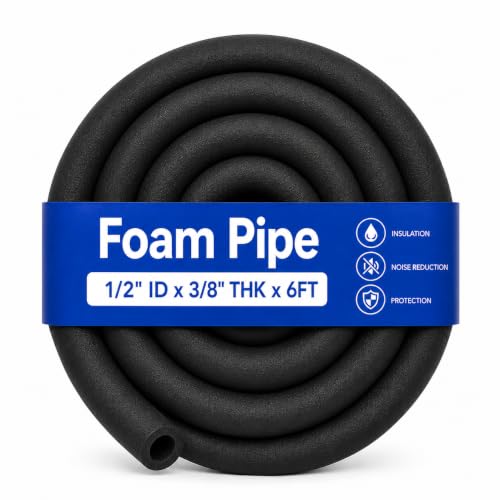
The CARGEN foam tube focuses on pipe freeze and sharp edge protection. Made from nitrile rubber foam, it offers good surface grip and a wide working range from -58°F to 230°F (-50°C to 110°C). It’s suitable for protecting pipes in areas prone to freezing or where edge protection is a priority. A caution: inner diameter must be confirmed prior to purchase to ensure a proper fit for your pipe size.
Buying Guide: Key Considerations For Insulating AC Pipes
What environment are you insulating for? Indoor pipes typically require lighter, easier-to-install foam sleeves, while outdoor pipes face UV, moisture, and temperature swings and benefit from heavier-duty outdoor wraps.
- Temperature range: Check the operating temperatures each product supports. Indoor applications usually stay well within standard room temperatures, while outdoor lines must endure more extreme conditions.
- Installation method: Pre-slit foam sleeves are quick for curved pipes; tapes and sleeves suit longer runs or exposed lines. Choose based on your pipe shapes and access.
- Weather and UV resistance: Outdoor pipes benefit from UV-stable fabrics, weatherproof coatings, and thicker outer layers to prevent degradation.
- Diameter and fit: Confirm inner/outer diameters align with your pipe size. Some products require precise sizing, while others offer flexible or stretchable designs.
- Durability vs. ease of removal: If you anticipate needing access for maintenance, consider materials that are easy to remove without damage to pipes.
- Edge protection: For sharp edges or corners, select products that offer edge coverage or additional padding to reduce abrasion.
How To Choose The Right Insulation For Your Setup
For quick DIY projects with curved indoor pipes, a pre-slit sleeve like the Duck Brand option is ideal. For outdoor lines exposed to sun and weather, a robust sleeve with UV resistance, like the Nkiy Quen five-layer model, is preferable. If you need a flexible tape approach for irregular layouts, the XFasten tape provides strong adhesion and long-term performance. Consider your climate, pipe material, and whether you value ease of installation over maximum thermal performance when choosing.
Installation Tips
- Prepare pipes by cleaning and drying the surface for best adhesion or fit.
- For foam sleeves, ensure a snug fit around bends without compressing insulation.
- When using tapes, apply at least two overlapping wraps and seal edges to prevent moisture ingress.
- Inspect outdoor installations seasonally for UV wear, cracking, or loosening edges.
FAQ
- Q: Can these products prevent condensation on AC lines? A: Yes, proper insulation reduces surface temperature differences that cause condensation on piping.
- Q: Are these suitable for high-temperature water pipes? A: Most options are rated up to typical building temperatures; verify the specific product’s maximum rating for hot water lines.
- Q: Is pre-slit installation necessary for all pipes? A: No. Pre-slit sleeves are convenient for curved pipes, while tape or larger sleeves may be better for straight runs.
- Q: Do outdoor insulation sleeves require maintenance? A: Periodic checks for UV damage, moisture intrusion, and edge integrity are recommended.
- Q: How do I measure for the right diameter? A: Measure the outer diameter of the pipe at the widest point and compare to the product’s listed inner diameter or elasticity range.
- Q: Can I reuse insulation after removing it? A: Some foam products may lose shape or adhesive properties after removal; check manufacturer guidance.