Best Industrial Grade Air Filter Solutions for Purity and Safety
When quality air matters in industrial and commercial environments, an industrial grade air filter is essential. This guide highlights five top options designed for heavy-duty filtration, odor control, and reliable performance on job sites or in large spaces. Best for restoration crews, contractors, and facilities managers who need scalable, powerful air cleansing. Each product is evaluated for its filtration stages, airflow, and practical suitability. Use the buying guide and FAQ to compare options and choose the right fit for your needs.
Product Comparison at a Glance
| Product | Airflow | Filtration | Best For | Notable Consideration |
|---|---|---|---|---|
| CADPXS Shield-550 Air Scrubber | 550 CFM | HEPA + MERV-10 pre-filter + activated carbon | Water damage restoration and construction sites | Heavier on odor control with carbon filter |
| PURISYSTEMS 900 CFM Air Scrubber | 900 CFM | HEPA + activated carbon, 3-stage | Large commercial spaces and remodeling projects | Supports daisy-chaining up to 3 units |
| Smart Air Blast MKII | 9000 Sq Ft/hr, 1200 CFM | HEPA 99.97% + carbon + prefilter | Very large rooms, homes, offices | Lower noise around 29-43 dBA |
| BSMTEK Air Scrubber | 550 CFM | HEPA + carbon, 3-stage | Remediation and confined spaces | Stackable and daisy-chain capable |
| Gokluuk 4-Stage Air-Dryer System | Industrial-grade, 0-240 PSI | 4-stage filtration + desiccant dryer | Compressed air cleanliness for painting/plasma | Primarily for air lines, not room air |
CADPXS Shield-550 Air Scrubber 550 CFM

The CADPXS Shield-550 is a professional-grade air scrubber designed for commercial and restoration use. It features a whole-home HEPA filter capable of removing large airborne particles such as smoke, dust, pollen, and construction debris. This model includes a MERV-10 pre-filter to extend the life of the HEPA stage and an activated carbon filter to reduce odors and VOCs from paints and solvents. Best for: water damage restoration teams, construction sites, and bulk air cleaning in larger spaces. Limitation: higher energy use compared to smaller units; best utilized in spaces where continuous operation is feasible.
BSMTEK Air Scrubber with 3 Stage Filtration

The BSMTEK Air Scrubber delivers up to 550 CFM with a three-stage filtration system that includes a pre-filter, carbon filter, and HEPA H13 stage. It captures 99.97% of particles as small as 0.3 microns and is designed to be daisy-chained with up to two additional units, enabling expanded coverage. Best for: small to midsize remediation projects and spaces where stacking efficiency matters. Caution: ensure proper electrical supply if daisy-chaining multiple units is planned.
PURISYSTEMS 900 CFM Air Scrubber

The PURISYSTEMS 900 CFM air scrubber is built for heavy-duty commercial environments, featuring a 3-stage filtration system with a pre-filter, HEPA, and activated carbon to remove odors and VOCs. It supports daisy-chaining up to three units and stacking for stability during transport. Best for: large renovation sites, hospitals, gyms, and other high-traffic areas. Choose this if you need scalable filtration across multiple rooms; avoid if you need portable, single-unit operation without expansion.
Gokluuk 4 Stage Industrial Air Dryer System

This 4-stage air-drying system is built for industrial air lines and compressors, featuring 3/4″ NPT ports and a 0-240 PSI operating range. It includes a 5-micron filter, a 0.01-micron coalescing filter, and a desiccant dryer to produce exceptionally dry air. Best for: paint spray booths and plasma cutting exhaust systems. Limitation: designed for air lines rather than room air purification.
EDGE Industrial 3-Stage Filter Regulator System
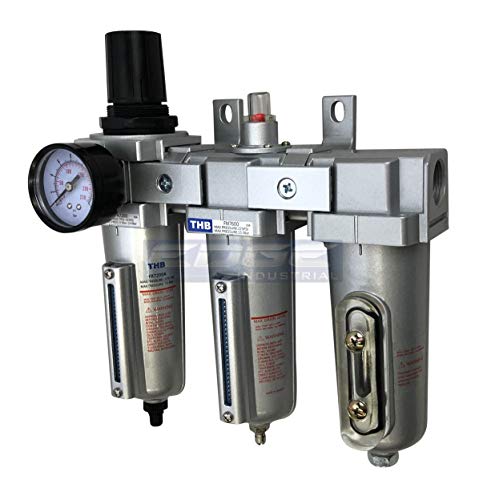
The EDGE Industrial 3-stage unit combines a water filter, pressure regulator, coalescing filter, and desiccant dryer for compressed air lines. It handles up to 175 PSI with a visible sight glass to monitor moisture and debris. Best for: workshops and facilities needing reliable air line filtration. Caution: unit is oriented for line filtration rather than room air purification, so use accordingly.
Buying Guide: Key Considerations for Industrial Air Filtration
What space size and airflow do I need?
Estimate room volume in cubic feet and choose a unit rated to deliver at least 4 air changes per hour in the target space. For larger areas, consider daisy-chaining multiple units or selecting higher-CFM models like 900 CFM products.
What filtration stages matter most?
Three-stage systems (pre-filter, HEPA, carbon) balance particle removal and odor control. HEPA captures 99.97% of 0.3-micron particles; activated carbon reduces odors and VOCs. A pre-filter extends HEPA life by capturing larger debris.
Is portability or stacking more important?
If you need to move equipment between sites, prioritize lighter units with simple handles. If space is tight, stacking or daisy-chaining capabilities provide scalability without crowding the area.
What about maintenance and indicators?
Look for visible sight glasses, filter replacement indicators, and straightforward maintenance procedures. Easy-to-change filters save downtime on critical restoration or construction projects.
Are there compatibility or accessory considerations?
Check for compatibility with existing ductwork, power supplies, and extension units. Some models offer additional sockets or daisy-chain options that enable larger total airflow when needed.
FAQ
- What is an industrial grade air filter used for? It cleans large indoor spaces on job sites and facilities by removing particles, odors, and VOCs to improve air quality and safety.
- How many CFM should I choose for a 1,000 sq ft room? A unit capable of 4–6 air changes per hour is typically effective; for 1,000 sq ft with 8 ft ceilings, 4,000–6,000 CFM may be appropriate in total depending on ceiling height and activities.
- Is daisy-chaining beneficial? Yes, it enables scalable coverage across multiple rooms, increasing total airflow without needing multiple standalone units.
- Do these units remove formaldehyde and other VOCs? Units with activated carbon filters help reduce VOCs, but the effectiveness varies by compound and concentration.
- Can I use these air scrubbers in occupied spaces? Many are designed for unoccupied or low-occupancy environments during heavy filtration tasks; always follow manufacturer safety guidelines and local regulations.
- How often should filters be replaced? Replacement intervals depend on usage, environment, and filter type; refer to the unit’s indicators and maintenance schedule for guidance.