Best Inline Blower Fans for Quiet, Efficient Airflow in Small to Large Spaces
Inline blower fans offer compact, high-efficiency airflow for grow rooms, bathrooms, kitchens, basements, attics, and HVAC boost support. This guide highlights five suitable options and explains who each is best for, with practical buying considerations and clear comparisons to help you decide.
Summary table of chosen products
| Product | Brand | Airflow (CFM) | Approx. Noise | Best For |
|---|---|---|---|---|
| Hon&Guan 3 Inch Inline Blower | Hon&Guan | 120 | Low | Small bathrooms, grow tents, compact spaces |
| VIVOSUN D4 4 Inch Inline Duct Fan | VIVOSUN | 195 | Quiet | Grow tents, basements, kitchens |
| VIVOSUN M4 4-Inch Inline Duct Fan | VIVOSUN | 195 | Quiet | HVAC, grow tents, hydroponics |
| Hon&Guan 6 Inch Inline Booster | Hon&Guan | 345 | Low | Larger rooms, attics, basements |
| SEAFLO 4” Inline Marine Blower | SEAFLO | 270 | Less than 45 dB | Marine installations, quiet offshore setups |
Hon&Guan 3 Inch Inline Blower Fan

Best for compact spaces where clean air exchange is needed without much noise. This 120 CFM inline fan draws low energy (20W) with a DC motor to move air efficiently. It suits small bathrooms, seed-start rooms, or compact grow tents. The included speed controller adds control over emission and noise. A potential limitation is its smaller diameter, which may require careful duct routing in larger systems. Mounting feet support vertical or horizontal installation for versatile setups.
VIVOSUN D4 4 Inch Inline Duct Fan
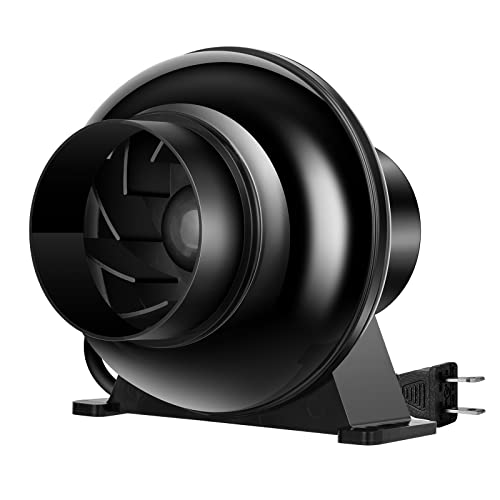
Best for grow tents and small rooms needing robust airflow with low sound. The 195 CFM output supports effective heat removal and humidity control, while a flow deflector reduces turbulence to keep noise around 30 dB. It’s ETL-listed with an automatic reset feature for safety. Best for users prioritizing strong performance in modest spaces; consider this if you need higher CFM without a big noise footprint. Not ideal for ultra-quiet locations where even 30 dB may be noticeable.
VIVOSUN M4 4-Inch Inline Duct Fan

Best for versatile ventilation requiring adjustable speed and safety. This 4-inch fan delivers 195 CFM with an EC motor for energy efficiency and longevity. It operates quietly at around 28 dB and includes safety features like automatic reset and locked-rotor protection. Choose this if you want precise speed control for varying conditions in grow tents or HVAC retrofits. A limitation is that the upfront size is fixed at 4 inches, which may require compatible ducting.
Hon&Guan 6 Inch Inline Booster

Best for larger rooms and higher airflow needs. The 6-inch booster moves up to 345 CFM with a low energy draw (19.2W) and low noise. It’s designed for efficient venting in grow rooms, bathrooms, kitchens, and attics. It’s easy to install due to its plastic blade and housing. A consideration is that a larger duct diameter may require broader ducting routes and mounting space. Ideal for expanding ventilation without increasing energy use significantly.
SEAFLO 4” Inline Marine Blower

Best for maritime or environments requiring durable, stable airflow with quiet operation. The 270 CFM air flow supports moderate to larger spaces onboard or water-adjacent installations. It operates below 45 dB, which is relatively quiet for its power level, and it comes with ISO 8846, CE, and RoHS certifications. It’s a solid choice where compliance and reliability are priorities, though it may be louder than compact indoor-only fans at top speed.
Buying Guide
Key purchase considerations:
- Airflow needs: For small rooms, 120–195 CFM is generally sufficient; larger spaces may require 270–345 CFM.
- Noise tolerance: Look for models advertised as 28–30 dB for quiet operation in living or work areas. Marine or workshop use may tolerate higher dB if airflow is critical.
- Motor type: EC/DC motors are typically more energy-efficient and offer smooth speed control; AC motors can be less complex but may consume more power.
- Installation flexibility: Check mounting feet, inline duct compatibility, and whether horizontal or vertical mounting is supported.
- Safety features: Auto-reset protection, flame-resistant housings, and UL/ETL listings add reliability and safety in busy spaces.
- Durability and environment: Marine-grade or flame-retardant components improve longevity in challenging conditions.
Frequently Asked Questions
- What is a typical use for an inline blower fan?
Inline blower fans move air through ducting for ventilation in grow rooms, bathrooms, basements, and HVAC systems. - How do I choose the right CFM?
Estimate room volume (length × width × height in feet) and multiply by 0.5–1.0 to approximate required air changes per minute; match to a fan’s CFM range accordingly. - Is quieter always better?
Quieter fans are preferable for living or office spaces; however, higher-CFM models often generate more noise, so balance airflow and sound output. - Are EC motors worth it?
EC motors offer energy efficiency, smoother speed control, and longer service life, which can reduce operating costs over time. - Should I choose an inline or a wall-mounted exhaust fan?
Inline fans are best when duct routing is long or routed through multiple spaces; wall-mounted options are suitable for direct, shorter exhaust paths. - What safety features matter most?
Look for auto-reset on overheating, flame-retardant enclosures, and proper electrical certifications for reliability and safety.